Summary: The Bible never reveals the name of Cain’s wife. However, Genesis tells us that Adam and Eve had many sons and daughters besides Cain, Abel, and Seth (Genesis 5:4). For this reason, most Bible scholars and Christian theologians conclude that Cain married one of his sisters or another close relative descended from Adam and Eve. While Scripture does not identify her by name, the biblical evidence strongly indicates that she came from the first human family created by God.
Introduction
Few questions about the Bible spark curiosity quite like this one:
Who was Cain’s wife?
It’s one of those questions that can stop a Bible study in its tracks.
Maybe you’ve wondered about it yourself.
After all, the book of Genesis introduces us to Adam, Eve, Cain, and Abel. Then suddenly, after Cain murders his brother and leaves his family, we read something unexpected:
“And Cain knew his wife, and she conceived and bore Enoch…” (Genesis 4:17, NKJV)
Wait a minute.
Where did she come from?
The Bible never tells us her name. It never introduces her. It simply assumes she exists.
For many people, that raises a flood of questions.
Did Cain marry his sister?
Were there other people already living on the earth?
If Adam and Eve were the first humans, why was Cain afraid that someone might kill him?
And perhaps the biggest question of all: Does this create a contradiction in the Bible?
These aren’t foolish questions. In fact, they are exactly the kind of questions thoughtful readers should ask.
Because when something doesn’t immediately make sense, digging deeper often reveals truths we would have otherwise missed.
The good news is that the Bible provides enough information to build a remarkably clear picture of who Cain’s wife was and where she came from. The answer may not satisfy every curiosity, but it does show that the Genesis account is far more coherent than many critics assume.
More importantly, this ancient mystery points us to a much bigger story.
A story about humanity’s beginnings.
A story about sin’s devastating consequences.
And a story about God’s mercy, even toward a man who committed the first murder in history.
So let’s examine the evidence carefully and discover what the Bible really says about Cain’s wife.
Certainly. Here’s the continuation of the article following the introduction, written in an engaging, conversational, and persuasive style suitable for your “Becoming Christians” audience.
Quick Answer: Who Was Cain’s Wife?
Let’s start with the short answer.
The Bible never tells us Cain’s wife’s name.
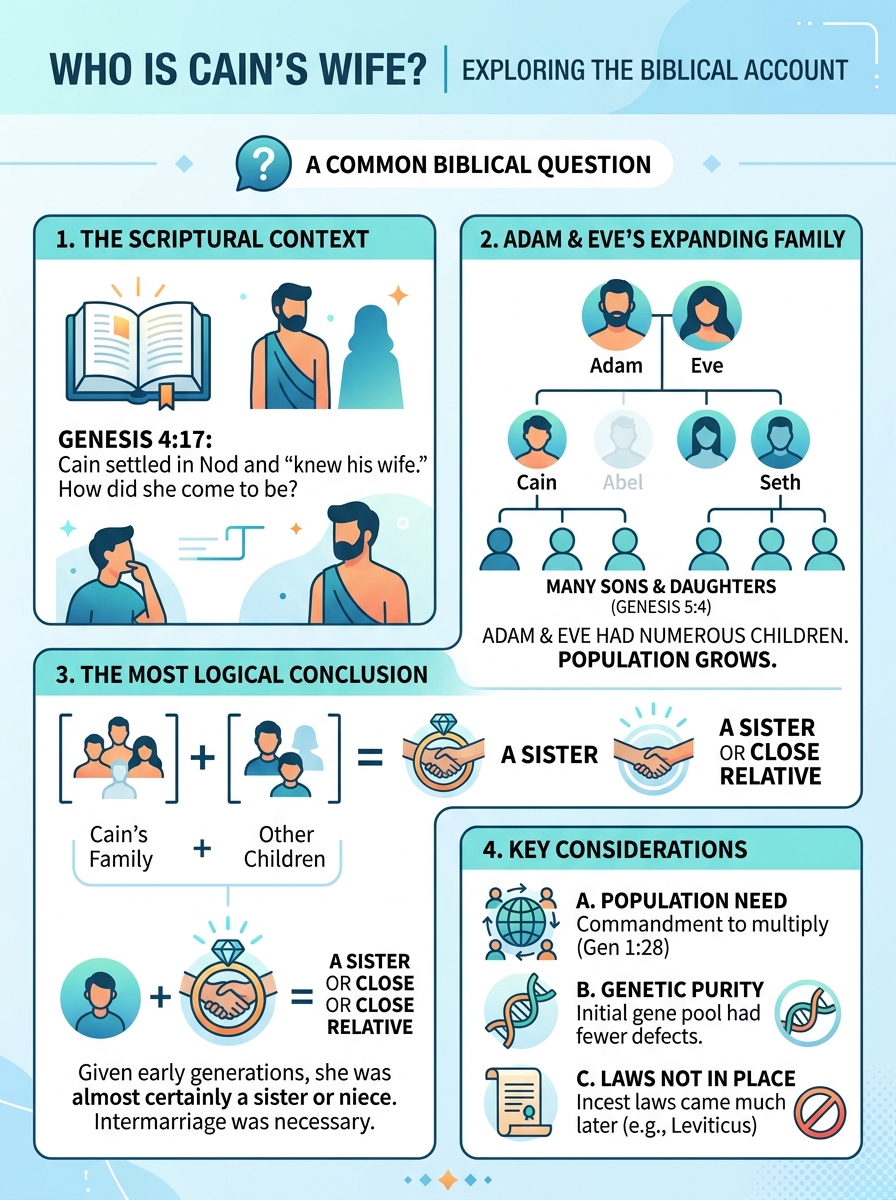
However, the most straightforward biblical explanation is that Cain married one of his sisters or possibly a close female relative descended from Adam and Eve.
At first, that answer may sound surprising—even uncomfortable. But before you dismiss it, consider something important.
The Bible teaches that Adam and Eve were the first human beings. If that is true, every person who ever lived would ultimately trace their ancestry back to them.
That means humanity had to begin from a single family.
In other words, the question is not whether Cain married a close relative. The real question is how else humanity could have multiplied if Adam and Eve were the first humans.
As we dig deeper into Genesis, you’ll see that the Bible provides clues that help solve this mystery.
Top 3 Christian Books on Marriage June 2026

What Does the Bible Actually Say About Cain’s Wife?
Interestingly, the Bible mentions Cain’s wife only once.
Genesis 4:17 says:
“And Cain knew his wife, and she conceived and bore Enoch. And he built a city, and called the name of the city after the name of his son—Enoch.” (NKJV)
Notice what the verse does not say.
It doesn’t explain where she came from.
It doesn’t identify her parents.
It doesn’t tell us her name.
The writer simply introduces her as if readers already understand who she is.
That can feel frustrating to modern readers because we’re accustomed to getting every detail. But ancient biblical writers often focused only on information necessary for the story they were telling.
Genesis is primarily concerned with tracing humanity’s origins and God’s dealings with mankind. The identity of Cain’s wife wasn’t the focus of the narrative.
Still, the answer is hidden in the broader context.
The Key Verse Many People Overlook
One of the biggest mistakes people make is assuming that Adam and Eve had only three sons: Cain, Abel, and Seth.
The Bible never says that.
In fact, Scripture says the opposite.
Genesis 5:4 tells us:
“After he begot Seth, the days of Adam were eight hundred years; and he had sons and daughters.” (NKJV)
That small phrase changes everything.
“He had sons and daughters.”
Plural.
Lots of them.
Think about it.
Adam lived 930 years.
Eve likely lived for centuries as well.
Over such a long period, they could have produced dozens, perhaps even hundreds, of descendants.
The Bible only mentions the children who are important to the story being told. Cain, Abel, and Seth receive attention because they play key roles in redemptive history.
Many other children undoubtedly existed but were never named.
Suddenly, Cain having a wife no longer seems mysterious.
If Adam and Eve had many sons and daughters, Cain’s wife could easily have been one of his sisters.
Did Cain Marry His Sister?
This is where many readers hesitate.
Let’s be honest.
The idea feels strange because we view sibling marriage through the lens of today’s laws and moral standards.
But we need to understand the world Cain lived in.
There was no human population yet.
No neighboring nations.
No distant tribes.
No alternative pool of people to marry.
If humanity truly began with Adam and Eve, then sibling marriages were not only possible—they were necessary.
Imagine planting the first tree in a vast empty field.
Every branch, leaf, and piece of fruit must come from that original tree.
Humanity’s family tree had to start somewhere.
The Bible never portrays these early marriages as sinful.
Why?
Because God had not yet prohibited such unions.
The laws forbidding close-family marriages would come much later through Moses.

Why Was Incest Not Forbidden Yet?
This is one of the most common objections raised against the biblical explanation.
People ask:
“If Cain married his sister, wouldn’t that be incest?”
Technically, yes.
But we need to remember that God’s prohibition against incest appears much later in Scripture.
For example, Leviticus 18 contains detailed laws forbidding marriages between close relatives.
Those laws were given thousands of years after Cain lived.
So why the difference?
Many Christian scholars point to two reasons.
First, humanity was in its earliest stages.
God’s command to “be fruitful and multiply” required close-relative marriages initially because no other option existed.
Second, many Christians believe the human genetic pool was much healthier near the beginning of creation.
Today, close-relative marriages carry significant genetic risks because harmful mutations have accumulated throughout generations.
According to this view, those dangers would have been far less severe in humanity’s earliest years.
Whether one fully accepts that explanation or not, the important point is that Scripture does not treat Cain’s marriage as a moral violation.
If Adam and Eve Were the Only People, Why Was Cain Afraid?
Now we come to another fascinating question.
After murdering Abel, Cain said:
“Surely You have driven me out this day from the face of the ground; I shall be hidden from Your face; I shall be a fugitive and a vagabond on the earth, and it will happen that anyone who finds me will kill me.” (Genesis 4:14, NKJV)
Many readers ask:
Who exactly was Cain afraid of?
If only four people existed, who could kill him?
The answer becomes clearer when we remember that Genesis often compresses long periods of time into just a few verses.
By the time Cain received his punishment, Adam and Eve may already have had many children and grandchildren.
A growing extended family could easily have existed.
Imagine being the man who murdered your own brother.
Wouldn’t you fear retaliation from grieving relatives?
Cain certainly did.
His fear makes perfect sense if a larger family population already existed.
Were There Other People Besides Adam and Eve?
Some people propose an alternative theory.
They suggest that God created other human populations besides Adam and Eve and that Cain married someone from those groups.
At first glance, this idea may seem attractive because it appears to solve the problem quickly.
However, it raises significant theological questions.
The Bible repeatedly presents Adam and Eve as the ancestors of all humanity.
For example, Eve is called:
“the mother of all living” (Genesis 3:20, NKJV)
Likewise, the New Testament traces humanity’s origins back to Adam.
For this reason, most traditional Christian interpretations reject the idea of unrelated human populations existing outside Adam’s family.
While Christians may debate details, the overwhelming historic position has been that Cain’s wife ultimately descended from Adam and Eve.
What Was the Name of Cain’s Wife?
Here’s an answer that may disappoint some readers.
We simply don’t know.
The Bible never names her.
Over the centuries, various traditions attempted to fill the gap.
One ancient Jewish work called the Book of Jubilees identifies Cain’s wife as Awan (or Avan), who was supposedly his sister.
However, this book is not part of the biblical canon and was written long after Genesis.
Could her name have been Awan?
Possibly.
Can we know for certain?
No.
The Bible remains silent.
Sometimes God tells us everything we need to know without telling us everything we want to know.
Does Cain’s Wife Create a Contradiction in the Bible?
Critics often point to Cain’s wife as evidence that Genesis contains contradictions.
But does it?
Not really.
A contradiction occurs when two statements cannot both be true.
Genesis never says Cain and Abel were Adam and Eve’s only children.
In fact, Genesis explicitly states that Adam had “sons and daughters.”
Once that detail is recognized, the apparent contradiction disappears.
The problem often comes not from what the Bible says, but from assumptions people bring to the text.
When we allow Scripture to interpret Scripture, the pieces fit together remarkably well.
The Bigger Lesson Behind Cain’s Wife
Here’s something worth thinking about.
The Bible never intended Cain’s wife to be the main point of the story.
That’s our fascination.
God’s focus is elsewhere.
The real tragedy of Genesis 4 isn’t that Cain had a wife whose name we don’t know.
The tragedy is that sin entered the human family and immediately produced jealousy, hatred, violence, and death.
The first family in history became the first family to experience murder.
Think about that.
Adam and Eve had already suffered the pain of being expelled from Eden.
Now they would experience another heartbreak no parent should ever endure.
One son dead.
Another son cursed and exiled.
Sin had delivered exactly what God warned it would deliver.
Yet even in judgment, God showed mercy.
Cain deserved immediate destruction.
Instead, God protected him.
That should remind us of something profound.
The story of Cain is not ultimately about a missing wife.
It’s about a merciful God.
A God who judges sin but still extends grace.
A God who continues working with broken people.
A God whose plan of redemption would eventually lead to Jesus Christ—the One who came to reverse the curse that began in Genesis.
And perhaps that’s why the Bible says so little about Cain’s wife.
Because the greatest mystery in Genesis isn’t where Cain found a wife.
The greatest mystery is why a holy God continues to show mercy to sinners.
Thankfully, the answer to that mystery is found throughout the rest of Scripture.

About the Author
Joshua Infantado is a Christian blogger and Bible teacher who has been writing faith-based content since 2013. He is the founder of Becoming Christians, where he shares blogs, books, videos, and online courses to help believers grow in truth and grace. Joshua lives in Davao City, Philippines, with his wife, Victoria, and their son, Caleb. Contact him at joshuainfantado@gmail.com.
Discover more from Becoming Christians
Subscribe to get the latest posts sent to your email.