What does the Bible say about suicide summary answer: The Bible does not use the word “suicide” and contains no single verse that explicitly forbids it. However, Scripture consistently teaches that human life is sacred, created by God, and bears His image — which forms a strong biblical foundation for valuing and protecting life.
While many theologians consider suicide contrary to God’s design, the Bible never declares it the “unforgivable sin,” nor does any verse state that it automatically condemns a person to hell.
The unforgivable sin, according to Jesus in Mark 3:28–29, is blasphemy against the Holy Spirit — not suicide. Salvation, Scripture teaches, is by grace through faith in Christ alone (Ephesians 2:8–9), and Romans 8:38–39 declares that nothing — not even death — can separate a believer from the love of God.
For those who are grieving, struggling, or searching for answers, the Bible’s deepest message on this topic is not condemnation but compassion: God draws near to the brokenhearted (Psalm 34:18), and no one is beyond His reach.
Few questions are as painful, personal, and urgent as this one: What does the Bible say about suicide? Whether you are grieving the loss of a loved one, wrestling with difficult theological questions, or searching for hope in a dark season, Scripture offers truth, compassion, and an unfailing love that reaches into the deepest places of human suffering.
This is not a topic that deserves a quick, cold theological answer. Behind every search for this question is a real person — a grieving mother, a struggling teenager, a pastor trying to comfort a shattered family, or someone sitting alone in the dark wondering if God cares. This article takes every one of those people seriously.
We will walk through what the Bible actually says — and what it does not say — about suicide, sin, salvation, mental illness, and the God who draws near to the brokenhearted.
If you are currently experiencing suicidal thoughts, please reach out to the 988 Suicide and Crisis Lifeline by calling or texting 988. You are not alone, and help is available right now.
Does the Bible Specifically Mention Suicide?
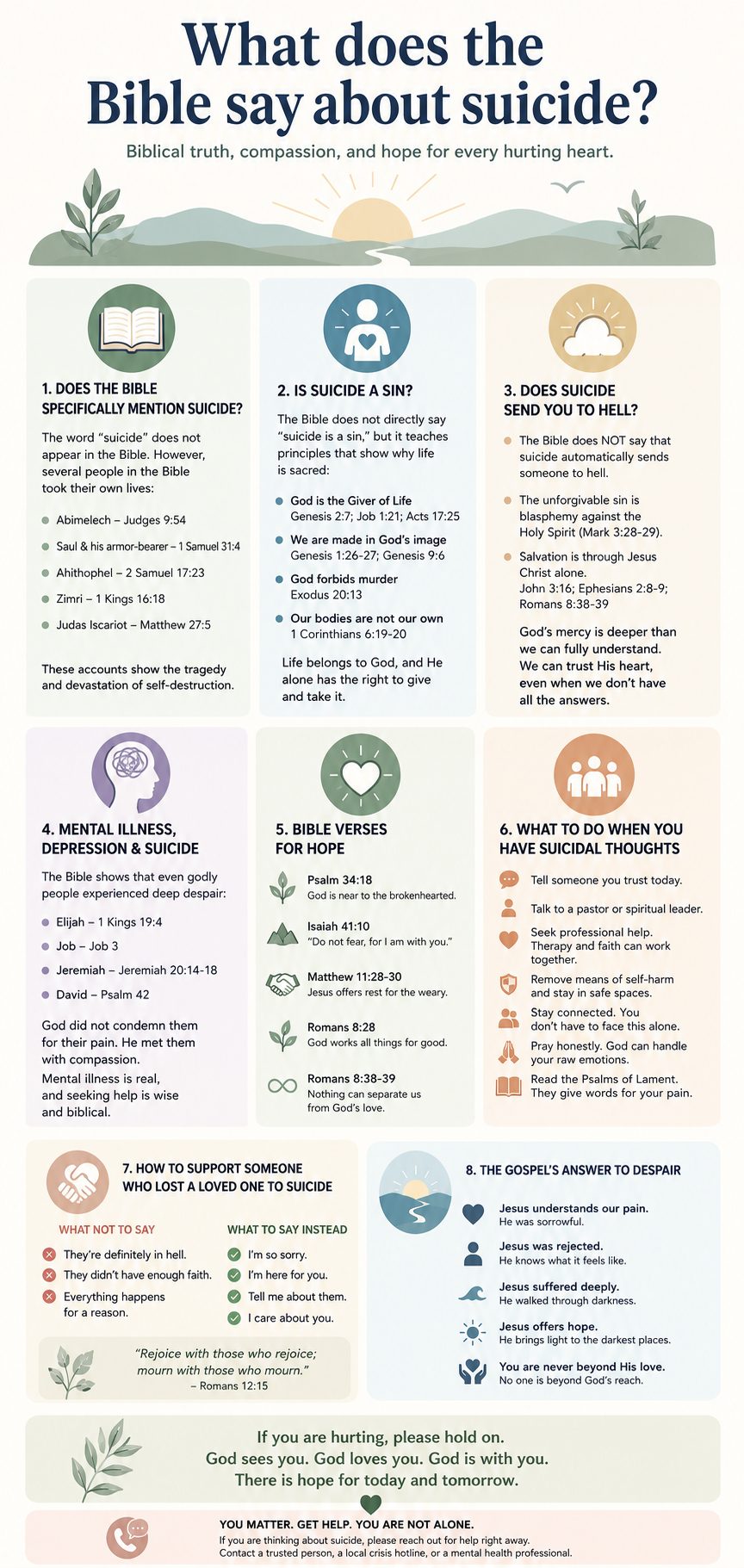
The word “suicide” does not appear anywhere in the Bible. There is no single verse that says, “You shall not take your own life.” Yet the Bible is not silent on the subject. Scripture records several accounts of individuals who ended their own lives, and from those stories — combined with broader biblical teaching on the value of human life — we can draw meaningful conclusions.
Here are the people in the Bible who took their own lives:
Abimelech (Judges 9)
Abimelech was a cruel ruler who seized power by killing seventy of his half-brothers. During a battle at Thebez, a woman dropped a millstone on his head, fatally wounding him. Fearing the shame of being killed by a woman, he commanded his armor-bearer to run him through with a sword. His armor-bearer complied (Judges 9:54).
This is considered an assisted suicide, though the Bible does not comment on the morality of the act itself — only that Abimelech’s violent end was understood as divine judgment for his wickedness.
Saul and His Armor-Bearer (1 Samuel 31)
King Saul, severely wounded in battle and fearing capture and torture at the hands of the Philistines, asked his armor-bearer to kill him. When the armor-bearer refused, Saul fell on his own sword. His armor-bearer, seeing Saul dead, then fell on his own sword as well (1 Samuel 31:4–5).
The Bible records this without direct moral condemnation, though it notes elsewhere that Saul died “because he was unfaithful to the Lord” (1 Chronicles 10:13) — a reference to his broader pattern of disobedience, not specifically to his manner of death.
Ahithophel (2 Samuel 17)
Ahithophel was King David’s most trusted counselor who defected to Absalom during the rebellion. When his military counsel was not followed, he went home, set his affairs in order, and hanged himself (2 Samuel 17:23).
His is one of the most striking accounts in Scripture — a man undone by wounded pride and political failure who chose death rather than face its consequences.
Zimri (1 Kings 16)
Zimri was a military commander who assassinated King Elah and seized the throne of Israel. He reigned for only seven days before being overthrown by Omri. When Zimri saw that his situation was hopeless, he went into the citadel of the royal palace and burned it down around himself (1 Kings 16:18).
Judas Iscariot (Matthew 27)
Perhaps the most well-known account is that of Judas, who betrayed Jesus for thirty pieces of silver. When he saw that Jesus had been condemned, he was seized with remorse and returned the money to the chief priests. Unable to live with his guilt, he went out and hanged himself (Matthew 27:3–5). The book of Acts also records that he fell headlong and his body burst open (Acts 1:18), which scholars interpret as a reference to the same event.
What About Samson?
Samson’s death is more theologically complex. After being captured by the Philistines, blinded, and chained, Samson prayed to God for strength one final time and pushed apart the pillars of the temple, killing himself along with thousands of Philistines (Judges 16:28–30). The text presents this not as an act of despair but as a final act of faith and purpose. He is even listed among the heroes of faith in Hebrews 11:32. Theologians generally distinguish Samson’s death from suicide in the modern sense because it was understood as a sacrificial act in fulfillment of his divine calling.
What is noteworthy across all these accounts is that the Bible records them with narrative detail but rarely with direct theological condemnation of the act itself. The moral evaluation of these individuals comes from their broader lives, not specifically from how they died.
Top 3 Christian Books for Overcoming Anxiety (July 2026)



Is Suicide a Sin?
This is perhaps the most asked question on this topic, and it deserves a careful, honest answer.
The Bible never explicitly states, “Suicide is a sin.” No verse uses those exact words. However, Scripture does establish a set of principles that, taken together, form a compelling biblical case that taking one’s own life is contrary to God’s design.
God Is the Giver of Life
The Bible is unambiguous: God is the source of all human life. He breathed life into Adam (Genesis 2:7). He declares in Job 1:21, “The Lord gave, and the Lord has taken away.” In Acts 17:25, Paul affirms that God “gives to all mankind life and breath and everything.” Life is a gift from God — which means it is not ultimately ours to dispose of as we choose.
Human Life Bears God’s Image
Genesis 1:26–27 records that God created human beings in His own image — the imago Dei. This gives every human life an inherent, God-given dignity and worth that no circumstance can erase. So sacred is human life that in Genesis 9:6, God establishes the principle that taking human life is a serious moral offense precisely because it destroys something that bears His image.
The Command Against Murder
Exodus 20:13 records the sixth commandment: “You shall not murder.” Many theologians have argued that this commandment applies to oneself as well as to others, since one’s own life bears the image of God equally. Augustine and Thomas Aquinas both argued from this principle that suicide violates the command against murder.
However, it is important to note that this is a theological inference, not an explicit statement of Scripture. The original commandment is directed toward the killing of others.
We Are Stewards, Not Owners
One of the most direct passages relevant to this discussion is 1 Corinthians 6:19–20: “Do you not know that your bodies are temples of the Holy Spirit, who is in you, whom you have received from God? You are not your own; you were bought at a price. Therefore honor God with your bodies.”
This passage, written in the context of sexual immorality, establishes a broader principle: believers do not own their own bodies. They belong to God. They have been purchased — redeemed — by the blood of Christ. This has significant implications for how we treat the body God has entrusted to us.
A Balanced Conclusion
While the Bible never directly labels suicide as a specific, named sin, Scripture consistently teaches that human life is sacred, that it belongs to God, and that we are called to be faithful stewards of the bodies He has given us. When considered alongside the full counsel of Scripture, the biblical perspective leans strongly toward viewing suicide as contrary to God’s design — while always holding that conclusion alongside profound compassion for those who suffer.
Theologians and Christian traditions have varied somewhat in how forcefully they state this position, and the Church’s historical view on suicide has evolved considerably in light of what we now understand about mental illness, trauma, and suffering.
FREE Guide:
7-Day Hope-Filled Bible Verse Devotional
Does Suicide Send You to Hell?
This question is the one that haunts grieving families most deeply, and it deserves the most careful and honest answer possible.
No verse in the Bible says that suicide automatically sends a person to hell.
This is worth saying plainly, because many people — either through well-meaning but misguided instruction, or through grief-fueled fear — have been led to believe otherwise. Let’s look at what the Bible actually teaches.
What the Bible Does NOT Say
There is no passage in Scripture that reads: “Anyone who takes their own life will be condemned.” That statement does not exist in the Bible. Any theology that makes this absolute claim goes beyond what Scripture teaches.
The Unforgivable Sin Is Something Else
The only sin the Bible explicitly calls “unforgivable” is blasphemy against the Holy Spirit. Jesus said, “Truly I tell you, people can be forgiven all their sins and every slander they utter, but whoever blasphemes against the Holy Spirit will never be forgiven” (Mark 3:28–29).
Biblical scholars generally understand this sin as the persistent, hardened rejection of the Holy Spirit’s testimony about Christ — a final, willful turning away from God. This is a sin of the heart’s ultimate posture toward God, not a single tragic act committed in a moment of overwhelming anguish.
Salvation Depends on Christ
The Bible is crystal clear on how a person is saved. John 3:16 tells us that “whoever believes in him shall not perish but have eternal life.” Ephesians 2:8–9 states that we are saved “by grace through faith — and this is not from yourselves, it is the gift of God — not by works, so that no one can boast.” Salvation is not earned by a perfect life, and it is not lost by a single act.
Perhaps most powerfully, Romans 8:38–39 declares: “For I am convinced that neither death nor life, neither angels nor demons, neither the present nor the future, nor any powers, neither height nor depth, nor anything else in all creation, will be able to separate us from the love of God that is in Christ Jesus our Lord.”
That is a breathtaking promise. Paul lists death as one of the things that cannot separate a believer from God’s love. If a Christian who genuinely trusted in Christ died by suicide — whether in a moment of severe mental illness, unbearable pain, or psychological crisis — there is nothing in Scripture that says God’s love cannot reach them.
A Pastoral Word to Grieving Families
If you have lost someone you loved to suicide, please hear this: you do not have to live in terror about where they are. The Bible does not give us grounds to issue blanket condemnations. God is the judge, and He alone knows the heart of every person fully. He is a God of perfect justice and perfect mercy. The question of your loved one’s eternal destiny rests in hands that are far more compassionate than ours.
What you can know with certainty is that you are loved, you are not alone, and the God who wept at Lazarus’s tomb weeps with you now.
What About Mental Illness, Depression, and Suicide?
This is one of the most important — and most neglected — aspects of this conversation. Many articles on this topic jump straight to theology without acknowledging the profound role that mental illness plays in suicidal crises.
Clinical depression, bipolar disorder, PTSD, severe anxiety, psychosis, and other mental health conditions can alter a person’s perception of reality, distort their thinking, and produce an overwhelming sense of hopelessness that has little to do with their spiritual state.
Neuroscience has shown us that these conditions involve real, measurable changes in brain chemistry and function. A person in the depths of a severe depressive episode is not simply “choosing” to feel hopeless any more than a person with cancer is “choosing” to have a tumor.
The Church has not always handled this well. For centuries, suicide was treated primarily as a moral failure — sometimes as a form of cowardice, sometimes as spiritual rebellion. Today, we understand far more about the relationship between brain health and behavior, and a compassionate biblical response must integrate this knowledge.
Here is something remarkable: the Bible itself is full of people who experienced crushing emotional suffering — people who expressed their anguish in ways that would today be recognized as symptoms of serious depression.
Elijah Wanted to Die
After a tremendous spiritual victory over the prophets of Baal, the prophet Elijah collapsed in exhaustion and despair beneath a tree and prayed, “I have had enough, Lord. Take my life; I am no better than my ancestors” (1 Kings 19:4). He was physically depleted, emotionally shattered, and spiritually isolated. He wanted to die.
What did God do? He did not rebuke Elijah. He did not condemn him. He sent an angel who touched him gently and said, “Get up and eat, for the journey is too much for you” (1 Kings 19:7). God met Elijah’s crisis with food, rest, and tender care. Then He gave him a new purpose.
Job Wished He Had Never Been Born
In the depths of his suffering, Job cursed the day of his birth: “Why did I not perish at birth, and die as I came from the womb?” (Job 3:11). He longed for death. He questioned God. He spoke from a place of agonizing pain.
And yet — Job was never condemned by God for these words. At the end of the book, God rebukes Job’s friends, not Job himself.
Jeremiah Cursed the Day of His Birth
The prophet Jeremiah, often called the “weeping prophet,” wrote, “Cursed be the day I was born!” (Jeremiah 20:14). He was persecuted, imprisoned, and utterly alone. His words read like the words of someone in a profound depressive crisis.
David Experienced Crushing Despair
Psalm 42 captures the voice of a soul drowning in sorrow: “Why, my soul, are you downcast? Why so disturbed within me?” (Psalm 42:5). The psalmist describes tears as his food day and night, and a soul that feels forgotten by God. This is honest, raw lament — and it is in the Bible because God takes suffering seriously.
The common thread through all these accounts is this: God did not condemn these people for expressing their pain. Instead, He met them in it. This should shape how the Church responds to people who are struggling.
What Does God Say to Someone Who Feels Hopeless?
If you are reading this in a dark place, these words are for you. God has not been silent about the suffering of broken hearts.
“The Lord Is Near to the Brokenhearted” — Psalm 34:18
“The Lord is near to the brokenhearted and saves those who are crushed in spirit.”
This is not a distant, indifferent God. This is a God who draws near — specifically, intentionally — to people in their greatest pain. If you are brokenhearted, you are not far from God. You may be exactly where He is closest.
“I Will Strengthen You” — Isaiah 41:10
“So do not fear, for I am with you; do not be dismayed, for I am your God. I will strengthen you and help you; I will uphold you with my righteous right hand.”
God does not promise an end to difficulty. He promises His presence in the middle of it. He promises to hold you when you cannot hold yourself.
“Come to Me” — Matthew 11:28–30
Jesus said, “Come to me, all you who are weary and burdened, and I will give you rest. Take my yoke upon you and learn from me, for I am gentle and humble in heart, and you will find rest for your souls.”
These words were not spoken to people who had everything together. They were spoken to the exhausted, the overburdened, the crushed. The invitation is not to perform, not to clean yourself up first — but simply to come.
“Nothing Can Separate You” — Romans 8:38–39
Even when you feel utterly alone and beyond reach, God’s love has not retreated. Paul’s declaration in Romans 8 is not a conditional promise. It is an absolute one.
“His Mercies Are New Every Morning” — Lamentations 3:22–23
“Because of the Lord’s great love we are not consumed, for his compassions never fail. They are new every morning; great is your faithfulness.”
Lamentations was written in the aftermath of Jerusalem’s total destruction — one of the most devastating events in Israel’s history. It was written by someone who had seen everything fall apart. And yet, from inside that wreckage, the writer found this: mercy that does not run out. Faithfulness that does not waver. Compassion that begins again every single morning.
Whatever darkness surrounds you today, morning is coming.
What Should Christians Do When They Have Suicidal Thoughts?
Suicidal thoughts are more common than most people realize, and they do not mean you are broken beyond repair or outside the reach of God. They do mean that you need support — real, human, immediate support.
Here are steps that matter:
Tell Someone Today
The most important thing you can do is break the silence. Tell a trusted person — a family member, a friend, a pastor, a counselor. Suicidal thoughts lose some of their power when brought into the light. You do not have to carry this alone.
Contact a Crisis Line
In the United States, you can call or text 988 to reach the Suicide and Crisis Lifeline. It is free, confidential, and available 24 hours a day. Trained counselors are ready to listen. You can also reach the Crisis Text Line by texting HOME to 741741. If you are outside the U.S., the International Association for Suicide Prevention maintains a directory of crisis centers at https://www.iasp.info/resources/Crisis_Centres/.
Contact a Pastor or Spiritual Leader
A pastor who is trained in pastoral care can offer spiritual support, help you connect with counseling resources, and walk alongside you. You do not need to be in crisis to reach out — but if you are, reach out immediately.
Seek Professional Help
Mental health care is not a sign of weak faith. Just as a person with diabetes seeks medical treatment, a person with depression, anxiety, or another mental health condition deserves professional care. Therapy and, where appropriate, medication can be life-changing and even lifesaving. A Christian therapist can integrate both clinical care and faith-based support.
Remove Means of Self-Harm
If you have access to means of self-harm — including medications, weapons, or other items — putting distance between yourself and those means can be a practical, life-saving step. Ask a trusted person to hold onto them for you. This is a wise and brave thing to do.
Stay Connected
Isolation magnifies darkness. Stay in community — even when it is hard, even when you do not feel like it. Attend church. Call a friend. Show up even if you cannot explain why you are there. The body of Christ is meant to carry one another’s burdens (Galatians 6:2).
Pray Honestly
You do not have to pray polished prayers. God can handle your anger, your confusion, your exhaustion, and your doubt. The Psalms of Lament — Psalm 22, Psalm 42, Psalm 88 — are full of raw, anguished cries to God. Give Him yours.
Read Psalms of Lament
The Psalms were written for people in darkness. Psalm 22 begins, “My God, my God, why have you forsaken me?” — the same words Jesus cried from the cross. Reading these psalms is a reminder that honest suffering has always had a place before God, and that it is possible to move from lament to trust.
How Should Christians Respond to Someone Who Lost a Loved One to Suicide?
Grief after suicide is uniquely complex. It often involves shock, guilt, confusion, unanswered questions, and a theological crisis all at once. Those who walk alongside the bereaved must do so with extraordinary care.
What Not to Say
Well-intentioned words can cause lasting harm. Avoid:
“They’re definitely in hell.” This goes beyond what Scripture teaches and adds theological anguish to an already unbearable loss. No one has the authority to make this declaration.
“They didn’t have enough faith.” This is both theologically inaccurate and deeply cruel. Many people with profound, genuine faith have struggled with severe mental illness. Faith is not a vaccine against suffering.
“Everything happens for a reason.” While Christians believe God is sovereign, this phrase often lands as dismissive and spiritually glib in moments of acute grief. It is not the right time for theological abstraction.
“I know how you feel.” Unless you have experienced the same loss, you do not. Claiming to understand can minimize the uniqueness of their pain.
What To Say
Sometimes the most powerful thing you can say is the simplest:
- “I’m so sorry.”
- “I’m here with you.”
- “Tell me about them.”
- “I love you and I’m not going anywhere.”
Presence matters more than words. Romans 12:15 says simply, “Mourn with those who mourn.” You are not required to have answers. You are called to be there.
2 Corinthians 1:3–4 describes God as “the Father of compassion and the God of all comfort, who comforts us in all our troubles, so that we can comfort those in any trouble with the comfort we ourselves receive from God.” Your role is to be a channel of that comfort — not an explainer of divine judgment.
Support Over Time
Grief after suicide does not resolve in weeks or months. Check in regularly. Mark anniversaries. Ask about the person who was lost by name. The bereaved often feel that others move on far too quickly, while they themselves are still standing in the rubble. Your continued presence — months and years later — is one of the most meaningful things you can offer.
The Gospel’s Answer to Despair
There is one more thing the Bible says about suffering, despair, and the experience of feeling utterly abandoned — and it may be the most important thing of all.
God did not answer human suffering from a distance. He entered it.
Jesus Christ, the Son of God, took on human flesh, human pain, human exhaustion, and human anguish. He was rejected by His community, betrayed by His friends, misunderstood by His family, and abandoned in His greatest hour of need. On the cross, He cried out, “My God, my God, why have you forsaken me?” (Matthew 27:46) — the language of desolation, of a soul that felt utterly cut off.
He understands.
The writer of Hebrews tells us that we do not have a high priest who is unable to empathize with our weaknesses (Hebrews 4:15). Jesus was tested in every way we are tested. That means when you sit in darkness, Jesus is not looking down at you from a comfortable distance. He is present with you in it, knowing what it is like from the inside.
And then there is the resurrection. The story did not end at the cross. The darkness did not win. What seemed like absolute, final defeat became the foundation of the world’s only unshakeable hope. Easter morning is the Bible’s declaration that endings are not always endings — that life can come from what looks like death.
For anyone reading this in despair: your story is not over. The God who raised Jesus from the dead is the same God who loves you. He is not finished with you. He is not far from you. And He has never stopped pursuing you.
The Bible’s message is not that hopeless people are beyond God’s reach. The Bible’s message is that no one — no one — is beyond God’s reach.
Frequently Asked Questions
What does the Bible say about suicide?
The Bible does not use the word “suicide” and contains no single verse prohibiting it explicitly. However, it consistently teaches that life is a sacred gift from God, that human beings bear His image, and that we are stewards — not owners — of our lives. These principles, taken together, form a biblical framework that values life deeply and calls us to protect and preserve it.
Is suicide an unforgivable sin?
No. The Bible identifies only one unforgivable sin: blasphemy against the Holy Spirit (Mark 3:28–29), which most theologians interpret as a final, persistent rejection of God’s grace — not a single desperate act. Suicide is not named as the unforgivable sin anywhere in Scripture.
Does suicide automatically send someone to hell?
No biblical verse makes this claim. Salvation, according to Scripture, is based on faith in Jesus Christ (John 3:16; Ephesians 2:8–9), and Paul declares in Romans 8:38–39 that nothing — not even death — can separate a believer from the love of God.
Can a Christian commit suicide?
Tragically, yes. The reality of severe depression, mental illness, and other conditions means that even genuine believers can reach a point of such psychological and emotional crisis that they end their lives. Faith does not make a person immune to mental health suffering. This reality calls the Church to greater compassion, not greater condemnation.
Who committed suicide in the Bible?
Abimelech (Judges 9), Saul and his armor-bearer (1 Samuel 31), Ahithophel (2 Samuel 17), Zimri (1 Kings 16), and Judas Iscariot (Matthew 27) are the clearest examples. Samson’s death is sometimes included but is generally treated differently because of its sacrificial, purposeful nature.
What Bible verse helps with suicidal thoughts?
Psalm 34:18 is one of the most comforting: “The Lord is near to the brokenhearted and saves those who are crushed in spirit.” Also deeply meaningful are Matthew 11:28–30, Isaiah 41:10, and Romans 8:38–39. The entire book of Psalms — especially the Psalms of Lament — speaks honestly into darkness and points toward hope.
Where can I find help if I’m struggling with suicidal thoughts?
Please reach out immediately:
988 Suicide and Crisis Lifeline: Call or text 988 (U.S.)
Crisis Text Line: Text HOME to 741741 (U.S.)
International resources: https://www.iasp.info/resources/Crisis_Centres/
Talk to a pastor, counselor, therapist, doctor, or trusted friend today.
This article is intended for informational and pastoral purposes. If you or someone you know is in crisis, please contact a mental health professional or crisis service immediately. The 988 Suicide and Crisis Lifeline is available 24/7 by calling or texting 988.

About the Author
Joshua Infantado is a Christian blogger and Bible teacher who has been writing faith-based content since 2013. He is the founder of Becoming Christians, where he shares blogs, books, videos, and online courses to help believers grow in truth and grace. Joshua lives in Davao City, Philippines, with his wife, Victoria, and their son, Caleb. Contact him at joshuainfantado@gmail.com.
Discover more from Becoming Christians
Subscribe to get the latest posts sent to your email.