You’re not alone in asking that question — and you’re not wrong for asking it.
Someone shared something online recently that stopped me cold. They described visiting their childhood church after years away — and noticing that the same families, the same sick children, the same desperate situations that had been on the prayer list for decades… were still there. Still suffering. Still waiting. And they said something I think a lot of us quietly believe but rarely dare to say out loud:
“Why are good things happening after prayer such a rarity?”
That is a brutally honest question. And it deserves a brutally honest answer — not the kind dressed up in Christian clichés that bounce off the pain and fall flat on the floor.
Do you want to learn more about the power of prayer? If yes, join my online, on-demand, and eye-opening Bible Study guide series, “How to Pray.” In this course, you’ll learn the truth about prayer and how to have a more intimate relationship with our Father.
If you have ever prayed and felt like nothing happened — you are in better company than you think.
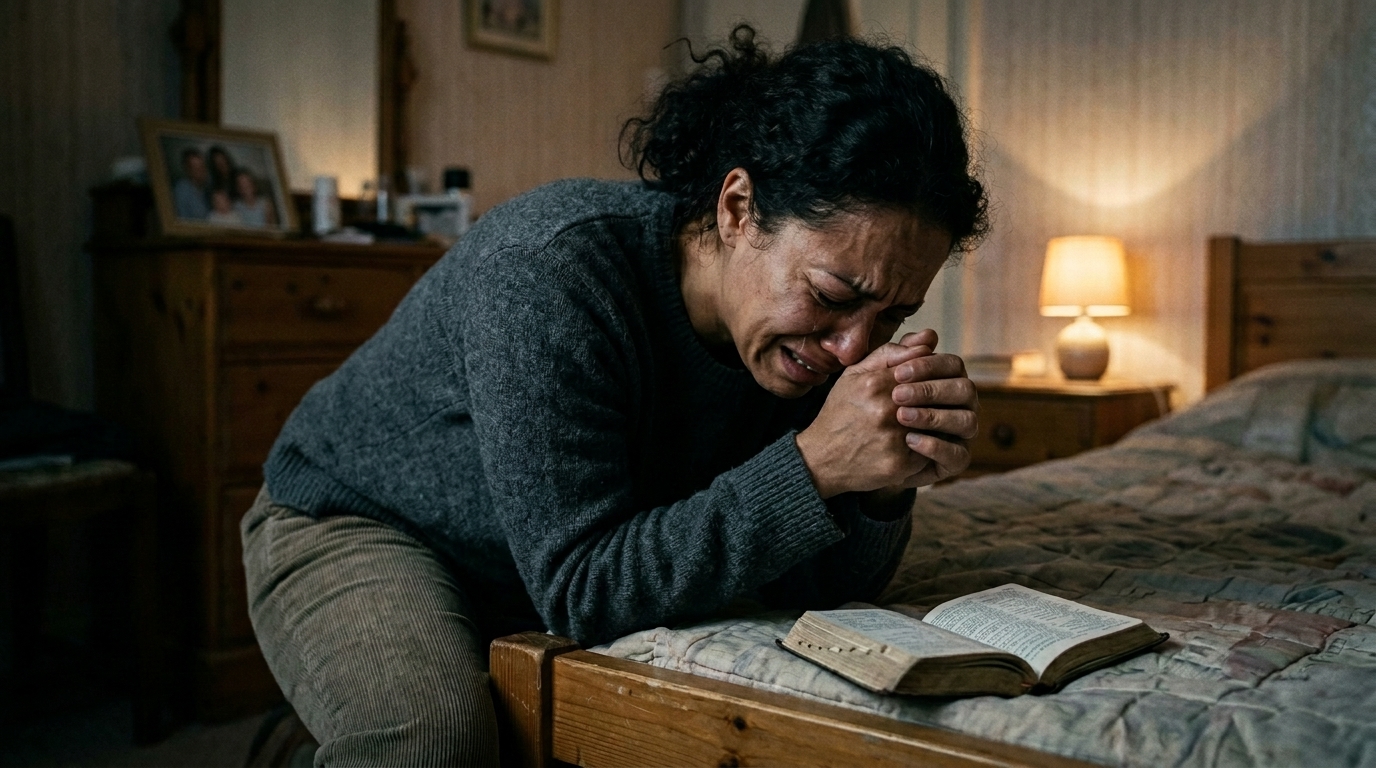
The Bible Doesn’t Hide the Frustration
Here’s what nobody tells you in Sabbath school: the Bible is full of people who were furious at God about unanswered prayer. Not politely confused.
Furious.
King David — the man called “a man after God’s own heart” — wrote this:
“My God, My God, why have You forsaken Me? Why are You so far from helping Me, and from the words of My groaning? O My God, I cry in the daytime, but You do not hear; and in the night season, and am not silent.” — Psalm 22:1–2 (NKJV)
This is not a man gently questioning God’s timing. This is a man screaming into the silence.
Crying day and night. Hearing nothing back. And he wrote it down — in Scripture — because God was not afraid of his honesty.
Then there’s the prophet Jeremiah, who said:
“Why is my pain perpetual and my wound incurable, which refuses to be healed? Will You surely be to me like an unreliable stream, as waters that fail?” — Jeremiah 15:18 (NKJV)
He called God unreliable. In Scripture. Think about that for a moment. God didn’t strike him down. God didn’t ghost him. God answered him. Because the complaint was real, and God is not threatened by real.
Even Job — who lost everything — sat in the ash heap and demanded God show up and explain Himself. And God’s response at the end of that book wasn’t a rebuke. It was a conversation. God showed up.
“God can handle your anger. What He can’t be replaced by — is your silence.”
So Why Doesn’t It Seem to Work?
Let’s be honest about something.
When we pray, especially in desperation, we are often treating prayer like a vending machine.
Insert faith.
Press button.
Receive miracle.
And when the miracle doesn’t come — we assume the machine is broken. Or that it was never real.
But what if prayer was never designed to be a transaction?
Jesus Himself prayed one of the most desperate prayers in history the night before He was crucified:
“Father, if it is Your will, take this cup away from Me; nevertheless not My will, but Yours, be done.” — Luke 22:42 (NKJV)
He asked. The answer was no. The cup was not taken. He went to the cross anyway.
Now here is where it gets uncomfortable: if the Son of God prayed for relief and didn’t receive it in the form He asked — what does that tell us about how prayer actually works?
It tells us that prayer is not a mechanism for bending God’s will toward ours. It is a relationship where we bring our honest, desperate, broken selves into the presence of Someone who actually sees the full picture. And the full picture is one we often cannot see from where we’re standing.
The Part That Hurts Most to Hear
The person who wrote that forum post noticed something real: it really does seem like the faithful suffer disproportionately. And that’s not imagined. James — the brother of Jesus — opened his letter to persecuted Christians by saying:
“My brethren, count it all joy when you fall into various trials, knowing that the testing of your faith produces patience.” — James 1:2–3 (NKJV)
I know. That sounds like a hard sell. “Count it joy.” Easy to say when you’re not the one with the sick child, or the debt, or the diagnosis that hasn’t moved in eleven years.
But notice what James doesn’t say. He doesn’t say pretend it’s fine. He doesn’t say stop praying. He says the suffering is producing something. And production takes time. It is painful. And it often looks like nothing from the outside — until it isn’t.
The little boy this person mentioned — the one who has been in and out of hospitals since birth — I don’t know why his story is what it is. And anyone who tells you they do is lying to you. But I do know this: the families still showing up to that church, still naming that child before God week after week, are doing something that the watching world cannot understand. They are holding on. And holding on is not weakness. It is an act of war against despair.
Top 3 Christian Books for Overcoming Anxiety (July 2026)



What Do You Do With Silence?
You keep talking. Not because it guarantees an outcome. But because the alternative — closing yourself off — leaves you completely alone in the dark. At least in prayer, you are speaking toward a Light, even if right now all you feel is the dark.
You lament. David did. Jeremiah did. Jesus (Yeshua) did. Lament is not a lack of faith. Lament is faith — it is the refusal to pretend everything is fine when it isn’t, while still believing there is Someone worth telling.
You adjust your expectations — not of God’s goodness, but of your timeline. Paul writes in Romans 8:
“Likewise the Spirit also helps in our weaknesses. For we do not know what we should pray for as we ought, but the Spirit Himself makes intercession for us with groanings which cannot be uttered.” — Romans 8:26 (NKJV)
Did you catch that? We don’t always know what to pray for. And that’s okay. The Spirit translates what we can’t even articulate into something God receives. Your broken, angry, barely-there prayer is not too broken.
It’s enough.
Prayer is not proof that God is a vending machine. It is proof that you have not yet stopped believing He is there.
Improve your prayer life with this FREE Downloadable GUIDE!
To the Person Who Wrote That Post
I want to speak directly to you for a moment — and to anyone reading this who has felt exactly what you described.
Your frustration is not a sin. Your anger at the suffering of innocent people is not faithlessness — it might actually be evidence that something in you still believes things should be better. That things shouldn’t be this way. That there is such a thing as “better” at all. That instinct comes from somewhere. And it matters.
You are not wrong to grieve. You are not wrong to question. You are not wrong to be furious. But don’t let the silence become a verdict. Silence is not the same as absence.
Sometimes God is not quiet because He doesn’t care. Sometimes He is quiet because the answer — the real answer — is bigger and longer and more layered than a moment. And He knows that if He showed you all of it right now, it would overwhelm you.
Keep the door cracked open. Even if it’s just barely. That tiny crack is enough.
“Evening and morning and at noon I will pray,
— Psalm 55:17 (NKJV)
and cry aloud, and He shall hear my voice.”

About the Author
Joshua Infantado is a Christian blogger and Bible teacher who has been writing faith-based content since 2013. He is the founder of Becoming Christians, where he shares blogs, books, videos, and online courses to help believers grow in truth and grace. Joshua lives in Davao City, Philippines, with his wife, Victoria, and their son, Caleb. Contact him at joshuainfantado@gmail.com.
Discover more from Becoming Christians
Subscribe to get the latest posts sent to your email.