Did you know that nature is filled with astonishing wonders that can leave you speechless? From octopuses that appear to dream while sleeping to cows that form strong bonds with their preferred companions, the natural world is far more remarkable than we often realize. In this blog, we’ll explore some of the incredible features of creation and consider what they reveal about the power, wisdom, and design of the Creator.
Have you ever stopped to think about how strange and incredible the world around us really is?
We wake up every morning, look outside, drink water, eat food, breathe air, watch birds fly, see trees grow, hear music, hold our children’s hands, and go about our ordinary lives.
Because we experience these things every day, they can begin to feel normal.
But they are anything but normal.
An octopus can enter a sleep state that resembles REM sleep. Sea otters can carry rocks in loose pockets of skin beneath their forearms and use them as tools. Honeybees communicate the location of food through an elaborate dance. Crows can recognize individual human faces and remember them for years. Rats produce high-frequency vocalizations during play and when they are tickled. Dolphins develop distinctive signature whistles that function somewhat like individual names.
Birds can perceive ultraviolet wavelengths that our eyes cannot detect.
Some sea slugs can take chloroplasts from algae and retain them in their own bodies, allowing them to use the captured chloroplasts for photosynthesis.
Some seeds can remain dormant for decades.
Monarch butterflies migrate thousands of miles using inherited biological mechanisms for navigation.
Sea turtles hatch from eggs, make their way toward the ocean, spend years at sea, and eventually return to their natal regions to reproduce.
Whales produce extraordinarily complex songs, and those songs can spread culturally from one population to another.
And then there is you.
You began as a single cell.
That single cell divided and developed into a human being with a brain capable of thought, eyes capable of seeing, ears capable of hearing, hands capable of manipulating objects, a heart capable of beating continuously, and a nervous system capable of transmitting electrical signals throughout your body.
You are not merely alive.
You are an extraordinarily complicated living system.
And the more we learn about creation, the harder it becomes to look at it casually.
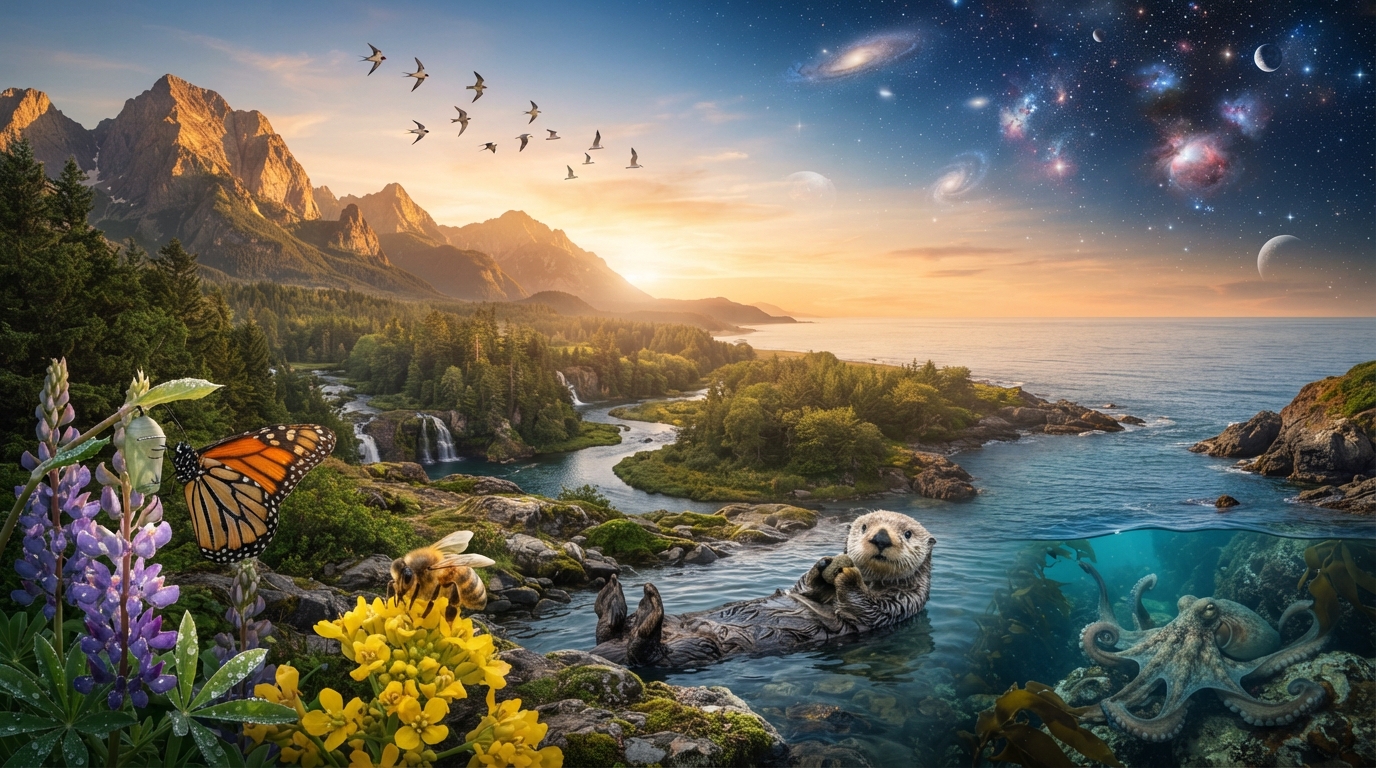
The Heavens Declare Something
The Bible begins with a simple statement:
“In the beginning God created the heavens and the earth.”
Genesis 1:1, NKJV
Notice what the Bible does not say.
It does not begin by trying to prove God’s existence through a philosophical argument.
It simply introduces God as the Creator.
Then, thousands of years ago, David looked at the heavens and reached a remarkable conclusion:
“The heavens declare the glory of God;
And the firmament shows His handiwork.”
Psalm 19:1, NKJV
The heavens are declaring something.
Creation is displaying something.
The universe is revealing something about its Creator.
And modern science has only increased our awareness of how extraordinary that creation is.
Look at the Design Around You
Consider the humble acorn.
An acorn is small enough to hold in your hand.
Yet inside it is the genetic information and developmental machinery that can eventually produce an enormous oak tree.
Give it appropriate conditions, and a tiny seed can become a living organism with roots, bark, branches, leaves, flowers and eventually more seeds.
The seed does not contain a miniature tree.
It contains biological information and machinery that directs the development of the organism.
That is astonishing.
And the same principle exists throughout the living world.
A caterpillar and a butterfly look like completely different creatures. Yet they are stages in the life cycle of the same organism.
During metamorphosis, much of the larval tissue is broken down while specialized cells develop the structures of the adult butterfly.
The result is an organism capable of flying, feeding, reproducing and continuing the cycle of life.
What appears to be an ordinary butterfly is actually the final product of an extraordinarily complex developmental process.
And butterflies are not an isolated example.
Bees Have Their Own Remarkable Communication System
Honeybees have developed one of nature’s most fascinating forms of communication.
When a worker bee discovers a valuable food source, it can return to the hive and perform what scientists call the waggle dance.
The direction and duration of the dance communicate information about the location of the food.
Think about that.
A bee leaves the hive, discovers food, returns, and communicates spatial information to other bees through movement.
Other bees can then use that information to locate the food source.
There is no GPS.
There is no spoken language.
There is no written map.
There is a biological communication system encoded into the behavior of these tiny creatures.
And different bee populations can even exhibit differences in aspects of this communication, sometimes described as regional “dialects.”
The more closely we examine life, the more we encounter information.
Dolphins Have Individual “Names”
Bottlenose dolphins produce distinctive vocalizations known as signature whistles.
These whistles can function somewhat like individual names.
A dolphin develops a distinctive whistle associated with itself, and dolphins can reproduce the signature whistles of other individuals.
Think about the significance of that.
We often assume that sophisticated communication belongs exclusively to human beings.
Yet the animal kingdom contains communication systems that are far more sophisticated than we might expect.
Dolphins live in complex social groups. They communicate. They recognize individuals. They learn behaviors.
And they do all of this with a nervous system that we did not design.
FREE GUIDE TO DOWNLOAD
Download for free, “20+ Life-Changing Bible Verses About Healing: Find Comfort, Strength, and Restoration Through God’s Promises)
Crows Can Remember Human Faces
Crows are another astonishing example.
Research has demonstrated that crows can recognize individual human faces, particularly faces associated with danger.
Even more remarkably, information about threatening individuals can spread socially among crows.
A crow can learn that a particular human is dangerous, and other crows can acquire information about that threat through social learning.
The popular phrase “generational beef with a bird” is humorous, but there is something remarkable underneath the joke.
These birds have memory.
They recognize individuals.
They learn socially.
They respond to information from their environment.
They are not mindless machines responding to isolated stimuli.
They are living creatures equipped with sophisticated biological systems.
Birds See a World We Cannot See
Look at a bird flying overhead.
It may appear to see the same world you see.
But many birds have visual systems capable of detecting ultraviolet wavelengths that human beings cannot see.
That means there are aspects of the visual world available to these creatures that are completely inaccessible to our eyes.
The world is bigger than our perception of it.
We experience only a portion of what exists around us.
And that should humble us.
We sometimes assume that our senses give us a complete picture of reality.
They do not.
Creation contains dimensions that our own biological equipment cannot perceive.
Top 3 Best-Selling Christian Books for September 2026


The Sea Contains Even More Wonders
Some sacoglossan sea slugs have a remarkable ability called kleptoplasty.
They consume algae and retain chloroplasts from the algae inside their own tissues.
Chloroplasts are the structures that carry out photosynthesis in plants and algae.
In certain species, these retained chloroplasts can remain functional for extended periods.
It sounds almost like science fiction.
An animal eats an alga and retains some of the alga’s photosynthetic machinery.
But it is real biology.
And once again, we encounter something that should make us pause.
Life is not simple.
Life is extraordinarily organized.
Even the Smallest Things Are Astonishing
We often imagine that complexity means something large.
But some of the most astonishing examples are microscopic.
Your body contains trillions of cells.
Those cells contain molecular machines.
DNA stores biological information.
Proteins perform highly specialized functions.
Cells communicate.
Membranes regulate what enters and leaves.
Molecular systems transport materials.
Your nervous system transmits electrical signals.
Your immune system identifies and responds to threats.
Your heart generates electrical impulses that coordinate its contractions.
And somehow, all of this works together to produce a living human being.
You do not have to understand every molecular detail to appreciate how extraordinary this is.
The more we discover, the more complicated the picture becomes.
Your Body Began as One Cell
Think about your own existence.
You began as a single cell.
That cell divided.
Then the resulting cells divided again.
Cells differentiated.
Some became muscle cells.
Some became nerve cells.
Some became blood cells.
Some became skin.
Some formed the structures of your eyes.
Some became part of your heart.
Some became part of your brain.
The developing organism somehow coordinates an enormous number of processes so that cells end up in the right places and perform the right functions.
And eventually, a human being emerges.
A person who can think.
A person who can reason.
A person who can ask, “Why am I here?”
A person who can look at the stars and wonder about the universe.
A person who can love.
A person who can create.
A person who can worship.
You are part of the creation you are capable of contemplating.
That is remarkable.
The Elements in Your Body Came From the Cosmos
There is another humbling reality.
The atoms that make up your body have an ancient history.
The heavier elements were produced through processes occurring in stars and stellar explosions and other cosmic events.
The iron used in your blood’s hemoglobin has an astrophysical history that stretches far beyond the existence of humanity.
So when you look at the night sky, you are not looking at something completely unrelated to yourself.
The material that makes up your body has a cosmic history.
The psalmist expressed this sense of wonder thousands of years ago:
“When I consider Your heavens, the work of Your fingers,
The moon and the stars, which You have ordained,
What is man that You are mindful of him,
And the son of man that You visit him?”
Psalm 8:3-4, NKJV
The more we discover about creation, the more appropriate those words become.
But Doesn’t Science Explain These Things?
Someone may respond:
“But evolution explains animals.”
Yes, evolutionary biology provides mechanisms that help explain how populations change over generations and how biological diversity arises.
Physics explains physical processes.
Chemistry explains chemical reactions.
Biology explains biological systems.
But there is an important distinction we should not overlook.
Explaining how something operates is not necessarily the same as explaining why the universe contains such an orderly system capable of producing it.
Knowing how a computer works does not mean the computer designed itself.
Understanding how a book is printed does not mean there was no author.
Understanding how an eye develops does not automatically answer every philosophical question about why a universe exists in which information, matter, physical laws and biological development can work together in such an extraordinary way.
A mechanism is not necessarily an explanation for the ultimate origin of the mechanism.
Chance Is Not a Creator
This is where we need to be careful with the word “chance.”
Chance can describe randomness within a process.
But chance itself is not a conscious entity.
Chance does not think.
Chance does not plan.
Chance does not communicate.
Chance does not write instructions.
Chance does not establish laws.
Chance does not create purpose.
If you find a message written on a piece of paper, you do not normally conclude that random ink molecules accidentally arranged themselves into meaningful sentences.
Why?
Because information points us toward an information source.
Biology contains extraordinary quantities of information.
DNA is a chemical molecule, but it also functions as an information-storage system.
The existence of a physical mechanism does not make the information meaningless.
The question remains:
Why is there a universe capable of storing, transmitting and using biological information in the first place?
The Universe Is Ordered and Intelligible
There is another remarkable fact.
The universe is understandable.
Human beings can discover mathematical relationships in nature.
We can formulate physical laws.
We can observe distant galaxies.
We can investigate DNA.
We can study cells.
We can predict astronomical events.
We can use mathematics to describe physical reality.
Why should human minds be capable of understanding the universe at all?
The Bible gives us a framework for understanding this.
The universe is not ultimately the product of blind chaos.
It came from the mind of God.
John wrote:
“In the beginning was the Word, and the Word was with God, and the Word was God.”
John 1:1, NKJV
And then:
“All things were made through Him, and without Him nothing was made that was made.”
John 1:3, NKJV
Creation has order because its ultimate source is not disorder.
It has intelligibility because its Creator possesses intelligence.
It has beauty because its Creator possesses wisdom.
It has complexity because its Creator is capable of creating complexity.
Creation Does Not Have to Be Simple to Be Natural
One objection sometimes raised is this:
“These things are natural, so we don’t need God to explain them.”
But “natural” simply describes something occurring within the natural world.
It does not answer the ultimate question of why the natural world exists.
Consider a magnificent building.
You can explain how the electricity works.
You can explain how the plumbing works.
You can explain how concrete hardens.
You can explain how steel supports the structure.
You can explain how the doors open and close.
You can explain how the building’s heating and cooling systems operate.
None of those explanations demonstrate that nobody designed the building.
In fact, understanding how the components work can make the design even more impressive.
The same principle applies when we study creation.
Understanding biology does not make biology less amazing.
It can make it more amazing.
The More We Discover, the More There Is to Discover
We have barely scratched the surface.
There are fungi forming enormous underground networks.
There are plants capable of responding to environmental conditions.
There are birds navigating across enormous distances.
There are insects capable of extraordinary feats of engineering.
There are whales communicating through complex vocalizations.
There are elephants displaying remarkable responses to their dead.
There are social animals that learn from one another.
There are microscopic organisms performing chemical processes upon which entire ecosystems depend.
There are ecosystems in which thousands of species interact.
There are forests, oceans, deserts, mountains and rivers.
And above all of this is a universe containing billions of galaxies.
We live on a small planet in an enormous cosmos, yet that planet contains life of staggering complexity.
It is easy to become accustomed to it.
But perhaps we should become astonished again.
Creation Is Not God
The Bible does not tell us to worship creation.
It tells us to recognize the Creator.
Paul wrote:
“For since the creation of the world His invisible attributes are clearly seen, being understood by the things that are made, even His eternal power and Godhead.”
Romans 1:20, NKJV
That is an extraordinary statement.
God’s invisible qualities can be understood through what He has made.
Creation is not God.
A tree is not God.
A whale is not God.
A galaxy is not God.
You are not God.
But creation can point beyond itself to the One who created it.
A painting points toward a painter.
A building points toward a builder.
A book points toward an author.
And creation points toward its Creator.
The Greatest Miracle Is That We Are Here to See It
Perhaps one of the most astonishing things about creation is that we are capable of contemplating it.
The universe contains stars.
The earth contains life.
Life contains information.
Brains contain extraordinary networks of neurons.
And one particular arrangement of matter is sitting here asking:
Why does any of this exist?
You can look at the ocean and wonder.
You can look at the stars and wonder.
You can watch a butterfly emerge from its chrysalis and wonder.
You can hold an acorn in your hand and wonder how something so small can become something so enormous.
You can watch a newborn child breathe and wonder.
And perhaps that sense of wonder is telling you something.
The World Is More Amazing Than We Usually Realize
We live on a planet covered with oceans.
There are creatures beneath those oceans producing their own light.
There are birds flying through a world containing colors our eyes cannot perceive.
There are bees communicating locations through dance.
There are dolphins using individual signature whistles.
There are crows capable of remembering human faces.
There are rats producing playful vocalizations.
There are whales learning songs from one another.
There are butterflies migrating across continents.
There are seeds waiting years, sometimes decades, for the right conditions.
There are trees growing from tiny seeds.
There are cells carrying out microscopic processes so complicated that we are still trying to understand them.
And there is you.
A human being capable of thinking about all of it.
The psalmist looked at creation and said:
“O LORD, our Lord,
How excellent is Your name in all the earth,
Who have set Your glory above the heavens!”
Psalm 8:1, NKJV
That should be our response as well.
The purpose of studying creation is not merely to collect interesting facts.
It is to recognize what those facts can tell us.
Creation is filled with order.
Creation is filled with information.
Creation is filled with interdependence.
Creation is filled with beauty.
Creation is filled with remarkable biological systems.
Creation is filled with things we cannot fully explain even after centuries of scientific investigation.
And behind all of it stands the Creator.
“For every house is built by someone, but He who built all things is God.”
Hebrews 3:4, NKJV
The next time you see a bird fly, a flower bloom, a tree grow, a baby breathe, or the stars appear in the night sky, don’t simply see something ordinary.
Stop.
Look.
Think.
Wonder.
Because the creation around you is not merely a collection of things.
It is a testimony.
The heavens declare God’s glory.
The earth displays His handiwork.
Life reveals astonishing order and complexity.
And the more carefully we look at what has been made, the more reason we have to ask the most important question of all:
Who made it?

About the Author
Joshua Infantado is a Christian blogger and Bible teacher who has been writing faith-based content since 2013. He is the founder of Becoming Christians, where he shares blogs, books, videos, and online courses to help believers grow in truth and grace. Joshua lives in Davao City, Philippines, with his wife, Victoria, and their son, Caleb. Contact him at joshuainfantado@gmail.com.
Discover more from Becoming Christians
Subscribe to get the latest posts sent to your email.