Dinosaurs have fascinated people for generations.
We see their enormous skeletons in museums. Children grow up learning the names Tyrannosaurus rex, Triceratops, Stegosaurus and Brachiosaurus. Scientists have uncovered millions of fossils that appear to show that these remarkable creatures once dominated the earth.
But there is a bigger question behind all of this:
Where do dinosaurs fit into the Bible?
Did God create dinosaurs?
Were dinosaurs alive before Adam?
Were dinosaurs on Noah’s ark?
Does the Bible actually mention dinosaurs?
And if dinosaurs became extinct millions of years ago, does that contradict the biblical account of creation?
The Bible does not use the modern word dinosaur. The word itself was not coined until the nineteenth century. But that does not mean the Bible has nothing to say about these creatures.
In fact, when we understand the biblical account of creation, the pre-Adamic world, and several unusual creatures mentioned in Scripture, the Bible provides a fascinating framework for understanding where dinosaurs fit.
Do you want to learn more about the Bible? If yes, join our online Bible school through our FREE community. Discover Biblical truths most churches have already forgotten!

The Bible does not mention the word “dinosaur”
Let’s begin with an important distinction.
You will not find the word “dinosaur” in the Bible.
That should not surprise us. The term dinosaur was created in 1841 by British paleontologist Richard Owen. Biblical writers obviously lived many centuries before that word existed.
The Bible generally describes animals according to broader categories rather than giving us the scientific classifications we use today.
For example, Genesis says:
“So God created great sea creatures and every living thing that moves…”
(Genesis 1:21, NKJV)
Genesis then describes land animals as cattle, creeping things and beasts of the earth.
Those categories are broad enough to include many different kinds of creatures.
Therefore, the absence of the word dinosaur proves very little.
The real question is:
Does the Bible allow us to believe that dinosaurs existed?
The answer is yes.
God created the animals
The Bible is very clear about the ultimate origin of animal life.
Animals did not appear because of some unguided process that operated independently of God. Scripture repeatedly attributes creation to God.
Genesis 1 describes God creating sea creatures and birds on the fifth day, followed by land animals on the sixth day.
Genesis 1:25 says:
“And God made the beast of the earth according to its kind…” (NKJV)
The phrase “according to its kind” is important.
The biblical account presents God as the Creator and Designer of the various forms of life. It does not present life as the product of blind, purposeless evolution.
That means there is no biblical difficulty in believing that God created enormous reptiles, flying reptiles, marine reptiles and other creatures that we today classify as dinosaurs.
They were creatures of God’s creation.
But this immediately raises another question.
When did God create them?
This is where the biblical account becomes especially interesting.
Were dinosaurs created before Adam?
A common assumption is that dinosaurs must have lived alongside Adam, Eve and all the animals mentioned in Genesis.
But that assumption is not necessary.
The traditional teaching associated with Herbert W. Armstrong understood Genesis 1 as describing a restoration of the earth after a previous catastrophic event.
This is sometimes called the gap theory, or the pre-Adamic creation understanding.
The basic idea is that Genesis 1:1 describes God’s original creation of the heavens and the earth:
“In the beginning God created the heavens and the earth.”
(Genesis 1:1, NKJV)
Then verse 2 describes the earth in a condition of desolation:
“The earth was without form, and void; and darkness was on the face of the deep.”
(Genesis 1:2, NKJV)
The Hebrew expression traditionally translated “without form, and void” is tohu wa-bohu, describing a condition of desolation, emptiness or wasteness.
Under this understanding, Genesis 1:3 onward describes God renewing and restoring the earth for human habitation.
This is an important distinction.
Genesis 1 does not necessarily begin with the creation of the physical earth in verse 1 and then describe everything that ever happened to it in chronological sequence.
Rather, verse 1 can be understood as describing the original creation, while verse 2 introduces the earth in a devastated condition and verse 3 onward describes God’s work of restoring it.
This framework was an important part of the teaching associated with Herbert W. Armstrong and the old Worldwide Church of God. Armstrong’s writings placed considerable emphasis on understanding the Bible’s account of creation, the angelic realm, Satan’s rebellion and the condition of the earth before Adam. His Mystery of the Ages presented creation and the purpose of humanity within that larger biblical framework.
And this gives us a possible answer to the dinosaur question.
Dinosaurs may have lived in the pre-Adamic world
If dinosaurs lived long before human beings, there is no need to place them inside the six-day period described in Genesis 1:3-31.
They could have existed during the ancient world before Adam.
They could have lived, reproduced and eventually become extinct before the creation of man.
Their fossils could therefore represent creatures that lived in a world that existed before the restoration described beginning in Genesis 1:3.
This view also provides a framework for understanding why the fossil record contains enormous numbers of extinct creatures.
It does not require Christians to place dinosaurs on Noah’s ark.
And it does not require us to believe that Adam and dinosaurs necessarily walked the earth at the same time.
However, we should be careful here.
The Bible never explicitly says, “Dinosaurs lived before Adam.”
That conclusion comes from putting several biblical teachings together with what we know about the fossil record.
That is different from saying that the Bible directly names the dinosaurs and gives us their complete history.
What happened between Genesis 1:1 and Genesis 1:3?
This is where the subject becomes much deeper.
The Bible teaches that God created angels. It also teaches that angels were created before the foundation of the earth, because God tells Job that the “sons of God” shouted for joy when the foundations of the earth were laid (Job 38:4-7).
The Bible also teaches that one of God’s angels became Satan through rebellion.
Isaiah 14 describes the rebellion of the one called Lucifer, while Ezekiel 28 uses language concerning a powerful being who was originally created perfect but later became corrupted.
Jesus Himself said:
“I saw Satan fall like lightning from heaven.”
(Luke 10:18, NKJV)
Revelation 12 also describes Satan and his angels being cast down.
The traditional Armstrong understanding connects these passages with the biblical teaching concerning the angelic rebellion and the destruction that came upon the earth before Adam.
In this framework, the world that existed before Adam was not necessarily the same world described after Genesis 1:3.
Something had happened.
The earth became desolate.
Then God began restoring it.
And this is where dinosaurs can fit naturally.
Top 3 Best-Selling Christian Books for September 2026


Dinosaurs do not need to have been on Noah’s ark
One of the most common questions is:
“If dinosaurs existed, were they on Noah’s ark?”
Not necessarily.
If dinosaurs lived during a pre-Adamic age and became extinct before Adam, they obviously could not have been on the ark.
The biblical account of Noah concerns the preservation of human beings and the animal kinds necessary for the world that existed in Noah’s generation.
Genesis 7 does not require us to believe that every animal species that had ever lived had to be preserved on the ark.
In fact, millions of creatures have become extinct throughout earth’s history.
So the question “Where did Noah put the dinosaurs?” assumes something the Bible never states.
There is no biblical requirement to put a Tyrannosaurus rex beside Noah’s family inside the ark.
But what about Behemoth?
Now we come to one of the most fascinating passages in the entire Bible.
In Job 40, God tells Job:
“Look now at the behemoth, which I made along with you.”
(Job 40:15, NKJV)
God then describes this enormous creature.
It eats grass like an ox.
It has extraordinary strength.
Its bones are described as being like beams of bronze.
Its ribs are like bars of iron.
And then comes one of the most intriguing statements:
“He moves his tail like a cedar.”
(Job 40:17, NKJV)
The description continues by placing the animal among rivers, reeds, marshes and vegetation.
So what was Behemoth?
Some commentators identify Behemoth with a hippopotamus. Others have proposed different animals.
But there is a problem with automatically assuming that Behemoth was simply a modern hippopotamus.
The description of its enormous strength and especially its tail “like a cedar” has caused many readers to wonder whether the creature was something much larger.
Could it have been a dinosaur?
Possibly.
But we should not claim more than Scripture allows.
The Bible does not say, “Behemoth was a dinosaur.”
The NKJV itself includes a footnote describing the creature as a large animal whose exact identity is unknown.
Therefore, Behemoth is an intriguing possibility, but it should not be presented as definitive proof that the Bible explicitly describes a dinosaur.
There is another creature that is even more mysterious.
Grow Closer to God…
What about Leviathan?
Job 41 describes Leviathan.
God asks Job:
“Can you draw out Leviathan with a hook?”
(Job 41:1, NKJV)
The description continues for an entire chapter.
Leviathan is portrayed as extraordinarily powerful and dangerous. Human beings cannot easily capture it. God asks whether anyone can stand before such a creature.
Later in the chapter, the description becomes even more remarkable, describing its powerful body, fearsome nature and armor-like scales.
What was Leviathan?
Again, we should be cautious.
Many commentators identify Leviathan with a crocodile or another large aquatic creature. Others believe the description may point to something more unusual.
Some creationist interpreters have suggested that Leviathan could represent a dinosaur-like creature or another extinct reptile.
But Scripture does not give us enough information to identify it with certainty.
So the safest biblical conclusion is:
Behemoth and Leviathan demonstrate that the Bible knew of extraordinarily large and powerful creatures, but Scripture does not explicitly tell us that either one was a dinosaur.
That distinction matters.
We do not need to force the Bible to say something it does not say.
Does Genesis 1:21 refer to dinosaurs?
Genesis 1:21 is another passage worth considering:
“So God created great sea creatures and every living thing that moves…”
(NKJV)
The Hebrew wording is broad. The verse describes the creation of great sea creatures along with the other life forms in the waters.
Some English translations historically used expressions such as “great whales” or “sea monsters.”
The NKJV uses the broader expression “great sea creatures.”
Could this category have included enormous prehistoric marine reptiles?
Yes, it certainly could.
But again, we should distinguish possibility from proof.
Genesis 1:21 is not a secret dinosaur verse.
It is a statement that God created the great creatures of the seas.
If some of those creatures were what we today classify as dinosaurs or other prehistoric reptiles, the verse would naturally include them.
Does the Bible contradict the existence of dinosaurs?
No.
The existence of dinosaurs does not contradict the Bible.
The real disagreement is not between “dinosaurs” and “the Bible.”
The deeper question concerns how we interpret the history of creation.
One interpretation says that the entire universe, earth, dinosaurs and human beings must all fit within a relatively short chronological framework.
Another interpretation, consistent with the traditional Armstrong teaching, understands Genesis 1:1 as referring to an original creation and Genesis 1:2 onward as describing the restoration of the earth after a catastrophic event associated with the rebellion of Satan and the angelic realm.
Under that framework, dinosaurs can belong to an ancient pre-Adamic world.
Their extinction does not create a biblical problem.
Their fossils do not require us to put them on Noah’s ark.
And their existence does not require us to accept the theory of evolution as an explanation for the origin of life.
What about the fossil record?
The fossil record presents us with an enormous number of extinct organisms.
Among them are dinosaurs.
Their bones, footprints, eggs and other fossilized remains provide evidence that these creatures once lived.
But fossils do not tell us everything about their ultimate origin.
A fossil can tell us that an organism existed.
It can provide information about its anatomy and environment.
But questions such as why life exists, where life ultimately came from, and what purpose life has go beyond what fossils themselves can establish.
The Bible begins with a much more fundamental statement:
“In the beginning God created…”
That is the foundation.
Science can investigate the physical evidence left behind by ancient creatures. But the Bible tells us who stands behind creation.
Were dinosaurs killed in the Flood?
This is another common assumption.
Some people believe the dinosaurs were destroyed in Noah’s Flood.
That is possible for some creatures that existed in Noah’s time, but it is not necessary to explain the extinction of dinosaurs as a whole.
If the majority of dinosaurs lived in a pre-Adamic world, their extinction would have occurred before human civilization.
The Bible does not specifically tell us what caused their extinction.
And we should not pretend that it does.
The important biblical point is that extinction does not contradict creation.
God created creatures for His purposes.
Not every creature God created had to continue existing forever.
Many animals that once lived are extinct today.
Their extinction does not mean they were never created by God.
Did death exist before Adam?
This question often comes up in discussions about dinosaurs.
Some Christians argue that no animal could have died before Adam sinned.
But that conclusion requires careful examination.
Romans 5:12 says:
“Therefore, just as through one man sin entered the world, and death through sin, and thus death spread to all men…”
(NKJV)
Notice what the verse specifically says.
Death entered the world through sin, and death spread to all men.
The passage is explaining the entrance of human sin and the human consequence of death.
It does not explicitly say that no plant or animal could ever die before Adam.
The traditional Armstrong understanding also distinguishes between the pre-Adamic world and the human world described in Genesis.
Therefore, the existence of extinct animals before Adam does not necessarily contradict Romans 5:12.
Why did God create dinosaurs?
This may be the most interesting question of all.
We often think of dinosaurs merely as extinct monsters.
But they were part of God’s creation.
And God’s creation has purpose.
The Bible says:
“You are worthy, O Lord, To receive glory and honor and power; For You created all things, And by Your will they exist and were created.”
(Revelation 4:11, NKJV)
Dinosaurs remind us of something important.
God’s creation is far bigger than human beings normally imagine.
Some dinosaurs were tiny.
Others were enormous.
Some lived on land.
Others lived in the seas.
Some flew or glided.
Some were predators.
Others ate plants.
Their incredible variety points us toward the creativity and power of the Creator.
And yet, dinosaurs were not the ultimate purpose of God’s creation.
Human beings were created for a purpose far greater than simply existing as intelligent animals.
God created human beings in His image and likeness, with the potential to become part of His family.
That is where the story of creation ultimately leads.
Dinosaurs and the purpose of humanity
The dinosaur question can actually point us toward a much bigger biblical question:
Why did God create anything at all?
Why create the universe?
Why create angels?
Why create earth?
Why create animals?
And why create human beings?
The Bible’s answer is much greater than “God wanted to populate the planet.”
Human beings were created with a unique purpose.
Genesis 1:26 says:
“Let Us make man in Our image, according to Our likeness…”
(NKJV)
Animals were created according to their kinds.
Human beings were created in God’s image.
That distinction is enormous.
Dinosaurs were part of God’s creation, but human beings were created with a future and purpose that goes beyond animal existence.
The existence of dinosaurs therefore does not diminish the biblical account.
It actually gives us another opportunity to appreciate the incredible creative power of God.
So, are there dinosaurs in the Bible?
The most honest answer is:
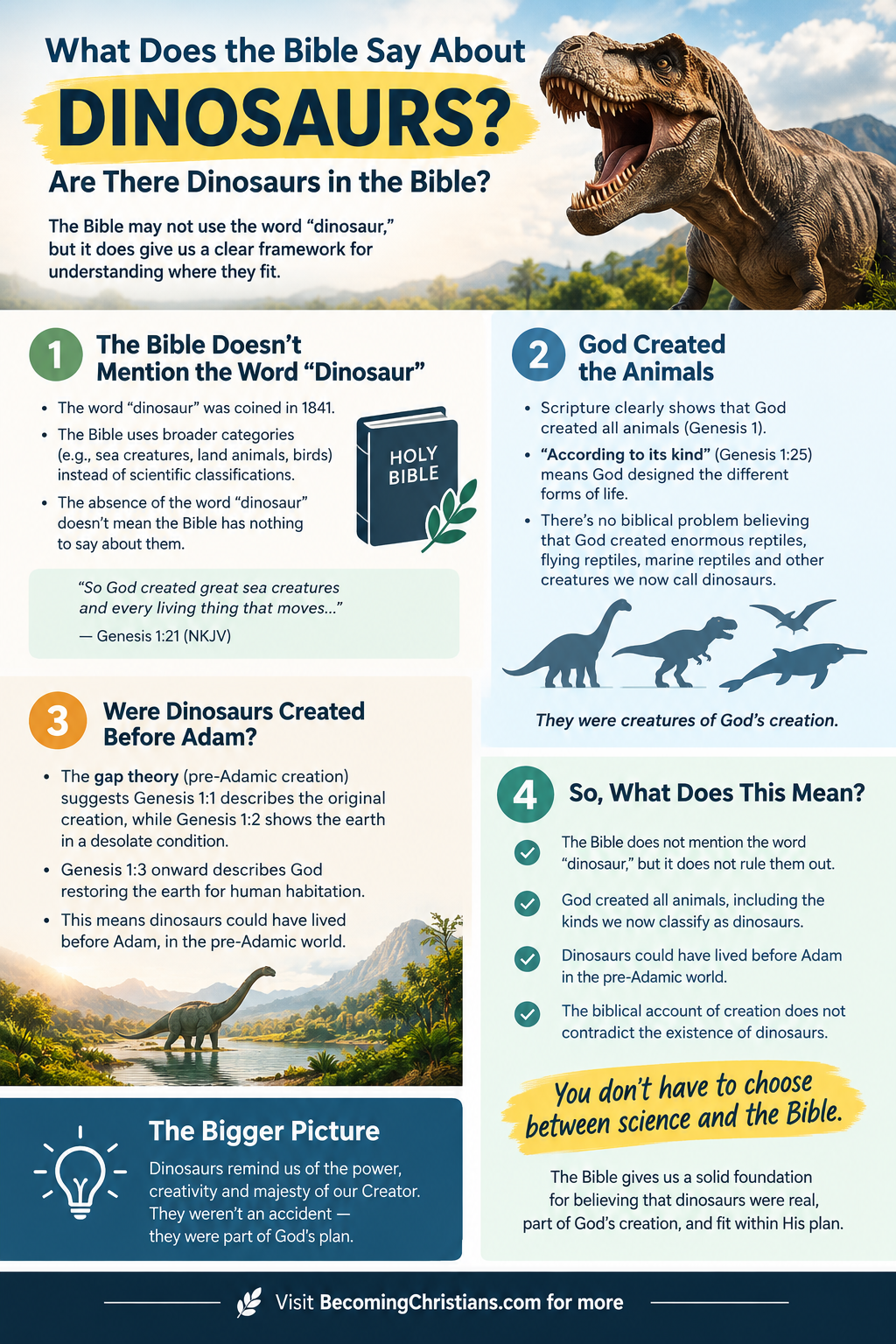
The Bible does not use the word “dinosaur,” and it does not explicitly identify any creature as a dinosaur.
However, the Bible describes categories of creatures broad enough to include the kinds of animals we now call dinosaurs.
Genesis 1 speaks about great sea creatures and various kinds of land animals.
Job 40 describes Behemoth, an enormous and powerful creature whose exact identity remains uncertain.
Job 41 describes Leviathan, another exceptionally powerful creature whose exact identity is debated.
And the biblical framework of an ancient world before Adam provides a reasonable place for dinosaurs to fit without forcing them into Noah’s ark or requiring Adam and dinosaurs to have lived together.
So we should neither dismiss the dinosaurs because they are not named in Scripture nor force Scripture to say that Behemoth or Leviathan definitely were dinosaurs.
There is a better approach.
Let the Bible say what it says.
Then allow the evidence from God’s creation to be considered within that biblical framework.
The bigger lesson of dinosaurs
Perhaps the most important lesson is not about dinosaurs at all.
It is about God.
When we look at a massive dinosaur skeleton, we are looking at evidence of a creature that once lived on this earth.
But behind that creature was a Creator.
The Bible says:
“For by Him all things were created that are in heaven and that are on earth, visible and invisible…”
(Colossians 1:16, NKJV)
Dinosaurs were not accidents.
They were not the result of some purposeless cosmic process that had no direction.
They were creatures God created.
They lived for a time.
They eventually disappeared.
And humanity remains here, asking questions about their existence thousands of years later.
The Bible’s message is therefore bigger than the question, “Where are the dinosaurs?”
It is this:
There is a Creator behind the creation.
And the same God who created creatures of enormous power and variety also created human beings for an incredible purpose.
So the next time you see a dinosaur skeleton, don’t merely think about extinction.
Think about the Creator.
Think about the incredible complexity of His creation.
And most importantly, ask the question that matters far more than how long a dinosaur lived:
Why did God create you?
That is a question the Bible does answer.

About the Author
Joshua Infantado is a Christian blogger and Bible teacher who has been writing faith-based content since 2013. He is the founder of Becoming Christians, where he shares blogs, books, videos, and online courses to help believers grow in truth and grace. Joshua lives in Davao City, Philippines, with his wife, Victoria, and their son, Caleb. Contact him at joshuainfantado@gmail.com.
Discover more from Becoming Christians
Subscribe to get the latest posts sent to your email.