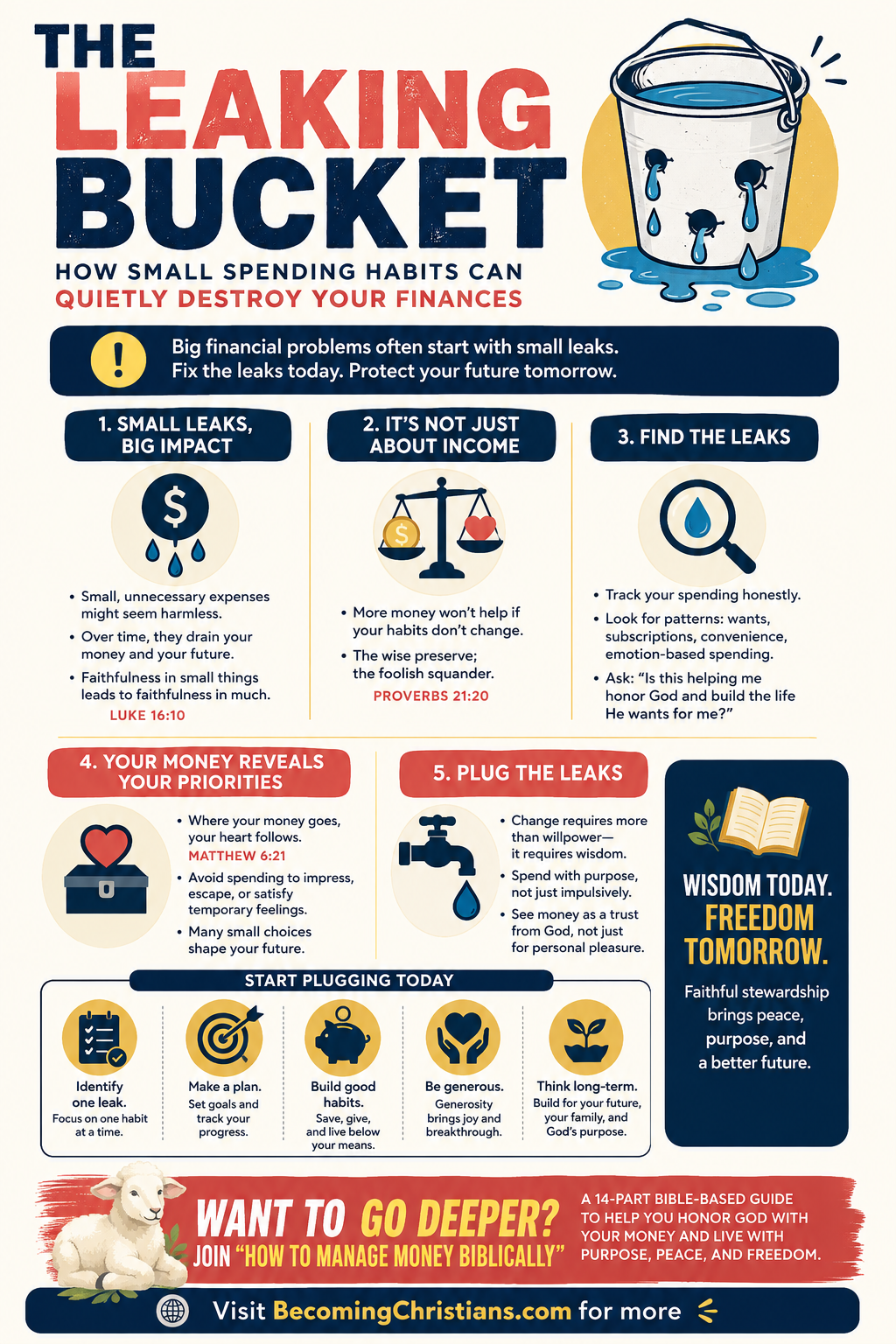
Imagine carrying water in a bucket with a small hole at the bottom.
At first, the hole may not seem like a serious problem. You can still fill the bucket. You can still carry it. From the outside, everything may appear perfectly fine.
But as you walk, drop by drop, the water escapes.
You may not notice the loss immediately. Yet by the time you reach your destination, you may discover that much of what you worked hard to carry is gone.
That is exactly how many people manage their money.
The problem is not always that they do not earn enough. Sometimes, the real problem is that their finances have developed small leaks.
A few unnecessary purchases here. An impulsive online order there. Another subscription that is barely used. Frequent spending on things that bring temporary satisfaction but provide little lasting value.
Individually, these expenses may seem harmless.
Together, however, they can quietly drain your finances.
And unless you identify the leaks, you may continue asking, “Where did all my money go?”
📢 Managing your spending is just one step toward true financial freedom. Join my online Bible study course, How to Manage Your Finances Biblically, and discover 14 powerful biblical principles that can help you honor God, break unhealthy financial habits, and manage your money with greater wisdom, purpose, and peace.

Small Leaks Can Create Big Problems
One of the most dangerous things about poor spending habits is that they rarely feel dangerous.
If someone suddenly loses a huge amount of money, the problem is obvious. But small expenses are easier to ignore.
You might tell yourself:
“It’s only a little.”
“I deserve this.”
“I’ll make it back next month.”
“Everyone spends money on this.”
The problem is not necessarily the occasional small purchase. Enjoying something you can afford is not automatically wrong. The issue arises when small, unnecessary expenses become repeated habits that slowly consume money that could have been used for something more important.
This is why the Bible gives us an important principle in Luke 16:10:
“He who is faithful in what is least is faithful also in much.”
Financial faithfulness does not begin when you finally earn a large salary.
It begins with what you do with what is already in your hands.
If we cannot manage small amounts wisely, receiving more money may simply give us more opportunities to make bigger mistakes.
More income does not automatically create financial peace.
In fact, a person with poor financial habits can earn twice as much and still wonder why there is never enough.
The bucket may be bigger, but if the holes remain, the water will still leak out.
The Problem Is Often Not What You Earn, but What You Keep
Many people believe their financial situation will improve once they earn more.
Certainly, there are situations where income genuinely is the problem. Rising costs, family responsibilities, emergencies, and limited opportunities can create real financial pressure.
But more income is not always the complete solution.
Imagine two people receiving the same increase in income.
The first person immediately increases spending. A better phone. More expensive food. More subscriptions. More wants. Before long, the additional income disappears.
The second person becomes more intentional. He examines his spending, plans ahead, saves for future needs, gives generously, and avoids unnecessary debt.
Both people earned more.
But only one changed the way he managed money.
This is why financial transformation requires more than an increase in income. It requires wisdom.
Proverbs 21:20 tells us:
“There is desirable treasure, and oil in the dwelling of the wise, but a foolish man squanders it.”
Notice the contrast.
The wise person preserves resources.
The foolish person squanders them.
The difference is not necessarily how much each person receives. The difference is how they manage what they have been given.
Identify the Leaks in Your Financial Bucket
If you constantly feel like your money disappears, do not immediately assume that you need to earn more.
First, examine where your money is going.
For the next several days or weeks, pay close attention to every expense.
You may discover leaks you never noticed before.
Perhaps you are spending regularly on convenience because you do not plan ahead.
Perhaps you are paying for subscriptions you rarely use.
Perhaps emotional spending has become a way to deal with stress, disappointment, or boredom.
Perhaps small purchases have become so automatic that you no longer question them.
The goal is not to feel guilty about every peso you spend.
The goal is awareness.
You cannot fix a leak you refuse to see.
A good question to ask before spending is:
“Is this helping me move toward the kind of life God wants me to build, or is this simply draining resources that could serve a greater purpose?”
That one question can change the way you look at money.
Because money is not merely something to spend.
It is a resource entrusted to us.
FREE Guide:
10 Bible Verses for Financial Breakthrough

Your Money Reveals Your Priorities
Yeshua said in Matthew 6:21:
“For where your treasure is, there your heart will be also.”
Our spending often reveals what we truly value.
We may say that family, faith, generosity, wisdom, and the future are important to us. But sometimes our financial decisions tell a different story.
This is not meant to condemn us.
It is meant to wake us up.
Every amount of money we spend represents a choice.
Of course, not every purchase needs to be analyzed as though it were a major spiritual decision. But our overall pattern of spending deserves attention.
Are we constantly spending to impress others?
Are we buying things to satisfy temporary emotions?
Are we sacrificing our future because we want immediate gratification?
Are we using money intentionally, or are we simply reacting to every desire that comes our way?
A leaking bucket does not become empty because of one giant hole.
Sometimes, it becomes empty because of many small holes that were ignored for too long.
The same can happen with our finances.
Top 3 Best-Selling Christian Books for October 2026


Plugging the Leaks Requires More Than Willpower
You may already know some of your financial weaknesses.
Perhaps you have promised yourself many times, “Next month, I’ll do better.”
But then the same pattern repeats.
This is because lasting financial change often requires more than good intentions.
It requires a different way of thinking.
Instead of asking, “Can I afford this?” we may need to ask, “Should I spend my money on this?”
Instead of allowing every desire to become a purchase, we need to learn the difference between a want and a genuine need.
Instead of managing money emotionally, we need to manage it intentionally.
And instead of allowing the culture around us to define financial success, we need to discover what God says about money, possessions, contentment, generosity, debt, stewardship, and wealth.
The world often tells us that more is always better.
More money.
More possessions.
More comfort.
More status.
But biblical financial wisdom teaches something deeper.
It teaches us to become faithful stewards.
A steward recognizes that what he possesses has been entrusted to him.
That changes everything.
When you begin viewing money as something God has placed in your care, financial decisions become about more than personal pleasure.
They become opportunities to demonstrate wisdom, faithfulness, self-control, generosity, and trust in God.
Start With One Leak
You do not have to fix your entire financial life overnight.
Start by identifying one leak.
Maybe it is an unnecessary expense.
Maybe it is impulsive buying.
Maybe it is failing to plan ahead.
Maybe it is spending money simply because you feel stressed.
Maybe it is a habit you have ignored because each individual purchase seems too small to matter.
Choose one area and begin there.
Small changes may not feel dramatic, but they can create momentum.
Remember, financial destruction can happen gradually.
But financial progress can also happen gradually.
One better decision.
One unnecessary expense avoided.
One thoughtful plan.
One habit changed.
One act of discipline.
Over time, those decisions can begin to transform your relationship with money.
The goal is not merely to have more money sitting in your account.
The greater goal is to become a wiser, more faithful person who knows how to manage the resources God has entrusted to him.
Because when the leaks are plugged, you are no longer constantly wondering where everything went.
You can begin using your resources with intention.
You can prepare for the future.
You can reduce unnecessary financial stress.
You can become more generous.
And most importantly, you can learn to honor God with the way you manage what He has placed in your hands.
It’s Time to Stop Letting Your Money Leak Away
Perhaps you work hard every month, yet you still find yourself asking, “Where did all my money go?”
Maybe the answer is not simply that you need more money.
Maybe it is time to discover a better way to manage the money you already have.
Financial freedom is not always about becoming rich.
Sometimes, it begins when you finally understand how to become a faithful steward.
If you want to go deeper and discover what the Bible really teaches about managing money, I invite you to join my online course:
How to Manage Money Biblically
Discover how to honor God with your money through this powerful 14-part, Bible-based guide. Through practical articles, insightful podcasts, and helpful videos, you will explore biblical principles that can transform the way you think about and manage your finances.
From stewardship and budgeting to generosity and legacy, this series will help you recognize unhealthy financial patterns, break financial strongholds, and develop a more purposeful approach to money.
You do not have to continue wondering where your money went.
You do not have to let small financial habits quietly drain your peace and your future.
It’s time to stop managing your finances according to the world’s wisdom and start discovering what it means to handle money God’s way.
Join “How to Manage Money Biblically” today and take the next step toward greater purpose, peace, freedom, and faithfulness with the resources God has entrusted to you.
It’s time to manage your finances, God’s way.
Discover more from Becoming Christians
Subscribe to get the latest posts sent to your email.