Have you ever prayed, “God, please show me what to do,” and then wondered afterward, “How will I know what He is saying?”
You are not alone.
Many Christians sincerely want to hear God’s voice. They pray. They read the Bible. They ask for guidance. Yet when an important decision comes, they struggle to distinguish God’s leading from their own thoughts, emotions, fears, or desires.
Perhaps the problem isn’t that God isn’t speaking.
Perhaps we haven’t learned how to listen.
📢 Do you ever wonder, “Is God really speaking to me, or is it just my own thoughts?” Go deeper with my How to Hear God’s Voice online course, featuring articles, podcasts, and videos designed to help you understand God’s guidance and grow in biblical discernment.

We Often Treat Prayer Like a Conversation With One Speaker
Think about your normal conversations.
If you constantly talked while the other person was trying to speak, you wouldn’t really be listening. You might be physically present, but you wouldn’t be paying attention.
Sometimes our prayer life can become like that.
We bring God our requests, concerns, plans, questions, and frustrations. Then we say “Amen” and immediately return to our busy lives.
But biblical prayer isn’t merely about talking to God. It also involves learning to recognize His instruction and respond to it.
Jesus said:
“My sheep hear My voice, and I know them, and they follow Me.”
John 10:27, NKJV
Notice the progression.
They hear. They know. They follow.
Hearing God’s voice isn’t simply about receiving information. It is about developing a relationship with the One who speaks so that we recognize His direction and respond faithfully.
The Listening Method: Stop, Search, and Discern
One of the most helpful changes you can make is to stop treating God’s guidance as something you must desperately chase.
Instead, learn to become more attentive.
I like to think of this as a simple three-part approach:
Stop. Search. Discern.
1. Stop
Sometimes the biggest obstacle to hearing clearly is noise.
Not necessarily physical noise, but mental and emotional noise.
We constantly consume information. We scroll through social media, watch videos, listen to opinions, worry about tomorrow, replay yesterday, and fill every quiet moment with something.
Then we wonder why we struggle to recognize God’s direction.
Psalm 46:10 says:
“Be still, and know that I am God.”
Psalm 46:10, NKJV
Stillness doesn’t mean abandoning responsibility or waiting for a mysterious voice to speak audibly.
It means creating enough space to become attentive.
Before immediately asking, “God, what should I do?” sometimes we need to stop and become quiet enough to honestly examine what is happening inside us.
What am I afraid of?
What do I really want?
What assumptions am I making?
Am I genuinely seeking God’s will, or am I asking God to approve the decision I’ve already made?
Those questions can be uncomfortable.
But they can also be revealing.
2. Search
The next step is to bring what you believe you are hearing back to Scripture.
This is essential.
God will not contradict His own Word.
If you believe you have received some kind of direction that conflicts with what Scripture teaches, you don’t need to spend weeks wondering whether it came from God.
You already have your answer.
The Bible gives us a reliable foundation for discerning God’s character, principles, commands, and purposes.
This is one reason knowing Scripture matters so much.
The more familiar you become with God’s revealed Word, the better equipped you are to recognize what is consistent with Him and what isn’t.
Think about recognizing someone’s handwriting.
If you’ve seen a person’s handwriting thousands of times, you can often recognize it quickly.
Likewise, familiarity with God’s Word helps train us to recognize what agrees with His revealed character.
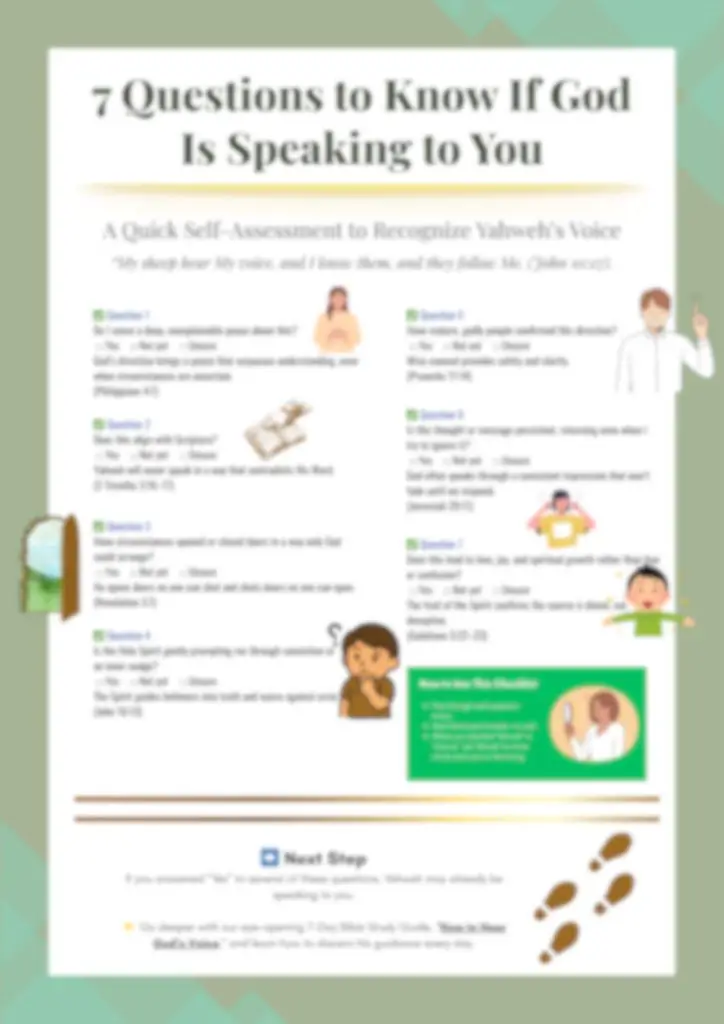
3. Discern
But even when something sounds spiritual and appears to agree with Scripture, we should still exercise discernment.
Not every thought that enters your mind is from God.
Not every opportunity is divine direction.
Not every coincidence is a sign.
Not every strong emotion is spiritual confirmation.
And not every closed door means God said no.
This is where discernment becomes incredibly important.
John wrote:
“Beloved, do not believe every spirit, but test the spirits, whether they are of God.”
1 John 4:1, NKJV
Notice the command: test.
Biblical faith doesn’t require us to switch off our judgment.
God wants us to grow in spiritual maturity.
That means learning to examine what we hear rather than automatically accepting every impression as divine.
Hearing God Is More Than Waiting for a Voice
One of the biggest misconceptions about hearing God is that we should expect an audible voice.
God certainly can communicate in extraordinary ways. Scripture records dreams, visions, angelic messages, prophetic revelation, and other remarkable encounters.
But we should not build our entire understanding of hearing God around extraordinary experiences.
God has already given us His written Word.
He has revealed His character and His will through Scripture.
He has given us principles that can guide our decisions.
And He expects His people to grow in wisdom and discernment.
Sometimes the most mature question isn’t:
“Did God give me a sign?”
It is:
“What does God’s Word teach me, and am I willing to obey it?”
That changes everything.
What If You’re Afraid of Getting It Wrong?
This is where many sincere Christians become paralyzed.
They think:
“What if I misunderstand God?”
“What if this is just my imagination?”
“What if I make the wrong decision?”
Those are legitimate concerns.
But fear shouldn’t drive you into spiritual paralysis.
Instead, let it drive you toward deeper knowledge of Scripture, prayer, humility, wisdom, and discernment.
You don’t need to become obsessed with decoding every thought or coincidence.
You need to become increasingly familiar with God’s ways.
The goal isn’t to become someone who sees a supernatural message in everything.
The goal is to become someone who knows God’s Word so well, seeks Him so sincerely, and develops such spiritual discernment that you become increasingly sensitive to His direction.

Start Listening Differently Today
Try something simple today.
Set aside a few quiet minutes.
Put away the distractions.
Open your Bible.
Pray honestly.
Then ask yourself:
“Am I actually willing to obey God if His answer isn’t the one I want?”
That’s an important question.
Because sometimes our biggest problem isn’t that we can’t hear.
It’s that we don’t really want to hear anything that challenges our plans.
Jesus said:
“If anyone wills to do His will, he shall know concerning the doctrine, whether it is from God…”
John 7:17, NKJV
A willing heart makes a tremendous difference.
Hearing God’s voice isn’t about chasing mysterious experiences.
It is about learning to recognize God’s direction, testing what you believe you hear, grounding yourself in Scripture, and developing the humility to follow where He leads.
And that is a skill you can grow in.
Want to Learn How to Hear God’s Voice?
If you’ve ever prayed, “God, I want to hear You, but I don’t know how,” I created something specifically for you.
My online course, How to Hear God’s Voice, is designed to help you go deeper into this subject through articles, podcasts, and videos that explore how God guides His people and how you can develop greater discernment when seeking His direction.

You don’t have to remain confused every time you wonder, “Is God speaking to me?”
You can learn how to approach God’s guidance with greater biblical understanding, wisdom, and discernment.
Join How to Hear God’s Voice today and begin learning how to listen differently.
Your relationship with God isn’t meant to be one-sided.
Learn to listen. Learn to discern. Learn to follow.
Discover more from Becoming Christians
Subscribe to get the latest posts sent to your email.