Have you ever asked your child to pray, only to hear, “I don’t want to”?
Maybe your child gets distracted. Maybe they think prayer is boring. Maybe they would rather play, watch something, or do anything else.
As a Christian parent, this can be discouraging.
You want your child to know God. You want them to develop a personal relationship with Him. You want prayer to become a natural part of their life, not something they do only because Mom or Dad told them to.
So what should you do when your child doesn’t want to pray?
Don’t panic. And don’t give up.
Your goal isn’t simply to make your child pray. Your goal is to help your child understand why prayer matters and learn to desire a relationship with God.
The Bible gives Christian parents a beautiful responsibility:
“And these words which I command you today shall be in your heart. You shall teach them diligently to your children.”
Deuteronomy 6:6-7, NKJV
Teaching children about God is not a one-time conversation. It is a process that happens through everyday life.
Here are practical ways you can help your child develop a genuine desire to pray.
📢 As a parent, you have a unique opportunity to influence your child and guide them toward becoming a child of God. But how do you do it intentionally and biblically? Join our online Bible study course, How to Raise Godly Children, and discover practical, Bible-based principles you can apply at home. You can start for free today!

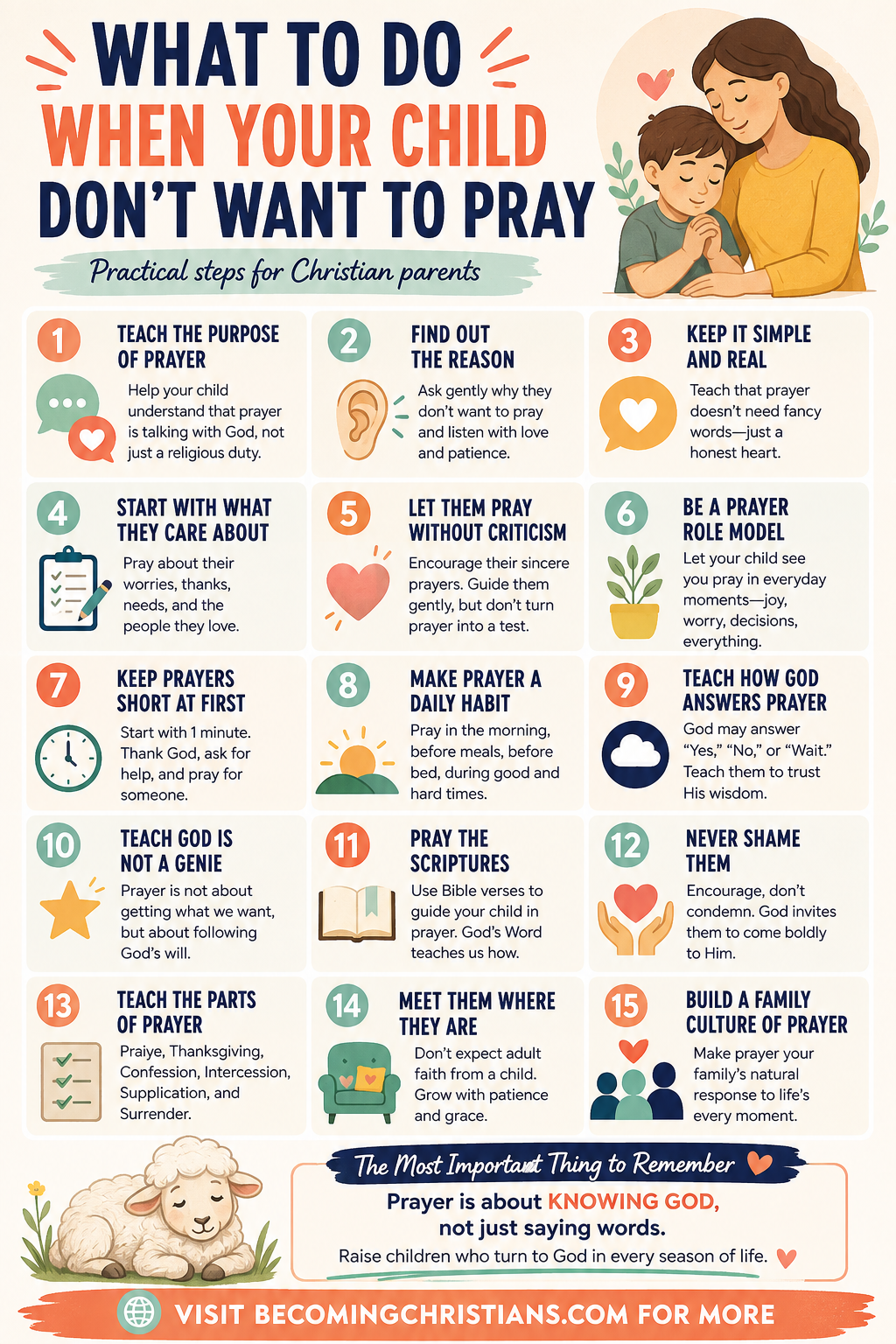
1. Don’t Force Prayer Without Teaching Its Purpose
One of the biggest mistakes parents can make is treating prayer like a religious obligation.
“Pray because you’re supposed to.”
“Close your eyes.”
“Say your prayer.”
“Don’t forget to pray.”
While discipline and routine have their place, children also need to understand why they pray.
Prayer is not merely reciting words to God.
Prayer is communication with our Creator.
Jesus taught His disciples to pray because prayer is an essential part of our relationship with God.
When your child understands that prayer is an opportunity to talk to God, thank Him, ask for His help, confess sins, seek wisdom, and develop a relationship with Him, prayer can become much more meaningful.
Instead of saying:
“You need to pray.”
Try saying:
“Let’s talk to God about what happened today.”
That small change can make prayer feel less like a chore and more like a relationship.
2. Find Out Why Your Child Doesn’t Want to Pray
Before correcting the behavior, discover the reason behind it.
Your child may not want to pray for several different reasons.
Perhaps prayer feels boring.
Perhaps they don’t know what to say.
Perhaps they are embarrassed about praying aloud.
Perhaps they think God is distant.
Perhaps they have unanswered questions about God.
Perhaps they associate prayer with long, repetitive family prayers.
Perhaps they simply want to play.
Or perhaps there is something deeper going on in their heart.
Ask your child gently:
“What makes you not want to pray?”
Then listen.
Don’t immediately correct them.
Don’t lecture.
Don’t tell them why their answer is wrong.
Listen.
You may discover that the problem isn’t rebellion at all. Your child may simply need someone to teach them how to pray.
3. Teach Your Child That Prayer Isn’t About Using Fancy Words
Children sometimes think they need to sound religious when they pray.
They may hear adults saying long prayers and conclude that prayer requires complicated words.
Jesus taught something very different.
“And when you pray, do not use vain repetitions as the heathen do. For they think that they will be heard for their many words.”
Matthew 6:7, NKJV
God isn’t impressed by the length of a prayer.
He wants sincerity.
Teach your child that they can talk to God simply.
For example:
“Father, thank You for today.”
“Please help me because I’m scared.”
“Please forgive me for what I did.”
“Thank You for Mom and Dad.”
“Please help me understand Your Word.”
Simple prayers can be genuine prayers.
Your child doesn’t need to sound like a pastor.
They need to learn to speak honestly to God.

4. Start With What Your Child Cares About
One of the easiest ways to make prayer relevant is to connect it to your child’s everyday life.
Ask:
“What are you worried about?”
Pray about it.
“What are you thankful for?”
Thank God for it.
“Who needs help?”
Pray for that person.
“What are you looking forward to?”
Bring it before God.
“Did something make you angry today?”
Talk to God about it.
This teaches an important lesson:
God isn’t only interested in church-related things.
God cares about the details of our lives.
Peter wrote:
“Casting all your care upon Him, for He cares for you.”
1 Peter 5:7, NKJV
When children discover that they can bring their fears, frustrations, hopes, questions, and gratitude to God, prayer becomes much more relevant.
Best Christian Parenting Books in August 2026



5. Don’t Make Every Prayer a Correction Session
Imagine a child finally agrees to pray.
They begin:
“God, thank You for today…”
Then the parent interrupts:
“Don’t pray like that.”
“Speak louder.”
“That’s not how you say it.”
“Don’t forget to thank God for this.”
“Keep your eyes closed.”
The child eventually learns something unfortunate:
Prayer is a performance.
Instead, allow your child to learn.
If their prayer is sincere and biblically appropriate, let them pray.
You can teach them gradually.
There is a time for instruction, but there is also a time to simply let your child talk to God.
Remember, you’re not training your child to perform prayer correctly.
You’re helping your child develop a relationship with God.
6. Let Your Child See You Pray
Perhaps the most powerful prayer lesson you can give your children is not a lesson at all.
Let them see you pray.
Your children should see that prayer isn’t something you only do when you’re teaching them.
Pray when you’re thankful.
Pray when you’re worried.
Pray when you need wisdom.
Pray when someone is sick.
Pray when something wonderful happens.
Pray when you’re struggling.
Let your children hear you say:
“Let’s ask God for wisdom.”
“Let’s thank God for providing for us.”
“Let’s pray for your friend.”
“I don’t know what to do, so I’m going to ask God to guide me.”
Your children are watching.
They are learning what Christianity looks like by observing your life.
Paul told Timothy:
“But you have carefully followed my doctrine, manner of life, purpose, faith, longsuffering, love, perseverance.”
2 Timothy 3:10, NKJV
Christianity is taught through words, but it is also demonstrated through example.

7. Make Prayer Short
If your child struggles with prayer, don’t begin with a 30-minute prayer session.
Start small.
Try one minute.
Ask your child to mention:
- One thing they’re thankful for.
- One thing they need help with.
- One person they want to pray for.
That’s it.
Over time, their prayers may naturally become longer.
Remember:
The goal isn’t to make your child pray longer. The goal is to help your child pray sincerely.
A short, heartfelt prayer is better than a long prayer spoken only because a child is afraid of punishment.
8. Make Prayer a Natural Part of Everyday Life
Prayer doesn’t have to happen only before bedtime.
Pray when you wake up.
Pray before meals.
Pray before traveling.
Pray before an important exam.
Pray after receiving good news.
Pray when your child is afraid.
Pray when your family has a problem.
Pray when someone needs encouragement.
This helps children understand that prayer isn’t confined to a particular place or time.
Paul instructed Christians:
“Pray without ceasing.”
1 Thessalonians 5:17, NKJV
That doesn’t mean we must literally spend every second speaking words of prayer.
It means we should cultivate a life that continually turns toward God.
Teach your child to develop that habit early.
9. Teach Your Child How God Answers Prayer
Children can become discouraged when they pray for something and don’t immediately receive what they want.
They might think:
“God didn’t answer my prayer.”
This is an important opportunity to teach them about God’s sovereignty.
God may answer:
Yes.
No.
Wait.
Sometimes God changes our circumstances.
Sometimes He changes us.
Sometimes He gives us strength to endure circumstances we wanted Him to remove.
Help your child understand that prayer isn’t a method of getting everything we want from God.
Prayer is about trusting God.
Jesus Himself demonstrated this when He prayed before His crucifixion:
“Nevertheless, not My will, but Yours, be done.”
Luke 22:42, NKJV
That’s a profound lesson for children.
We can ask God boldly while still trusting His wisdom.
10. Teach Your Child That God Isn’t a Genie
Children naturally tend to think in terms of getting what they want.
If they pray:
“God, please give me this toy.”
And they don’t receive it, they might conclude that prayer doesn’t work.
This is why parents need to teach children that God isn’t a cosmic vending machine.
Prayer isn’t:
“God, give me what I want.”
Prayer is:
“God, help me know and follow Your will.”
As your child grows, teach them to pray not only for things but also for character.
Pray:
“Father, help me be patient.”
“Help me forgive.”
“Help me obey.”
“Help me tell the truth.”
“Help me love others.”
“Help me understand Your Word.”
These prayers move your child’s attention from merely what God can give them to who God wants them to become.
11. Teach Them to Pray From the Bible
One of the best ways to teach children how to pray is to teach them to pray Scripture.
For example, after reading Psalm 23, you could pray:
“Father, thank You for being my Shepherd. Help me trust You and follow You wherever You lead me.”
After reading Proverbs 3:5-6:
“Father, help me trust You with all my heart and not depend only on what I understand. Please guide my decisions.”
After reading Philippians 4:6:
“Father, help me bring my worries to You instead of being controlled by anxiety.”
This teaches children two important things at the same time:
how to read the Bible and how to pray.
The Bible gives us the language and foundation for a healthy prayer life.
12. Don’t Shame Your Child for Struggling
Be careful with statements like:
“You’re a bad Christian because you don’t pray.”
“God must be disappointed in you.”
“If you really loved God, you’d want to pray.”
These statements can produce fear and guilt rather than genuine faith.
Your child needs to understand that God is holy, but they also need to understand that they can approach Him honestly.
Hebrews says:
“Let us therefore come boldly to the throne of grace, that we may obtain mercy and find grace to help in time of need.”
Hebrews 4:16, NKJV
Your child may struggle with prayer today and develop a beautiful prayer life later.
Don’t confuse spiritual growth with instant perfection.
Give them instruction.
Give them patience.
Give them an example.
And most importantly, keep pointing them toward God.
13. Teach Them That Prayer Is More Than Asking for Things
A mature prayer life contains more than requests.
Teach your children different elements of prayer:
Praise
“Father, You are good and worthy of praise.”
Thanksgiving
“Thank You for providing for our family.”
Confession
“Please forgive me for lying.”
Intercession
“Please help Grandma.”
Supplication
“Please give me wisdom for my test.”
Surrender
“Help me follow Your will even when it isn’t what I want.”
When children learn these different aspects of prayer, prayer becomes richer and more meaningful.
14. Don’t Expect Your Child to Have Your Faith
This is an important lesson for parents.
Your child isn’t you.
They are developing their own understanding of God.
You may have spent decades reading Scripture, praying, worshiping, and learning about God.
Your child may only be beginning.
Don’t expect a five-year-old to pray like an adult.
Don’t expect a teenager to have the same spiritual maturity as their parents.
Meet them where they are.
Jesus said:
“Let the little children come to Me, and do not forbid them; for of such is the kingdom of heaven.”
Matthew 19:14, NKJV
Your responsibility is to lead them toward Christ, not to manufacture spiritual maturity overnight.
15. Build a Family Culture of Prayer
Ultimately, prayer should become part of the culture of your home.
Imagine a home where children grow up hearing:
“Let’s pray about it.”
Someone is sick?
“Let’s pray.”
There’s a difficult decision?
“Let’s pray.”
Someone receives a blessing?
“Let’s thank God.”
Someone is struggling?
“Let’s ask God to help them.”
A family member makes a mistake?
“Let’s ask God for forgiveness and wisdom.”
When prayer becomes the family’s natural response to life, children begin to internalize it.
They learn:
When life happens, we turn to God.
That may become one of the most valuable lessons you ever teach your child.
What If Your Child Still Refuses to Pray?
There may be seasons when your child simply refuses.
Don’t turn every refusal into a battle.
Continue teaching.
Continue modeling.
Continue inviting.
Continue praying for your child.
And remember something important:
You can guide your child’s spiritual development, but you cannot manufacture genuine faith.
Salvation and faith ultimately involve the individual’s response to God.
Your job as a parent is to faithfully plant and water.
Paul wrote:
“I planted, Apollos watered, but God gave the increase.”
1 Corinthians 3:6, NKJV
This should give Christian parents both responsibility and peace.
You plant.
You water.
You teach.
You model.
You pray.
God gives the increase.
The Most Important Thing You Can Teach Your Child About Prayer
If you could teach your child only one thing about prayer, teach them this:
Prayer is not merely something Christians do. Prayer is part of knowing God.
Your child doesn’t need to become a prayer expert.
They need to learn to turn toward God.
When they’re afraid, turn to God.
When they’re thankful, turn to God.
When they sin, turn to God.
When they need wisdom, turn to God.
When they don’t understand something, turn to God.
When life is difficult, turn to God.
When life is beautiful, turn to God.
The goal isn’t simply to raise children who know how to pray.
The goal is to raise children who know the God to whom they pray.
And that takes more than teaching children a bedtime prayer.
It takes intentional parenting.
It takes biblical instruction.
It takes consistent example.
It takes patience.
And it takes a parent who is committed to leading their family toward God.
Want to Raise Children Who Truly Follow God?
If you’re serious about raising godly children, you probably already know that good intentions aren’t enough.
You need biblical principles you can actually apply in your home.
That’s why I created How to Raise Godly Children, an online Bible study course designed to help Christian parents intentionally guide their children toward a life centered on God.
Instead of simply telling your children to “be good” or “go to church,” you’ll learn practical, Bible-based principles for helping your children develop faith, character, discipline, godly habits, and a genuine relationship with God.
And you don’t have to figure it all out alone.
If you want to become a more intentional Christian parent and learn how to raise children who don’t merely know about God but learn to follow Him, I invite you to join the course today.
Start free, learn at your own pace, and begin building a stronger spiritual foundation for your family.
👉 Start the How to Raise Godly Children Bible Study Course for Free today.
Because one of the greatest gifts you can give your child isn’t wealth, possessions, or worldly success.
It’s teaching them how to know, love, trust, and follow God.
Discover more from Becoming Christians
Subscribe to get the latest posts sent to your email.