One of the most common questions Christians ask is, Did Jesus go to hell after He died? Many churches teach that after His crucifixion, Jesus descended into hell to preach to the dead, defeat Satan, or rescue righteous believers.
But is that really what the Bible says?
The answer depends on whether we are willing to let Scripture define its own terms instead of relying on centuries of tradition. When we carefully examine the biblical evidence, we discover that Jesus did not spend three days in a place of fiery torment. Instead, He experienced exactly what He said He would: death.

Why Do Many Christians Believe Jesus Went to Hell?
This belief is often based on a few passages that are interpreted through the lens of later church tradition, particularly:
- Acts 2:27
- Ephesians 4:8-10
- 1 Peter 3:18-20
- The Apostles’ Creed (“He descended into hell”)
However, before examining these passages, we must first answer an important question.
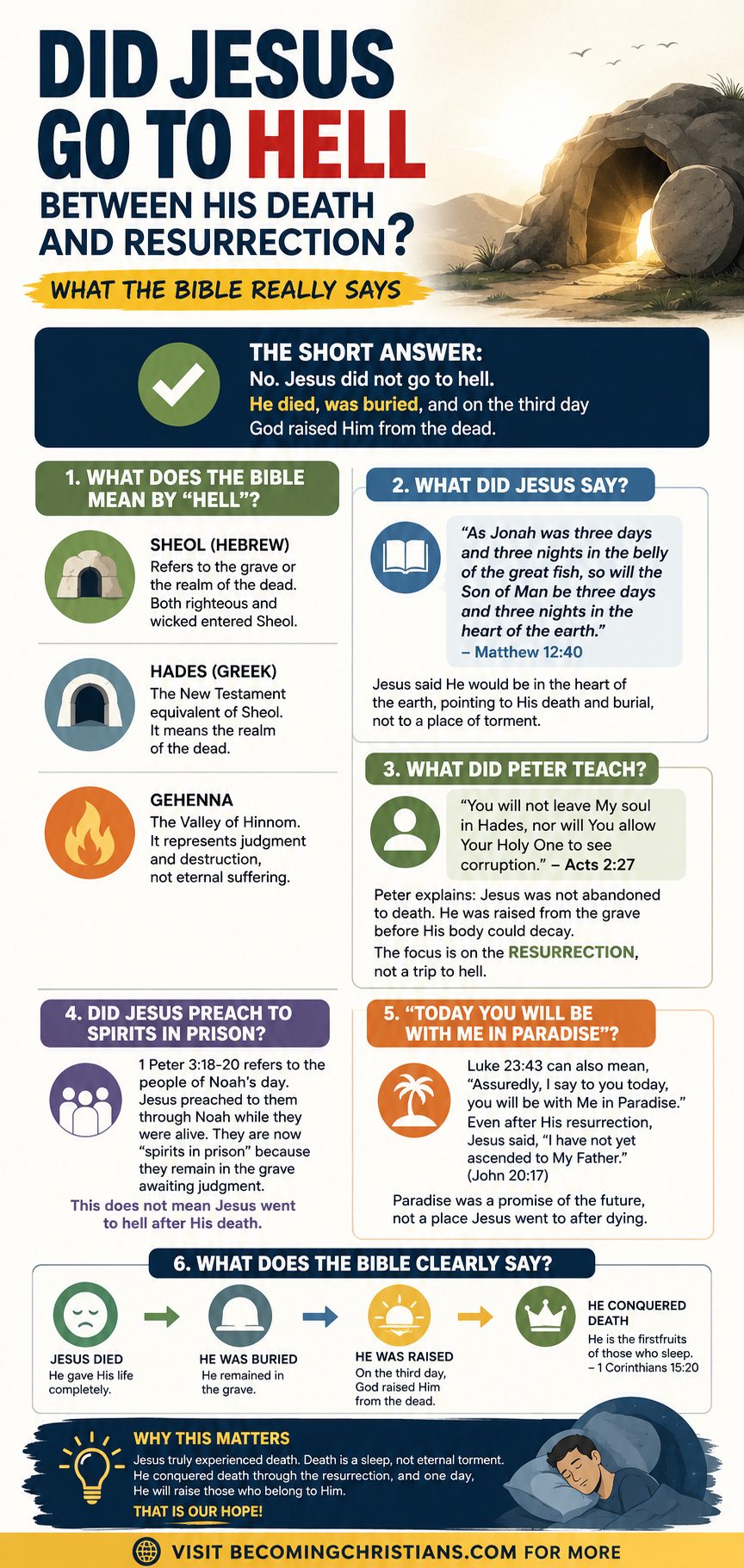
What Does the Bible Mean by “Hell”?
One of the biggest causes of confusion is that our English Bibles translate several different Hebrew and Greek words as “hell.”
These words do not all mean the same thing.
Sheol (Hebrew)
In the Old Testament, the word Sheol simply refers to the grave or the realm of the dead.
Jacob expected to go there (Genesis 37:35).
Job expected to go there (Job 14:13).
David expected to go there (Psalm 89:48).
Both righteous and wicked were said to enter Sheol because it simply meant death or the grave.
Hades (Greek)
The New Testament equivalent of Sheol is Hades.
Like Sheol, it refers to the realm of the dead, not a place where immortal souls are consciously suffering.
Gehenna
Jesus also spoke about Gehenna, which referred to the Valley of Hinnom outside Jerusalem, a place associated with judgment and destruction.
Gehenna is never described as a place where people remain alive forever while suffering. Instead, it symbolizes complete destruction of the wicked.
Recognizing these distinctions changes the way we understand many passages.
What Did Jesus Say Would Happen After His Death?
Jesus compared His coming death to Jonah.
“For as Jonah was three days and three nights in the belly of the great fish, so will the Son of Man be three days and three nights in the heart of the earth.” (Matthew 12:40, NKJV)
Notice that Jesus said He would be in the heart of the earth, not in a fiery place of torment.
The expression points to His burial and death.
Throughout Scripture, death is repeatedly described as sleep.
Jesus said Lazarus had “fallen asleep” before explaining plainly that Lazarus had died (John 11:11-14).
If death is a state of unconsciousness until the resurrection, then Jesus truly experienced death just as every human does.
Peter Explains Where Jesus Was
The clearest passage is Acts 2.
Peter quotes Psalm 16:
“For You will not leave my soul in Hades, nor will You allow Your Holy One to see corruption.” (Acts 2:27, NKJV)
Many assume this means Jesus went to a burning hell.
But Peter immediately explains his meaning.
David’s body remained in the grave, but Jesus was raised before His body decayed (Acts 2:29-32).
“Hades” here simply means the grave.
Jesus was not abandoned to death.
He was resurrected from it.
Peter says nothing about Jesus preaching in hell, battling demons, or rescuing souls.
Instead, his entire emphasis is on the resurrection.
Did Jesus Preach to Spirits in Prison?
Perhaps the most debated passage is 1 Peter 3:18-20.
Some conclude that Jesus descended into hell after His death and preached to the dead.
However, notice what Peter actually says.
He speaks about the people who were disobedient during the days of Noah.
Throughout Scripture, Noah is described as “a preacher of righteousness” (2 Peter 2:5).
The natural reading is that Christ, through the Holy Spirit, preached to those people during Noah’s lifetime.
Those people are now “spirits in prison” because they remain in the grave awaiting the resurrection and judgment.
The passage does not require Jesus to have traveled into hell between His death and resurrection.

What About “Today You Will Be With Me in Paradise”?
Another frequently cited verse is Luke 23:43.
“Assuredly, I say to you, today you will be with Me in Paradise.”
The difficulty is that ancient Greek manuscripts did not contain commas.
The punctuation was added centuries later.
The sentence can also be understood as:
“Assuredly, I say to you today, you will be with Me in Paradise.”
This understanding fits the rest of Scripture.
Even after His resurrection, Jesus told Mary:
“I have not yet ascended to My Father.” (John 20:17, NKJV)
If Jesus had not yet gone to the Father on Sunday morning, then Paradise could not have been where He went immediately after dying on Friday.
Did Jesus Go Anywhere While Dead?
The Bible consistently presents Jesus as truly dead.
He did not merely appear dead.
He gave His life completely.
Scripture repeatedly says that He:
- died for our sins (1 Corinthians 15:3)
- was buried (1 Corinthians 15:4)
- remained in the grave
- was raised on the third day
His victory over death came through the resurrection, not because He remained conscious somewhere else.
Paul even says:
“If Christ is not risen, your faith is futile.” (1 Corinthians 15:17, NKJV)
The resurrection, not a descent into hell, is the centerpiece of the gospel.
Why This Matters
This question is about much more than where Jesus spent three days.
It concerns what the Bible teaches about death itself.
If Jesus truly experienced death, then death is exactly what Scripture repeatedly describes: an unconscious state from which only God can awaken us through the resurrection.
That makes Christ’s victory even more glorious.
He entered the same condition every human enters.
He fully experienced death.
Then the Father raised Him to immortal life, becoming “the firstfruits of those who have fallen asleep” (1 Corinthians 15:20).
Because He conquered death, those who belong to Him can look forward with confidence to their own resurrection when He returns.
Final Thoughts
Did Jesus go to hell between His death and resurrection?
The biblical evidence points to a different conclusion.
Jesus did not descend into a place of eternal torment. He died, was buried, remained in the grave, and on the third day God raised Him from the dead.
The words translated “hell” in many English Bibles often refer simply to the grave or the realm of the dead, not to conscious punishment. When these terms are understood in their biblical context, the apparent contradictions disappear.
The good news of the gospel is not that Jesus escaped death by remaining conscious elsewhere. It is that He truly died for our sins and then triumphed over death through His resurrection.
That is the hope He offers every believer: not immediate life after death, but the promise that those who have fallen asleep in Him will one day hear His voice and rise again to everlasting life.

About the Author
Joshua Infantado is a Christian blogger and Bible teacher who has been writing faith-based content since 2013. He is the founder of Becoming Christians, where he shares blogs, books, videos, and online courses to help believers grow in truth and grace. Joshua lives in Davao City, Philippines, with his wife, Victoria, and their son, Caleb. Contact him at joshuainfantado@gmail.com.
Discover more from Becoming Christians
Subscribe to get the latest posts sent to your email.