How can anyone possibly pray without ceasing? Does God expect us to spend every waking moment with our eyes closed and our heads bowed?
After all, we have jobs to do, families to care for, meals to prepare, errands to run, and responsibilities that demand our attention. If God expects Christians to pray every second of every day, then this may be one of the most impossible commands in the entire Bible.
Yet the apostle Paul did not present it as a suggestion. He wrote it as a clear instruction:
“Pray without ceasing” (1 Thessalonians 5:17, NKJV).
So what did Paul mean?
Was he speaking literally? Are believers expected to remain in a nonstop state of verbal prayer twenty four hours a day? Or was he describing something deeper and more practical?
The answer is both freeing and life changing.
Far from placing an impossible burden on Christians, this command invites us into something beautiful: a continual relationship with God that extends beyond church services, devotional time, and mealtime prayers. It is about learning to live every moment with an awareness of God’s presence and a heart that remains open to Him.
In this article, we will explore what “pray without ceasing” really means, why Paul commanded it, and how ordinary believers can practice it in everyday life.

Where Does the Phrase “Pray Without Ceasing” Come From?
The phrase comes from Paul’s first letter to the Thessalonian believers:
“Rejoice always, pray without ceasing, in everything give thanks; for this is the will of God in Christ Jesus for you” (1 Thessalonians 5:16-18, NKJV).
These words appear near the end of Paul’s letter as part of a series of short but powerful instructions for Christian living. Rather than discussing theology in the abstract, Paul was teaching believers how faith should shape everyday life.
Notice that “pray without ceasing” is sandwiched between two other commands:
- Rejoice always.
- In everything give thanks.
This is not accidental.
Paul was painting a picture of a God-centered life. Joy, prayer, and gratitude are not separate spiritual activities that we practice only during worship services or quiet devotional moments. They are attitudes that should flow continuously through the life of a believer.
A Christian who rejoices in God naturally wants to speak with Him. A Christian who regularly speaks with God naturally becomes more grateful for His blessings. Likewise, a thankful heart often overflows into praise and prayer.
The three commands work together like strands in a rope, each strengthening the others.
Prayer, then, is not meant to be an isolated religious exercise performed at certain hours of the day. It is meant to become part of the rhythm of life itself, woven into our joys, our struggles, our decisions, and our daily routines.
This is the foundation for understanding what Paul meant when he told believers to pray without ceasing.
What Does “Pray Without Ceasing” Mean?
When many people first read Paul’s command to “pray without ceasing,” they imagine a believer spending every waking hour on his knees with folded hands and closed eyes. But that cannot be what Paul meant.
If taken literally in that sense, Christians would be unable to work, raise children, sleep, eat, or fulfill any of their responsibilities. The Bible never teaches believers to withdraw from the world and spend all their time in isolated religious activity.
Praying without ceasing does not mean:
- Praying verbally twenty four hours a day.
- Neglecting work, family, or daily responsibilities.
- Retreating to a monastery or living in complete isolation from society.
So what did Paul mean?
The answer becomes clearer when we examine the Greek word translated “without ceasing.” The word is adialeiptos, which carries the idea of something occurring repeatedly and continually rather than happening every single second without interruption.
One Bible commentator compared it to a persistent cough. A person with a cough does not cough every second of the day, but the cough keeps returning again and again throughout the day.
That is the picture Paul had in mind.
Praying without ceasing means maintaining continual fellowship with God. It means developing an ongoing awareness of His presence and regularly turning our thoughts, concerns, joys, fears, and gratitude into prayers.
Instead of limiting prayer to a few scheduled moments each day, prayer becomes a continual conversation with our Creator.
You thank God for a beautiful sunrise.
You ask for wisdom before making a difficult decision.
You pray for protection while traveling.
You silently ask for patience when dealing with a difficult situation.
You praise God after receiving an unexpected blessing.
Throughout the day, your heart continually returns to God.
Brother Lawrence, a seventeenth century Christian known for his deep devotion, described it as practicing the presence of God. Whether washing dishes or performing ordinary tasks, he sought to remain consciously aware that God was with him.
That captures the spirit of Paul’s command.
Prayer is not merely an activity we perform. It becomes an atmosphere in which we live.
| Pray Without Ceasing Is… | Pray Without Ceasing Is Not… |
|---|---|
| Maintaining continual fellowship with God | Verbally praying every second of the day |
| Frequently turning thoughts into prayers | Neglecting work or family responsibilities |
| Living with an awareness of God’s presence | Living in isolation or a monastery |
| Bringing concerns to God throughout the day | Repeating formal prayers endlessly |
| Depending on God in everyday situations | Spending all day on your knees |
| Talking to God naturally and regularly | Using complicated religious language |
| Making prayer a lifestyle | Limiting prayer to church services or mealtimes |
You should also read:
Why Does God Want Us to Pray Without Ceasing?
God never gives commands simply to make life harder. Every instruction He gives is for our good and for His glory. The command to pray without ceasing is no exception.
A. Prayer Keeps Us Dependent on God
Human nature pushes us toward self reliance.
When life is going well, it is easy to believe we can manage on our own. We trust our intelligence, our experience, our finances, or our abilities. Unfortunately, self reliance often pushes God to the margins of our lives.
Continual prayer does the opposite.
Every prayer, no matter how short, is an admission that we need God.
“Father, give me wisdom.”
“Lord, help me respond with patience.”
“Please guide my decision.”
These simple prayers remind us that we are not self sufficient creatures but dependent children relying on a loving Father.
Prayer shifts us from independence to dependence and from pride to humility.
B. Prayer Protects Us from Anxiety
One of the greatest antidotes to worry is prayer.
Paul wrote:
“Be anxious for nothing, but in everything by prayer and supplication, with thanksgiving, let your requests be made known to God; and the peace of God, which surpasses all understanding, will guard your hearts and minds through Christ Jesus” (Philippians 4:6-7, NKJV).
Notice the exchange that God offers.
We give Him our worries.
He gives us His peace.
People who pray only occasionally often carry burdens they were never meant to carry alone. But those who continually bring their concerns to God learn to release their fears into His hands.
The result is not always immediate answers, but often immediate peace.
C. Prayer Strengthens Our Relationship With God
Every healthy relationship depends upon communication.
Imagine a husband who speaks to his wife for only five minutes every Sunday morning. Or a friend who contacts you only when he needs a favor.
No relationship can thrive under those conditions.
The same is true spiritually.
God desires more than occasional conversations during church services or before meals. He desires an ongoing relationship with His children.
The more we speak with God throughout the day, the more natural our relationship with Him becomes.
Prayer moves from feeling like a religious duty to becoming the joyful communication of a close friendship.
D. Prayer Helps Us Stay Spiritually Alert
The Christian life is not lived on neutral ground. Scripture repeatedly reminds believers that spiritual battles are taking place around us.
That is why Paul wrote:
“Praying always with all prayer and supplication in the Spirit, being watchful to this end with all perseverance and supplication for all the saints” (Ephesians 6:18, NKJV).
Prayer keeps us spiritually awake.
It sharpens our sensitivity to temptation.
It helps us recognize God’s guidance.
It strengthens us against discouragement and compromise.
Soldiers on a battlefield cannot afford to fall asleep while the enemy is nearby. In the same way, believers who neglect prayer often become spiritually vulnerable.
Continual prayer keeps our hearts watchful, our minds focused, and our spirits prepared for whatever challenges may come.
Improve your prayer life with this FREE Downloadable GUIDE!
What Does Praying Without Ceasing Look Like in Real Life?
Understanding the meaning of “pray without ceasing” is one thing. Learning to practice it is another.
Fortunately, continual prayer is far simpler and more practical than many people imagine. It is less about spending more hours on your knees and more about inviting God into the ordinary moments of everyday life.
For many believers, prayer happens only during morning devotions, before meals, and at bedtime. Paul’s instruction invites us to go much further than that.
Imagine what your day could look like if prayer became a constant companion.
While driving to work, you notice a beautiful sunrise and quietly say, “Thank You, Father, for another day.”
Before an important meeting, interview, or difficult conversation, you whisper, “Please give me wisdom and help me say the right words.”
You pass an ambulance with its siren blaring and immediately pray for the injured person inside and for the medical workers caring for them.
You see a stressed cashier, an exhausted parent, or a struggling coworker and silently ask God to bless and strengthen them.
During moments of frustration, anger, or disappointment, you pause and pray, “Lord, help me respond with grace.”
When temptation appears, instead of relying on your own strength, you immediately turn to God: “Father, help me overcome this.”
When unexpected blessings arrive, whether a financial provision, answered prayer, or encouraging conversation, your first response becomes praise rather than entitlement.
At the end of the day, before sleep takes over, you review the day with gratitude and thank God for His guidance, protection, and provision.
This is what praying without ceasing looks like.
Prayer becomes less like a scheduled appointment and more like an ongoing conversation.
Just as a loving husband and wife communicate throughout the day through conversations, messages, and simple check ins, believers are invited to maintain continual communication with their heavenly Father.
The goal is not nonstop words.
The goal is continual connection.
Biblical Examples of People Who Practiced Continual Prayer
The command to pray without ceasing may sound difficult, but Scripture provides numerous examples of people who lived lives marked by continual communication with God.
Daniel: Faithful Prayer Even Under Pressure
Daniel is perhaps the Bible’s greatest example of consistency in prayer.
Even after a royal decree made prayer illegal, Daniel continued his regular practice of praying three times each day with his windows open toward Jerusalem (Daniel 6:10).
His circumstances changed.
His government changed.
The risks increased dramatically.
But his prayer life remained unchanged.
Daniel teaches us that continual prayer is not built during crises. It is built through daily habits long before crises arrive.
Nehemiah: Quick Prayers in the Middle of Work
Not all prayers need to be long.
When King Artaxerxes asked Nehemiah why he looked troubled, Nehemiah silently prayed before answering the king:
“So I prayed to the God of heaven. And I said to the king…” (Nehemiah 2:4-5, NKJV).
The prayer may have lasted only seconds.
Yet it demonstrates exactly what Paul later described in 1 Thessalonians 5:17.
Nehemiah turned immediately to God in the middle of a conversation, seeking wisdom before speaking.
Many of the most powerful prayers in our lives may be these brief, sincere cries for help.
David: A Life Filled With Conversation With God
The Psalms reveal a man who spoke with God constantly.
David prayed in moments of fear.
He prayed in moments of joy.
He prayed in repentance after sin.
He prayed while fleeing enemies.
He prayed in worship and thanksgiving.
For David, prayer was not an event. It was a lifestyle.
Reading the Psalms often feels less like reading formal prayers and more like listening to an ongoing conversation between a child and his Father.
Jesus Christ: The Perfect Example of Continual Prayer
No one demonstrated continual communion with God more perfectly than Jesus.
Again and again, the Gospels show Him withdrawing to pray, often early in the morning or late at night.
Before major decisions, before miracles, before His crucifixion, and during moments of intense pressure, Jesus turned to the Father in prayer.
His earthly life was characterized by continual dependence upon God.
If the sinless Son of God considered prayer essential, how much more should we?
Common Misunderstandings About Praying Without Ceasing
Because the phrase can sound overwhelming, many Christians misunderstand what Paul intended.
Myth #1: God Expects Believers to Pray Every Second
This is perhaps the most common misunderstanding.
God is not commanding believers to spend every moment speaking words of prayer. The command refers to a recurring pattern of communion with God rather than uninterrupted speech.
Continual prayer means repeatedly returning to God throughout the day.
Myth #2: Only Pastors, Missionaries, and Monks Can Obey This Command
Paul wrote these words to ordinary believers living ordinary lives.
The command was not limited to church leaders or people living in monasteries.
Parents can obey it.
Students can obey it.
Construction workers, business owners, nurses, drivers, teachers, and retirees can obey it.
Praying without ceasing is possible wherever life takes you.
Myth #3: Long Prayers Are Better Prayers
Some believers assume that spiritual maturity is measured by the length of their prayers.
Yet some of the most powerful prayers in Scripture were remarkably short.
Peter cried, “Lord, save me!”
Nehemiah offered a quick prayer before answering the king.
The tax collector simply prayed, “God, be merciful to me a sinner!”
God is not impressed by word count.
He listens to sincere hearts.
Myth #4: You Can Only Pray in Quiet Places
Certainly there is value in private prayer and solitude.
Jesus Himself sought quiet places to pray.
But prayer is not limited to churches, bedrooms, or prayer closets.
You can pray while driving.
You can pray while walking.
You can pray while cooking dinner, waiting in line, or sitting in a hospital waiting room.
God is just as present in ordinary places as He is in extraordinary ones.
Myth #5: You Must Use Special Words for God to Hear You
Many people avoid prayer because they believe they do not know the right words.
Fortunately, God is not evaluating grammar, vocabulary, or eloquence.
Prayer is conversation with your Father.
Simple prayers such as “Thank You,” “Help me,” “Guide me,” or “Forgive me” are precious in His sight.
God listens to genuine hearts, not polished speeches.
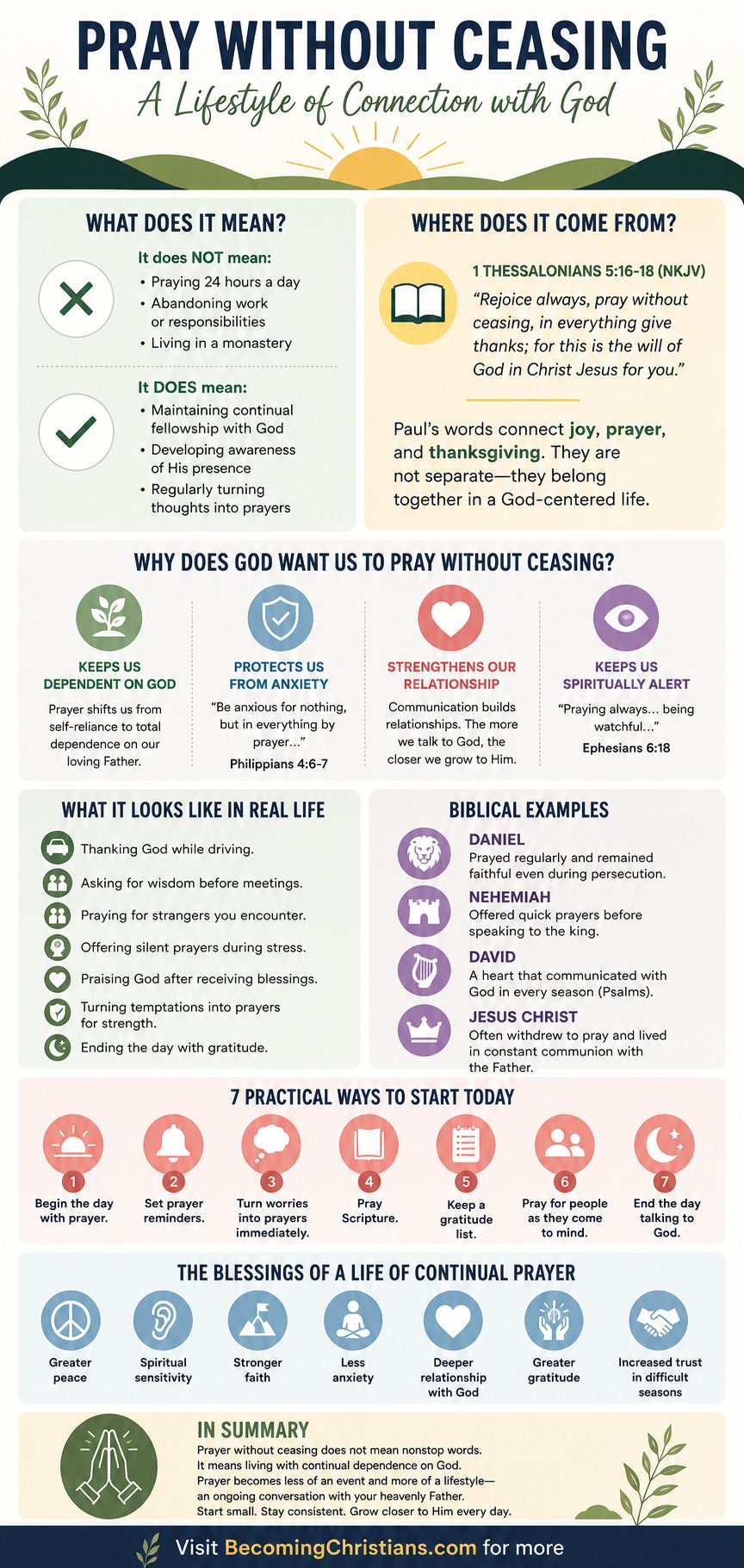
7 Practical Ways to Start Praying Without Ceasing Today
Understanding the concept of continual prayer is important, but eventually the question becomes practical: How do you actually begin?
The good news is that praying without ceasing does not require dramatic life changes. It simply requires intentionally inviting God into the moments that already fill your day.
Here are seven practical ways to begin.
1. Begin the Day With Prayer
Before reaching for your phone, checking your messages, or scrolling through social media, spend a few moments talking to God.
Thank Him for the gift of another day.
Commit your plans to Him.
Ask for wisdom, protection, and guidance.
Starting the day with prayer helps set the tone for everything that follows.
2. Set Prayer Reminders
Many of us remember meetings, deadlines, and appointments because our phones remind us.
Why not use technology to strengthen your prayer life?
Set reminders throughout the day that simply say:
- Pray.
- Give thanks.
- Trust God.
- Pray for someone.
These small prompts can gradually train your mind to return to God more frequently.
3. Turn Worries Into Prayers Immediately
Whenever anxiety appears, use it as a reminder to pray.
Worry and prayer often compete for the same space in our minds.
Every time a concern enters your thoughts, consciously hand it over to God.
Instead of replaying fears repeatedly, turn them into conversations with your Father.
If it is big enough to worry about, it is big enough to pray about.
4. Pray Scripture
One of the simplest ways to enrich your prayer life is to pray God’s own words back to Him.
When reading the Psalms, turn verses into personal prayers.
When reading promises in Scripture, thank God for them.
When reading commands, ask for the strength to obey them.
Scripture provides an endless source of inspiration for prayer.
5. Keep a Gratitude List
Gratitude naturally leads to prayer.
Keep a notebook or digital list of blessings, answered prayers, and moments of God’s faithfulness.
Reviewing these reminders regularly transforms complaints into thanksgiving and strengthens your awareness of God’s presence in your life.
6. Pray for People as They Come to Mind
Have you ever randomly thought about someone you have not seen in years?
Instead of assuming it is merely coincidence, use that moment as an opportunity to pray.
Pray for family members.
Pray for friends.
Pray for coworkers.
Pray for church leaders.
Pray for strangers you encounter throughout the day.
These short prayers gradually turn everyday moments into opportunities for ministry.
7. End the Day Talking to God
Just as many people begin the day with prayer, it is equally valuable to end the day with God.
Reflect on the victories and failures of the day.
Thank Him for His blessings.
Confess your shortcomings.
Entrust tomorrow into His hands.
Ending the day with prayer creates a beautiful rhythm of beginning and ending each day in God’s presence.
The Blessings of a Life of Continual Prayer
God does not command continual prayer merely because He wants us to perform more religious duties.
He invites us into a better way of living.
Believers who cultivate ongoing fellowship with God often experience remarkable spiritual blessings.
Greater Peace
Those who continually bring their burdens to God discover a peace that circumstances cannot easily shake.
The heart becomes calmer because it no longer carries every burden alone.
Greater Spiritual Sensitivity
Continual prayer sharpens our awareness of God’s guidance, conviction, and direction.
We become more attentive to His leading and more sensitive to spiritual realities around us.
Stronger Faith
Every answered prayer strengthens confidence in God’s faithfulness.
Over time, prayer becomes a record of God’s provision and care.
Less Anxiety
People who consistently release their worries to God often experience less fear and emotional exhaustion.
Prayer does not remove every problem, but it changes how we carry those problems.
A Deeper Relationship With God
Relationships grow through communication.
The more frequently we speak with God, the closer we grow to Him.
Eventually prayer becomes less about asking for things and more about enjoying His presence.
Greater Gratitude
Continual prayer opens our eyes to blessings we might otherwise overlook.
The ordinary becomes extraordinary when viewed through thankful eyes.
Increased Trust During Difficult Seasons
Storms come to every life.
But believers who have learned to depend on God daily often discover a deeper confidence in Him when hardship arrives.
Trust built in ordinary days becomes strength during difficult days.
Conclusion
Prayer without ceasing does not mean nonstop words or constant verbal prayers.
It means living with continual dependence upon God.
It means developing a heart that repeatedly turns toward Him throughout the day in gratitude, worship, requests, confession, and praise.
Prayer becomes less of an event and more of a lifestyle.
Less like an appointment on the calendar and more like an ongoing conversation with a loving Father.
The beauty of this command is that anyone can begin practicing it today.
You do not need a seminary degree.
You do not need hours of free time.
You simply need a willing heart that invites God into the ordinary moments of life.
Start small.
Thank God while driving.
Pray for someone while waiting in line.
Ask for wisdom before a difficult decision.
Offer praise after receiving a blessing.
Over time, those small moments become a habit.
And that habit becomes a way of life.
Frequently Asked Questions
What does “pray without ceasing” mean?
Praying without ceasing means maintaining continual fellowship with God and regularly turning your thoughts, concerns, and gratitude into prayer throughout the day.
Is it possible to pray without ceasing?
Yes. Paul was not commanding nonstop verbal prayer but encouraging believers to maintain an ongoing attitude of dependence and communication with God.
Is it possible to pray without ceasing?
Yes. Paul was not commanding nonstop verbal prayer but encouraging believers to maintain an ongoing attitude of dependence and communication with God.
Does praying without ceasing mean praying all day long?
No. The phrase refers to recurring prayer throughout the day rather than uninterrupted prayer every moment.
How can busy people pray without ceasing?
Busy people can pray while commuting, working, exercising, cooking, or performing daily tasks by turning ordinary moments into opportunities for conversation with God.
What is the Greek meaning of “without ceasing”?
The Greek word is adialeiptos, which means continual or recurring rather than absolutely uninterrupted.
What Bible verse says “pray without ceasing”?
The phrase appears in 1 Thessalonians 5:17: “Pray without ceasing” (NKJV).
How did Jesus pray continually?
Jesus regularly withdrew for prayer, prayed before major decisions, and maintained continual communion with the Father throughout His earthly ministry.
What is the difference between regular prayer and continual prayer?
Regular prayer often refers to scheduled times of prayer, while continual prayer describes an ongoing awareness of God and communication with Him throughout the day.
Can silent prayers count as prayer?
Absolutely. Many prayers in Scripture were spoken silently or internally. God hears the prayers of the heart as well as spoken words.
How can I develop a lifestyle of prayer?
Start with small habits such as beginning the day with prayer, praying for people as they come to mind, expressing gratitude regularly, and turning worries into prayers immediately. Over time, these habits create a lifestyle of continual prayer.

About the Author
Joshua Infantado is a Christian blogger and Bible teacher who has been writing faith-based content since 2013. He is the founder of Becoming Christians, where he shares blogs, books, videos, and online courses to help believers grow in truth and grace. Joshua lives in Davao City, Philippines, with his wife, Victoria, and their son, Caleb. Contact him at joshuainfantado@gmail.com.
Discover more from Becoming Christians
Subscribe to get the latest posts sent to your email.