John 3:16 meaning shows up on cardboard signs behind the end zone at football games. It’s printed on T-shirts, bumper stickers, and coffee mugs. Ask almost anyone, believer or not, to name a Bible verse, and John 3:16 is often the first one they recall.
But familiarity has a cost. When a verse becomes this well-known, it can start to feel like background noise — words we’ve heard so many times that we stop actually hearing them.
So it’s worth asking: have we become so used to John 3:16 that we’ve stopped listening to what it actually says?
This article takes a slower, deeper look — not just at what the verse says, but at the conversation that produced it, the specific words Jesus chose, and what those words are asking of us today.

John 3:16 (NKJV)
“For God so loved the world that He gave His only begotten Son, that whoever believes in Him should not perish but have everlasting life.”
Quick Answer: John 3:16 means that God loved humanity so deeply that He gave His Son, Jesus Christ, so that everyone who places their trust in Him and continues in that faith will receive eternal life instead of perishing. It is the Bible’s clearest summary of God’s love and His plan of salvation.
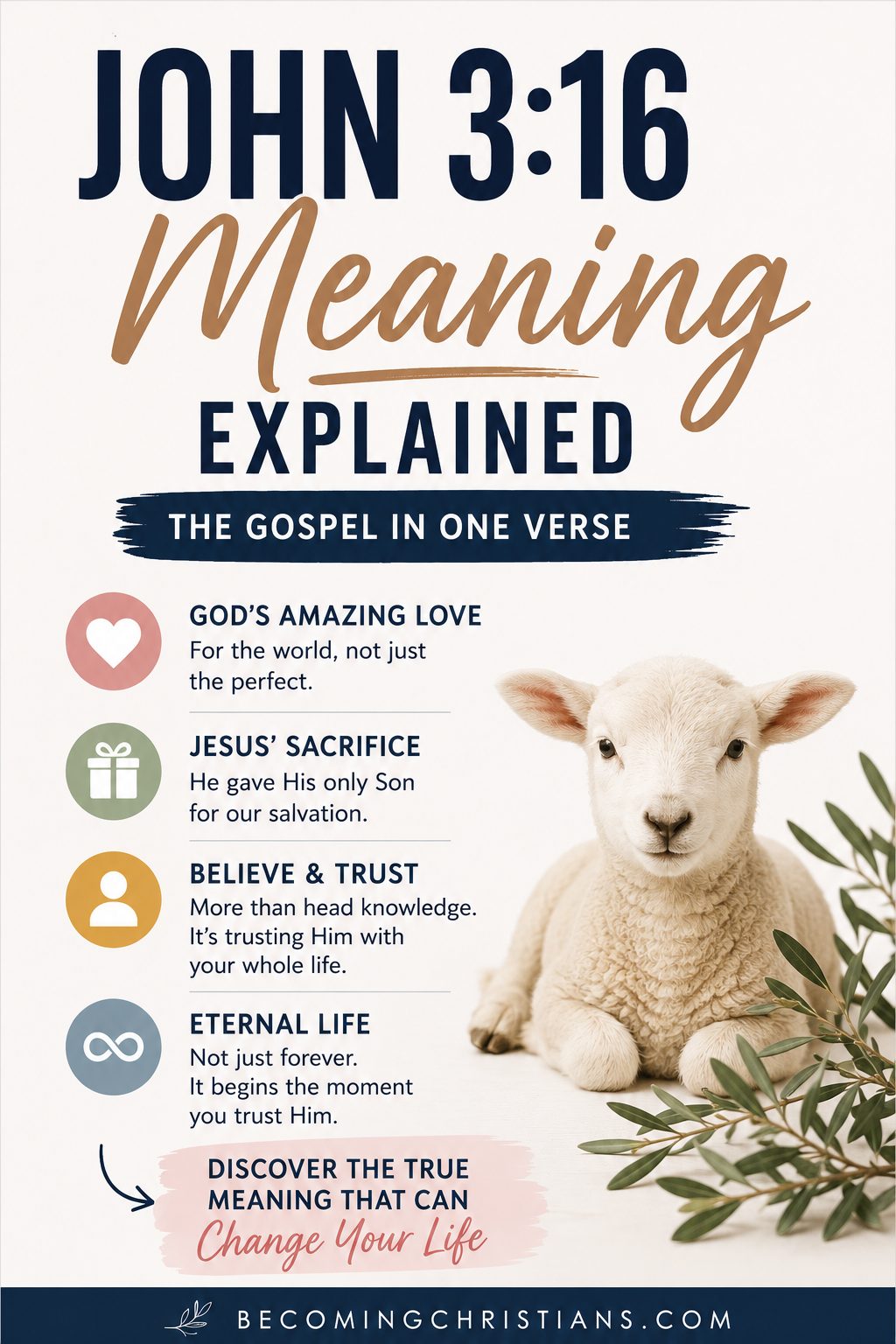
It’s often called “the Gospel in a single verse” because it compresses the entire message of Christianity — God’s love, human need, Christ’s sacrifice, and the offer of eternal life — into one sentence. But to understand why Jesus said it, and what He meant by each phrase, we need to back up and look at the conversation it came from.
The Context of John 3:16
John 3:16 doesn’t stand alone. It’s the climax of a private, nighttime conversation between Jesus and a man named Nicodemus, and skipping that conversation is probably the single biggest reason people misread this verse.
Nicodemus was a Pharisee and “a ruler of the Jews” — a member of the Sanhedrin, the Jewish ruling council. He was educated, respected, and religiously devout. He came to Jesus at night, likely to avoid being seen associating with a controversial rabbi, and opened with genuine curiosity: he recognized that Jesus was doing things no ordinary teacher could do.
Jesus didn’t respond with small talk. He went straight to the heart of the matter: “Unless one is born again, he cannot see the kingdom of God.” Nicodemus, taking this literally, was confused — how can a grown man re-enter his mother’s womb? Jesus clarified that He was talking about a spiritual rebirth, a transformation of a person from having a physical body to a spiritual body.
Then Jesus made a striking reference to an old story from Numbers 21. In the wilderness, the Israelites had rebelled against God and were being bitten by venomous snakes.
God told Moses to make a bronze serpent and lift it up on a pole — anyone who looked at it would live. It wasn’t the bronze itself that healed them; it was their trust in God’s provision, expressed through the simple act of looking.
Jesus told Nicodemus that He Himself would be “lifted up” in the same way — a clear reference to His coming crucifixion. Just as the Israelites were healed by looking to the serpent, people would be saved by believing in Him.
John 3:16 is Jesus’ explanation of why this rescue was happening at all. The bronze serpent moment was about the mechanism. John 3:16 is about the motive: love.
“For God So Loved the World” — What Does This Really Mean?
What does “so loved” mean?
Most readers hear “so loved” and think it means “loved so much” — as in, an enormous quantity of love. That reading is true, but it’s not the primary sense of the Greek. The word translated “so” (houtōs) more precisely means “in this way” or “in this manner.” Jesus isn’t only measuring the size of God’s love; He’s describing its shape — the way it was expressed.
In other words, the verse is saying: “This is how God loved the world: He gave His only Son.” The love is demonstrated, not just declared. Both ideas — intensity and manner — sit comfortably together in the verse, but the “manner” reading is often missed entirely in popular explanations.
FREE Bible Study Guide DOWNLOAD

Love That Never Fails: 10 Bible Verses That Reveal God’s Heart and Transform Your Life
What does “world” mean?
“World” here doesn’t mean a select group of especially good or deserving people. It means humanity in its rebellious, broken condition — sinners, rebels, people who have turned away from God. The same Gospel of John elsewhere describes the world as being in darkness, in opposition to God, loving its own sin.
This matters enormously. God’s love in John 3:16 isn’t a reward for good behavior. It’s directed at people who, by definition, don’t deserve it. That’s what makes it grace rather than payment.
“That He Gave His Only Begotten Son”
The word “gave” carries enormous weight. This wasn’t a distant gesture — it was costly, personal, and total.
“Giving” His Son meant the incarnation: God taking on human flesh and entering His own creation. It meant a life of suffering, rejection, and misunderstanding. And ultimately, it meant the crucifixion — an agonizing, humiliating death that Jesus willingly walked toward.
The word “only begotten” (sometimes translated “one and only”) emphasizes that Jesus is uniquely God’s Son — not one of many, not a created being, but the singular, beloved Son given up for the sake of others. The cost of the gift is part of what proves the reality of the love. This is love expressed through sacrifice, not sentiment.
The resurrection completes the picture. The gift wasn’t just a death — it was a death followed by victory over death, which is what makes the promise of eternal life credible in the first place.
Top 3 Best-Selling Christian Books for October 2026



What Does “Whoever Believes in Him” Really Mean?
This is where most articles on John 3:16 fall short — and it’s worth slowing down here, because getting “believe” right changes everything about how you read the rest of the verse.
Belief is not mere intellectual agreement
In casual English, “believe” often just means “think something is true.” I can believe that Paris is the capital of France without that belief changing my life in any way.
That is not what the Greek word behind “believe” — pisteuō — is describing. Pisteuō means to trust, to rely upon, to place confidence in, to commit oneself to. It’s relational and active, not merely mental.
Consider two simple illustrations:
Example 1: The parachute. I can believe, with complete intellectual certainty, that a parachute will work. That belief alone does nothing for me. Only when I put it on and jump — entrusting my weight to it — does my belief actually save me.
Example 2: The medicine. I can believe a medication is effective. But if the bottle sits unopened on my shelf, my correct belief changes nothing about my health. Belief has to be acted on to matter.
Biblical faith works the same way. It’s not simply agreeing that certain facts about Jesus are true. It’s entrusting your life to Him — leaning your whole weight on Him the way you’d lean on a parachute, not just admiring the fact that it exists.
Scripture is blunt about the difference. James points out that even demons hold correct theological beliefs about God — they “believe” in the sense of intellectual acknowledgment — and it doesn’t save them at all; it only makes them tremble. Correct information is not the same thing as saving faith.
Faith that produces action
Throughout Scripture, genuine faith shows up in what people do, not just what they say they believe. Abraham’s faith led him to leave his homeland and, eventually, to be willing to offer his son. Noah’s faith led him to spend decades building a boat for a flood no one else believed was coming. Hebrews 11 catalogs faith after faith that expressed itself in action, obedience, and risk.
This doesn’t mean salvation is earned by good works — John 3:16 is emphatic that eternal life is a gift, received through faith, not wages paid for effort. But genuine, saving faith is never inert. It reorients a person’s direction, priorities, and behavior, because trusting someone with your life naturally changes how you live.
As someone who has spent years studying Scripture and answering questions about salvation, I’ve noticed this is where the most common misunderstanding creeps in. People assume “believing in Jesus” means checking a mental box — agreeing that He existed, that He died, that He rose again — and then moving on with life unchanged. But throughout Scripture, biblical faith always leads somewhere. It leads to trust, to surrender, to a redirected life. Saving faith isn’t merely believing facts about Christ. It’s entrusting yourself to Him as Savior, Lord, and King.

What Does “Should Not Perish” Mean?
The verse presents two, and only two, possible outcomes: perishing or eternal life. There is no third option offered.
“Perish” doesn’t primarily describe physical death — everyone experiences that regardless of faith. In this context, it points to a deeper and more final kind of loss: separation from God, sometimes described elsewhere in Scripture as the “second death.” It’s the natural trajectory of a life and a world cut off from its Creator, if nothing intervenes.
The point of the verse isn’t to dwell on the details of that fate — it’s to highlight the contrast. Jesus is describing a rescue, and a rescue only makes sense if there’s something genuinely serious being rescued from. The emphasis of John 3:16 lands on the solution, not an extended argument about judgment.
What Is Eternal Life?
It’s tempting to read “eternal life” as simply meaning “life that goes on forever” — an unending extension of existence. That’s part of it, but it undersells what John actually means by the phrase.
In John’s Gospel, eternal life is described less as a quantity of time and more as a quality of relationship. Jesus later defines it directly: “This is eternal life, that they may know You, the only true God, and Jesus Christ whom You have sent.”
That means eternal life isn’t a reward that starts only after death. According to John’s own framing, it begins the moment a person trusts Christ. It is:
- Knowing God personally, not just knowing facts about Him
- An ongoing relationship, not a one-time transaction
- Present participation in God’s kingdom, starting now
This reframes the whole verse. John 3:16 isn’t only a promise about the afterlife — it’s an invitation into a relationship that starts today and continues without end.
Five Life-Changing Lessons from John 3:16
- God loved you before you loved Him. The initiative is entirely His. Nothing in the verse suggests humanity earned this love — it was given to a rebellious, undeserving world.
- Love gives. God’s love isn’t described as a feeling; it’s described as an action. Real love costs something and gives something.
- Salvation is available to everyone. “Whoever” is deliberately universal. No ethnicity, background, or history disqualifies a person from this offer.
- Faith requires trust and surrender, not just agreement. As explored above, believing in Jesus means entrusting your life to Him, not simply affirming facts.
- Eternal life begins today, not just after death. Knowing God is a present relationship, not only a future destination.
Common Misunderstandings About John 3:16
“God only loves Christians.” The verse says the opposite — God’s love was directed at “the world,” while it was still in rebellion against Him. His love precedes and produces faith; it isn’t a reward reserved only for those who already believe.
“Believe just means intellectual agreement.” As shown above, biblical belief is trust and reliance, not mere mental assent to facts.
“Eternal life only starts after death.” John’s Gospel explicitly frames eternal life as beginning the moment someone knows God through Christ.
“Salvation requires earning God’s favor.” The verse describes a gift, received through faith — not a wage paid for good behavior.
“Everyone will automatically be saved regardless of faith.” The verse is conditional: eternal life comes to “whoever believes.” Belief is the means by which the gift is received, not an optional extra.
John 3:16 Doesn’t Stand Alone — Consider Verse 17
It’s easy to stop reading at verse 16, but the very next verse changes how the whole passage should be understood: “For God did not send His Son into the world to condemn the world, but that the world through Him might be saved.”
Many people, consciously or not, picture God as eager to judge and condemn, reluctantly offering salvation as an afterthought. Verse 17 corrects that picture directly. The purpose of sending Jesus wasn’t condemnation — it was rescue. Condemnation was already the world’s situation; salvation is the intervention.
Reading verses 16 and 17 together reframes the tone of the whole passage: not a courtroom verdict, but a rescue mission motivated by love.
What Does John 3:16 Mean for You Today?
It’s possible to know this verse by heart and never let it touch daily life. So it’s worth asking some direct questions:
- Have you moved past knowing about God’s love toward actually trusting Him with your life?
- Is your faith closer to the parachute you admire from a distance, or the parachute you’ve actually put on?
- Are you living in the reality that eternal life — knowing God — is available to you right now, not just someday?
I’ve spoken with many Christians who could quote John 3:16 from memory but had never once considered the conversation that led to it — the confused Pharisee, the bronze serpent in the wilderness, the quiet nighttime meeting. Once you understand the exchange between Jesus and Nicodemus, the verse stops sounding like a slogan and starts sounding like what it actually is: an invitation, spoken personally, in the middle of someone’s honest confusion.
Frequently Asked Questions
What is the simple meaning of John 3:16?
God loved the world so much that He gave His Son so that anyone who trusts in Him will not be lost but will have eternal life.
What does “God so loved the world” mean?
It means God’s love was demonstrated in a specific way — by giving His Son — and it was directed at humanity in its rebellious, sinful state, not just toward people who already deserved it.
Does John 3:16 teach salvation by faith alone?
Not entirely. The verse says eternal life comes to “whoever believes,” describing salvation as something received through faith rather than earned through works, but genuine faith naturally produces a changed life.
What does “believe in Him” mean?
It means trusting and relying on Jesus personally, not just agreeing that certain facts about Him are true. It involves surrender and commitment, not mere intellectual assent.
Does believing mean simply accepting facts about Jesus?
No. Scripture points out that even demons acknowledge facts about God without being saved. Saving belief involves entrusting your life to Christ, not just affirming information about Him.
What does “perish” mean in John 3:16?
It refers to a deeper, spiritual loss — separation from God — rather than simply physical death, which everyone experiences regardless of faith.
What is eternal life according to John 3:16?
According to John’s Gospel, eternal life means knowing God personally through Jesus Christ. It’s a relationship that begins now and continues without end, not just an unending extension of time.
Was Jesus speaking to Nicodemus in John 3:16?
Yes. The verse comes from a private nighttime conversation between Jesus and Nicodemus, a Pharisee and Jewish ruler, and builds on Jesus’ teaching about being “born again” and being “lifted up” like the bronze serpent in Numbers 21.
Why is John 3:16 considered the gospel in one verse?
Because it compresses the core message of Christianity — God’s love, human need, Christ’s sacrifice, and the offer of eternal life through faith — into a single sentence.
What does John 3:16 teach about God’s love?
It teaches that God’s love is initiating (given before it’s earned), universal (offered to “the world”), costly (expressed through giving His Son), and personal (received through individual trust, not automatic).
Conclusion
John 3:16 is not merely a verse to memorize. It’s an invitation — spoken originally to a confused religious leader in the middle of the night, and offered just as personally to every reader since. To understand its true meaning is to see it not as a slogan, but as a summons: to trust, to follow, and to live for the One whom God lovingly gave for the world.

About the Author
Joshua Infantado is a Christian blogger and Bible teacher who has been writing faith-based content since 2013. He is the founder of Becoming Christians, where he shares blogs, books, videos, and online courses to help believers grow in truth and grace. Joshua lives in Davao City, Philippines, with his wife, Victoria, and their son, Caleb. Contact him at joshuainfantado@gmail.com.
Discover more from Becoming Christians
Subscribe to get the latest posts sent to your email.