There are books that inform you.
There are books that challenge you.
And then there are books that quietly place a mirror in front of your soul.
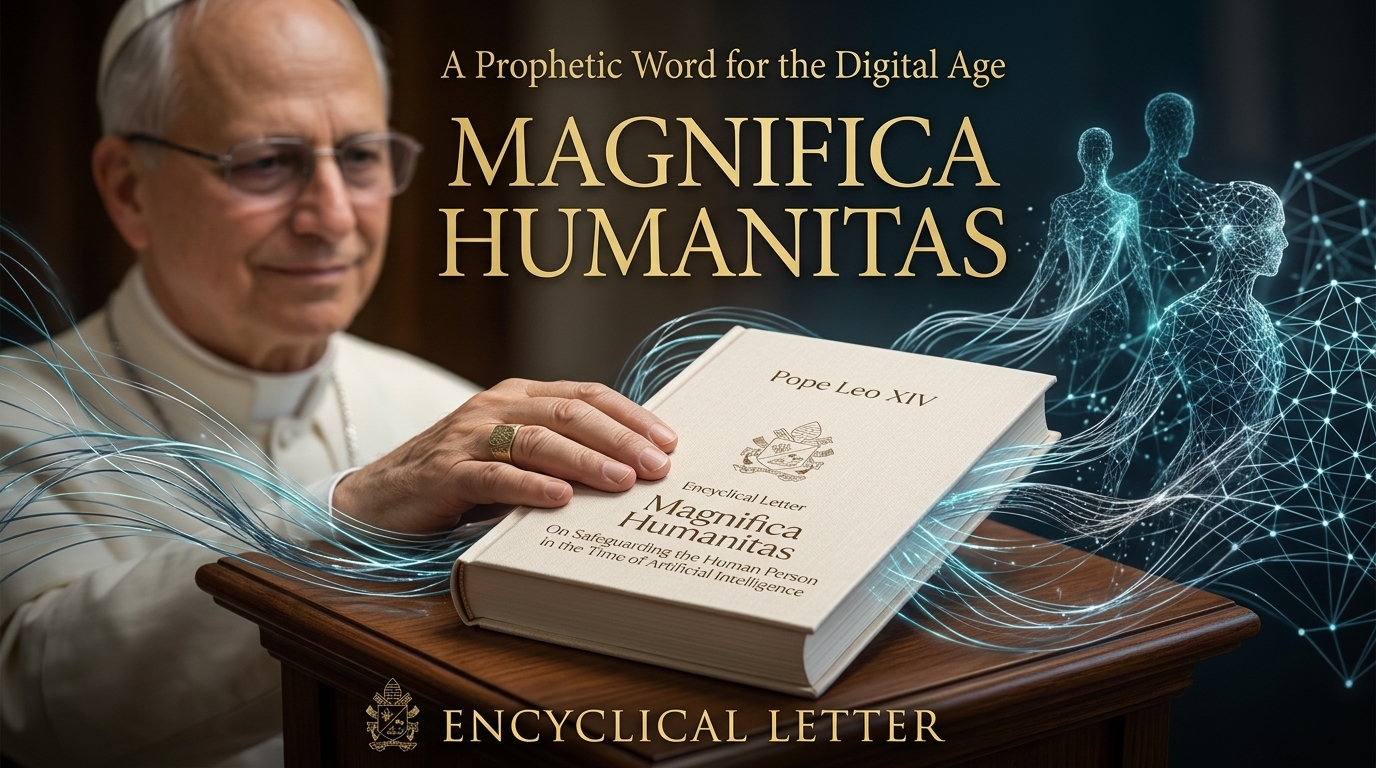
Magnifica Humanitas: On Safeguarding the Human Person in the Time of Artificial Intelligence belongs to the third category.
In his first encyclical, Pope Leo XIV does not merely discuss artificial intelligence as a technological issue. He treats it as a profoundly spiritual issue. The central question of the book is not, “What can AI do?” but rather, “What will become of humanity if we forget what it means to be human?”
That distinction changes everything.
A Timely and Prophetic Work
Released on May 25, 2026, the encyclical arrives at a moment when AI is rapidly reshaping work, relationships, education, warfare, communication, and even spirituality. The Pope frames this era as a modern “Industrial Revolution,” echoing the concerns addressed in Industrial Revolution and intentionally connecting his work to Rerum Novarum, the landmark Catholic social teaching document on labor and human dignity.
The title itself — Magnifica Humanitas (“Magnificent Humanity”) — reveals the heart of the message: humanity is not obsolete. Humanity is sacred.
And honestly, that message feels desperately needed.
We live in a culture fascinated with efficiency, optimization, automation, and speed. We celebrate machines that think faster than us, systems that replace workers, and algorithms that shape public opinion. But Pope Leo asks an uncomfortable question:
What happens when society becomes technologically advanced but spiritually hollow?
That question hangs over every chapter.
🚨 SUPER IMPORTANT TO READ: 🚨
Editor’s note: This list of books is intended to be used for informational purposes only. Moreover, I have my own fundamental beliefs that may differ from that of the authors, creators, and sellers of the products featured here. Moreover, you can also choose to read books I have written or enroll in my best online course. Ultimately, whatever books you choose in this list, make sure you study your Bible first because it is always the best of the best books of all time Here’s a list of Bibles that you should have. Finally, I am an Amazon Affiliate Program participant. As an Amazon Associate, I earn from qualifying purchases at no additional cost to you. I would highly appreciate it if you buy books through my site. Thank you!
The Book’s Central Argument
The Pope’s main thesis is clear: technology must remain the servant of humanity, never its master.
He repeatedly warns against what he describes as a new “Tower of Babel” — a civilization intoxicated with its own technological power yet disconnected from God, moral truth, and authentic human relationships.
One of the strongest aspects of the book is that it refuses simplistic thinking.
Pope Leo is not anti-technology.
He does not demonize innovation.
He openly acknowledges the benefits of AI in medicine, communication, education, and dangerous labor.
But he also refuses to worship technology.
That balance gives the encyclical credibility.
He argues that human dignity cannot be measured merely by productivity, data, or computational ability. Human beings are not valuable because they are efficient. They are valuable because they are created in the image of God. That biblical conviction quietly anchors the entire work.
For Christian readers, this becomes the emotional core of the book.
Strengths of the Book
1. Deep Moral Clarity
One of the most impressive qualities of Magnifica Humanitas is its moral seriousness.
The Pope speaks directly about:
- AI-driven job displacement
- surveillance capitalism
- concentration of technological power
- digital addiction
- AI warfare
- manipulation of truth
- exploitation of human weakness online
- the erosion of authentic relationships
Many modern discussions about AI feel shallow or purely technical. This book goes deeper. It asks ethical questions many people are afraid to ask.
Should everything technologically possible actually be done?
That question echoes throughout the document.
2. A Strong Defense of Human Dignity
The encyclical’s greatest strength is its unwavering defense of the human person.
At one point, the Pope argues that no machine, regardless of sophistication, can truly possess conscience, moral responsibility, love, or spiritual wisdom in the way humans do.
Whether readers fully agree with every philosophical conclusion or not, the underlying concern is compelling: modern society risks reducing people into data points, consumers, and replaceable economic units.
The Pope pushes back against that reductionism with force and compassion.
As Christians, this resonates deeply because Scripture consistently presents human life as sacred, relational, and spiritually meaningful — not merely functional.
3. Rich Biblical and Theological Imagery
Another remarkable feature is the book’s use of biblical symbolism.
The contrast between the “Tower of Babel” and the “New Jerusalem” is especially powerful.
Babel represents humanity attempting to build a future without humility before God. The New Jerusalem represents a redeemed humanity living in communion with God and one another.
This imagery transforms the book from a policy document into something almost pastoral and prophetic.
It reads less like a tech essay and more like a warning to the human soul.
Weaknesses and Criticisms
No serious review should ignore the book’s limitations.
At times, Magnifica Humanitas feels broad rather than specific. Readers looking for detailed policy proposals or technical AI frameworks may find the encyclical too philosophical.
The Pope excels at diagnosing moral problems but is less precise in outlining practical global solutions.
Some secular readers may also feel the book underestimates the complexity of machine consciousness debates. Online discussions already show disagreement over the Pope’s insistence that AI can never possess authentic inner experience or moral awareness.
Others may view portions of the book as overly cautious toward technological progress.
Still, these criticisms do not weaken the work’s core achievement. The purpose of an encyclical is not primarily technical engineering guidance. Its purpose is moral discernment.
And on that level, the book succeeds remarkably well.
Top 3 Best-Selling Christian Books for October 2026



Writing Style and Readability
For a papal encyclical, the writing is surprisingly readable.
It is intellectually rich without becoming inaccessible. The tone is thoughtful, pastoral, and often poetic. Certain passages carry genuine emotional weight, especially when discussing workers displaced by automation, children shaped by digital systems, and societies becoming emotionally numb through technological dependence.
There is urgency in the writing.
You can feel that the Pope believes humanity stands at a crossroads.
And perhaps we do.
Final Verdict
Magnifica Humanitas is one of the most important Christian reflections on artificial intelligence written in recent years.
It is not merely a Catholic document. It is a human document.
Even readers outside Catholicism will find themselves wrestling with its questions:
- What makes human beings unique?
- Can society remain moral while becoming increasingly automated?
- What happens when profit outruns wisdom?
- How do we preserve compassion, truth, and spiritual depth in a machine-driven age?
Most importantly, the book reminds Christians that technological progress can never replace spiritual formation.
A faster world is not automatically a better world.
A smarter machine does not create a wiser society.
And no algorithm can replace the human soul breathed into us by God.
Rating: 4.7 / 5 (User Reviews)
Recommended For:
- Christians interested in faith and technology
- pastors and ministry leaders
- ethicists and educators
- AI developers seeking moral reflection
- readers who enjoy thoughtful Christian social commentary
- anyone concerned about the future of humanity in the digital age
Discover more from Becoming Christians
Subscribe to get the latest posts sent to your email.