This article is a thorough examination of one of Christianity’s most popular — and most dangerous — doctrines, tested against the full counsel of Scripture.
Introduction
Few doctrines in modern Christianity are as widely believed — or as deeply consequential — as the teaching commonly known as “once saved, always saved.” Walk into almost any evangelical church in the world today and you will find this belief woven into the fabric of Sunday sermons, evangelistic tracts, and altar-call invitations.
The promise is appealing: once you confess Jesus Christ as your Lord and Savior, your eternal salvation is guaranteed — permanently, irrevocably, unconditionally secured. Nothing you do after that moment can sever your relationship with God or cost you your place in His Kingdom.
But is this what the Bible actually teaches? Or is this a well-intentioned but ultimately unbiblical doctrine that gives believers a false sense of security? In this article, we examine the origins of this teaching, the scriptures used to support it, and — most importantly — the many passages of Scripture that directly contradict it.

What Does “Once Saved, Always Saved” Actually Mean?
The formal theological term for this doctrine is Perseverance of the Saints or Eternal Security. In popular Christian culture, it is often expressed through phrases such as:
- “I know I’m going to heaven because I prayed the sinner’s prayer.”
- “God won’t let His children go — nothing can separate us from Him.”
- “My salvation is sealed by the Holy Spirit — it’s done.”
The basic claim is this: once a person is truly “born again” through repentance and faith in Jesus Christ, they are permanently and unconditionally saved. No subsequent sin — regardless of how grievous, habitual, or unrepented — can cause them to lose that salvation.
“The doctrine teaches that God will, in effect, do everything necessary to ensure that a true believer never finally falls away — even if their life shows little evidence of transformation.”
On the surface, this sounds like glorious assurance. But read carefully, and a troubling implication emerges: personal conduct and ongoing obedience become theologically irrelevant to one’s final destination. And that, Scripture makes clear, is a profoundly dangerous conclusion.
You should also read:
- Can a Christian Lose Salvation?
- What does Romans 7:7-12 mean? (The Role of Law and Grace in Your Salvation)
- 5 Common but False Teachings That Endanger Your Salvation
Where Did This Doctrine Come From?
The doctrine of eternal security does not have apostolic origins. It was not taught by the early church fathers as a settled doctrine. Its modern form can be traced primarily to the 16th-century Protestant reformer John Calvin, who systematized it as the fifth point of what became known as Calvinist theology — famously summarized by the acronym TULIP, where the “P” stands for “Perseverance of the Saints.”
However, Calvin himself drew heavily from the writings of the 5th-century Catholic bishop Augustine of Hippo, who wrestled with questions of divine sovereignty, election, and predestination. Over time, Calvin’s framework was embraced, popularized, and eventually simplified into the bumper-sticker theology of “once saved, always saved” that permeates much of evangelical Christianity today.
Knowing the human origin of this doctrine matters. It was not handed down from the apostles. It was a theological construct developed centuries after the closing of the New Testament canon. And as we will see, it stands in direct conflict with the plain teaching of Scripture.
Top 3 Best-Selling Christian Books for October 2026



What Mainstream Christianity Believes — and Why
To engage this doctrine fairly, we must understand the strongest biblical case its proponents make. Eternal security advocates are not fools — they cite genuine scriptures, and those scriptures deserve honest engagement.
The Key Texts Used to Support Eternal Security
For I am persuaded that neither death nor life, nor angels nor principalities nor powers, nor things present nor things to come, nor height nor depth, nor any other created thing, shall be able to separate us from the love of God which is in Christ Jesus our Lord.
Romans 8:38–39
My sheep hear My voice, and I know them, and they follow Me. And I give them eternal life, and they shall never perish; neither shall anyone snatch them out of My hand.
John 10:27–28
In Him you also trusted, after you heard the word of truth, the gospel of your salvation; in whom also, having believed, you were sealed with the Holy Spirit of promise, who is the guarantee of our inheritance…
Ephesians 1:13–14
Being confident of this very thing, that He who has begun a good work in you will complete it until the day of Jesus Christ.
Philippians 1:6
These are powerful, beautiful texts. And none of them are wrong. The issue is not the scriptures themselves — it is what this doctrine does with them: taking these assurances of God’s faithfulness and transforming them into a license for human unfaithfulness. There is a critical difference between God’s commitment to His people and a blanket guarantee that covers willful, unrepented apostasy.
Critical Distinction
Romans 8:38–39 lists created things that cannot separate us from God’s love — but it never claims that a believer’s own willful rebellion and apostasy cannot separate them. The passage assumes a believer walking in the Spirit, not one who has deliberately turned away from God.
John 10:28 says no one can snatch a sheep from Jesus’ hand — but a sheep can wander away on its own. The passage guards against external theft, not internal defection. Similarly, Ephesians 1:13–14 speaks of the Spirit as a guarantee for those who continue in faith — it is a conditional seal, not an unconditional blank check.
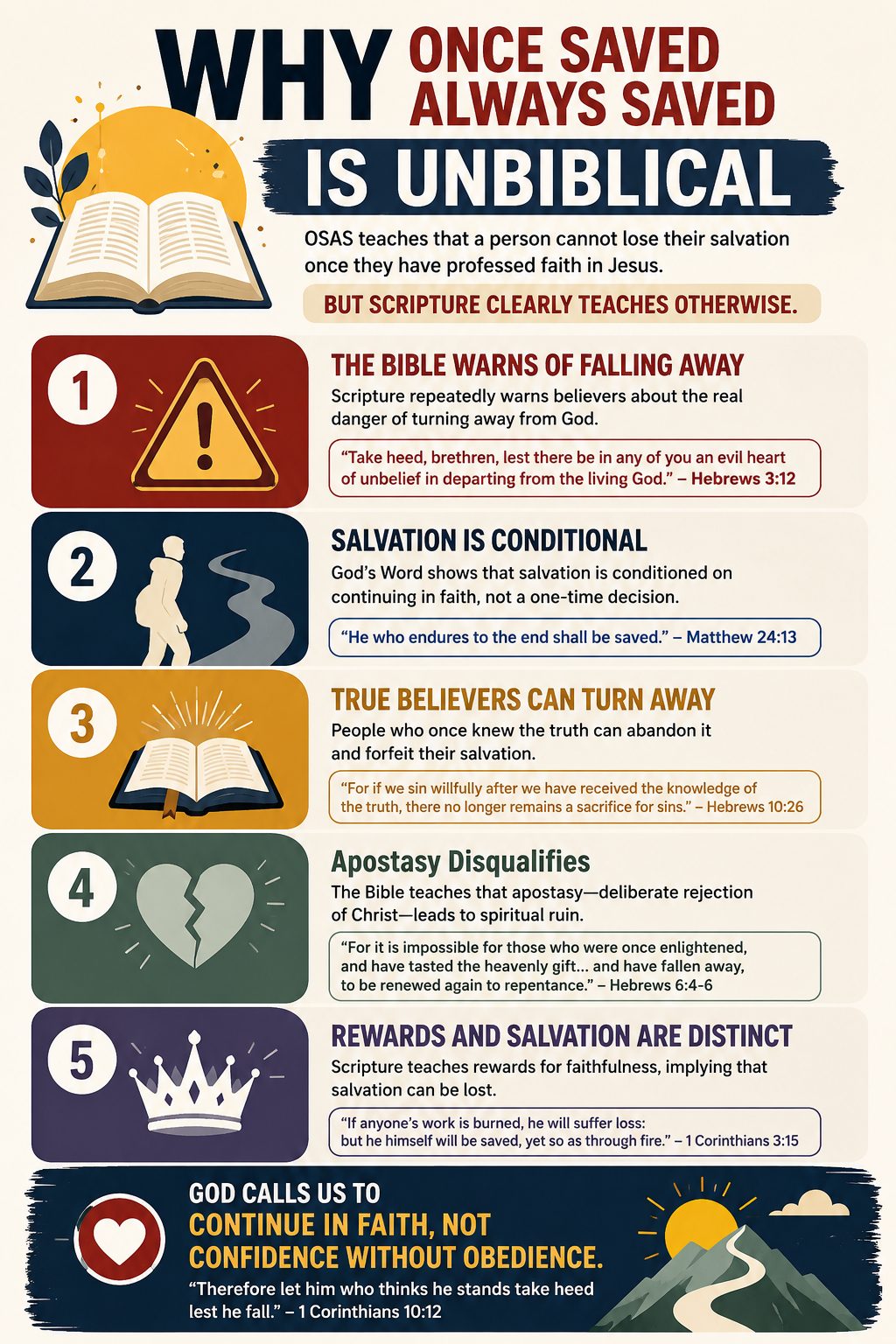
Salvation Is a Process, Not a One-Time Event
The foundational error underlying “once saved, always saved” is a misunderstanding of what salvation actually is. In much of modern evangelicalism, salvation is treated as a moment — a single prayer prayed, a single decision made, a single line crossed — after which one is permanently “in.”
The Bible tells a very different story. Salvation is not an event. It is a journey — a process with a beginning, a middle, and a final destination. The New Testament describes this process in four interconnected stages:
| Stage | Process | Verses |
|---|---|---|
| Stage 1 | Calling | John 6:44, 65 |
| Stage 2 | Justification | Romans 5:9 |
| Stage 3 | Sanctification | 1 Thess. 4:3–4 |
| Stage 4 | Glorification | Romans 8:17, 30 |
Calling is the Father’s sovereign initiation — no one comes to Christ unless drawn by God (John 6:44). Justification is the forgiveness of past sins through faith in Christ’s atoning sacrifice (Romans 5:9). Sanctification is the ongoing process of being set apart and made holy — it is active, ongoing, and demands personal participation (1 Thessalonians 4:3–4). Glorification is the final state of perfection at the resurrection — the destination, not yet reached (Romans 8:17, 30).
Notice that sanctification — the middle of the process — is not passive. It requires cooperation with the Holy Spirit, ongoing repentance, and continued obedience. The “once saved, always saved” doctrine effectively collapses this entire process into the single moment of justification and ignores everything that comes after.
Therefore, my beloved, as you have always obeyed, not as in my presence only, but now much more in my absence, work out your own salvation with fear and trembling; for it is God who works in you both to will and to do for His good pleasure.
Philippians 2:12–13
Paul does not say salvation has been worked out for you, finalized, and filed away. He commands believers to actively work it out — with fear and trembling. These are not the words of a man who believed a believer’s destiny was unconditionally secured the moment they first believed.
Scriptures That Directly Contradict This Doctrine
If “once saved, always saved” were truly biblical, we would expect the New Testament to be free of warnings about falling away, about believers losing their place in God’s kingdom, or about the possibility of apostasy. Instead, the New Testament is filled with exactly such warnings — written to believers, not unbelievers.
Hebrews 6: The Gravity of Falling Away
For it is impossible for those who were once enlightened, and have tasted the heavenly gift, and have become partakers of the Holy Spirit, and have tasted the good word of God and the powers of the age to come, if they fall away, to renew them again to repentance, since they crucify again for themselves the Son of God, and put Him to an open shame.
Hebrews 6:4–6
Why This Cannot Be Ignored
The person described here is not a casual churchgoer or a false convert. They were “enlightened,” had “tasted the heavenly gift,” and were “partakers of the Holy Spirit.” This is as thorough a description of a genuine believer as you will find in Scripture — and the text explicitly states they can fall away. The “once saved, always saved” position has no honest answer to this passage.
Hebrews 10: Willful Sin After Receiving the Truth
For if we sin willfully after we have received the knowledge of the truth, there no longer remains a sacrifice for sins, but a certain fearful expectation of judgment, and fiery indignation which will devour the adversaries. Anyone who has rejected Moses’ law dies without mercy on the testimony of two or three witnesses. Of how much worse punishment, do you suppose, will he be thought worthy who has trampled the Son of God underfoot, counted the blood of the covenant by which he was sanctified a common thing, and insulted the Spirit of grace?
Hebrews 10:26–29
Note the phrase: “the blood of the covenant by which he was sanctified.” The person who falls under this judgment was previously sanctified — set apart — by Christ’s blood. They were a believer. And yet, through willful, persistent sin and apostasy, they have placed themselves under the expectation of judgment.
1 Corinthians 6: “Such Were Some of You”
Do you not know that the unrighteous will not inherit the kingdom of God? Do not be deceived. Neither fornicators, nor idolaters, nor adulterers, nor homosexuals, nor sodomites, nor thieves, nor covetous, nor drunkards, nor revilers, nor extortioners will inherit the kingdom of God. And such were some of you. But you were washed, but you were sanctified, but you were justified in the name of the Lord Jesus and by the Spirit of our God.
1 Corinthians 6:9–11
Paul here warns believers in Corinth — people who were already washed, sanctified, and justified — that the unrighteous will not inherit the kingdom of God. If their salvation were eternally secured regardless of behavior, this warning would be utterly meaningless. Why warn people who are already guaranteed an inheritance?
2 Peter 2: The Dog Returning to Its Vomit
For if, after they have escaped the pollutions of the world through the knowledge of the Lord and Savior Jesus Christ, they are again entangled in them and overcome, the latter end is worse for them than the beginning. For it would have been better for them not to have known the way of righteousness, than having known it, to turn from the holy commandment delivered to them.
2 Peter 2:20–22
This passage makes an extraordinary claim: it would have been better for these people never to have known the way of righteousness than to have known it and turned back. If “once saved, always saved” were true, this statement makes no sense — because those people would still be saved despite turning back. Peter’s logic only works if genuine apostasy is possible.
1 Corinthians 9: Even Paul Feared Disqualification
But I discipline my body and bring it into subjection, lest, when I have preached to others, I myself should become disqualified.
1 Corinthians 9:27
A Striking Admission
The Apostle Paul — the man who wrote half the New Testament, who was caught up to the third heaven, who planted churches across the Roman world — feared that without ongoing self-discipline, he himself could become disqualified. If eternal security were real, what exactly was Paul afraid of? This verse alone is a powerful rebuttal to the doctrine of unconditional eternal security.
The Most Misused Verses — Properly Understood
Key Principle for Biblical Interpretation
- Scripture must be interpreted by Scripture — no single verse stands alone.
- Context determines meaning — who is writing, to whom, and about what situation.
- Clear passages must govern the interpretation of unclear ones.
- A doctrine built on selective reading while ignoring contradicting texts is not a biblical doctrine.
Romans 8:38–39 — Nothing Can Separate Us
This glorious passage declares that no external created force — death, angels, powers, height, depth — can separate the believer from God’s love. But it does not say that a believer’s own deliberate, sustained rebellion cannot sever the relationship. Paul is assuring believers of divine faithfulness against outside forces — not granting a license for internal apostasy. The passage assumes a person who is actively living in Christ (see Romans 8:1: “those who walk not after the flesh, but after the Spirit”).
John 10:28–29 — No One Can Snatch Them
Jesus promises that no external agent can snatch His sheep from His hand. The sheep in view are those who hear His voice and follow Him (v.27). The promise is for those actively following — not those who stop following. Furthermore, the text addresses the threat of outside snatching, not the possibility of a sheep wandering away of its own will.
Philippians 1:6 — He Who Began a Good Work Will Complete It
God is faithful to complete what He begins — no one disputes that. But this text does not promise completion for those who abandon the work. God’s commitment does not override human free will and the possibility of willful departure from faith. The verse is a promise of God’s faithfulness to those who continue in faith — not a blanket guarantee for those who walk away.
Why This Doctrine Is Spiritually Dangerous
Beyond the theological debate, this doctrine has real-world spiritual consequences for those who believe it. Consider the following dangers:
It Removes Personal Accountability
If salvation is eternally secured regardless of behavior, then sin — however grievous, persistent, or unrepented — carries no eternal consequence for the believer. This effectively abolishes the believer’s moral accountability before God and removes one of the most powerful motivations for holy living: the fear of God.
It Renders Biblical Warnings Meaningless
The New Testament is filled with warnings against apostasy, falling away, and returning to sin. If eternal security is absolute, every single one of these warnings is either nonsensical or aimed only at non-Christians who merely appear to be believers. But the biblical evidence strongly suggests these warnings were written to genuine, Spirit-filled believers.
It Creates a False Assurance
Perhaps the most devastating consequence of “once saved, always saved” is the false security it grants to people who may have made an emotional decision at some point in their lives but show no evidence of ongoing transformation, repentance, or discipleship. These individuals may live their entire lives outside of fellowship with God, believing themselves eternally secure — only to discover at the judgment that their assurance was built on sand.
“Examine yourselves as to whether you are in the faith. Test yourselves.” — 2 Corinthians 13:5
It Contradicts the Call to Endurance
Jesus Himself said, “He who endures to the end shall be saved” (Matthew 24:13). The entire concept of endurance — pressing through suffering, temptation, and hardship — becomes theologically redundant if the outcome is guaranteed from the moment of initial belief.
Conclusion: What the Bible Actually Teaches
The doctrine of “once saved, always saved” is not a teaching that emerges from a careful, comprehensive reading of Scripture. It is a theological construct developed centuries after the apostolic age, built on a selective reading of a handful of passages while systematically ignoring a large body of New Testament teaching that speaks plainly about the possibility of falling away.
The Bible teaches that salvation is a process — beginning with God’s calling, moving through justification and sanctification, and ultimately culminating in glorification. Each stage is real, each stage is necessary, and each stage demands genuine, ongoing participation from the believer.
The God of Scripture is faithful beyond all measure. His love is inexhaustible. His desire is that none should perish (2 Peter 3:9). But He is also just, and He has given every human being the freedom to respond or to turn away. Salvation can be received — and salvation can be forsaken. This is not a cause for terror among those who are genuinely walking with God; it is a call to sober-minded, faithful discipleship.
As Paul instructed: “Work out your own salvation with fear and trembling” (Philippians 2:12). Not with dread, but with reverence — the reverence of a believer who understands the gravity of what God has given, and who refuses to treat that gift as something that can be received, pocketed, and forgotten about.

About the Author
Joshua Infantado is a Christian blogger and Bible teacher who has been writing faith-based content since 2013. He is the founder of Becoming Christians, where he shares blogs, books, videos, and online courses to help believers grow in truth and grace. Joshua lives in Davao City, Philippines, with his wife, Victoria, and their son, Caleb. Contact him at joshuainfantado@gmail.com.
Discover more from Becoming Christians
Subscribe to get the latest posts sent to your email.