If you’re asking this question, “Can Women Be Priests or Deacons in the Catholic Church?”, you’re not alone. It’s one of the most searched and debated topics about the Catholic Church today.
Here’s the clear and direct answer:
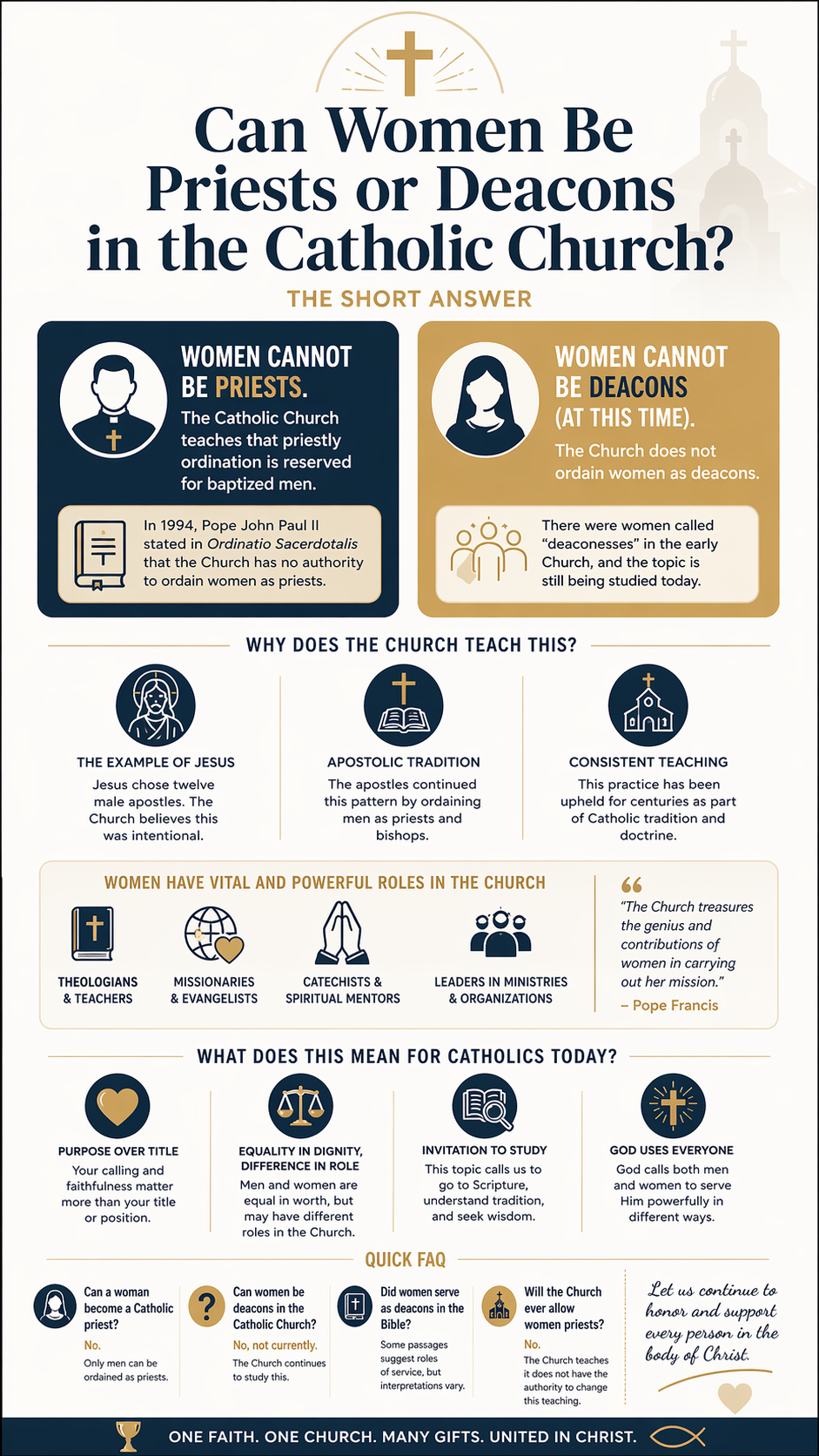
No, women cannot be ordained as priests in the Catholic Church. The Church teaches that priestly ordination is reserved for men, a position formally affirmed by Pope John Paul II.
As for deacons, the answer is slightly more complex. At present, women are not ordained as deacons either. However, there have been ongoing discussions about the historical role of women, sometimes referred to as “deaconesses,” in the early Church.
This teaching is rooted in how the Church understands apostolic tradition. According to Catholic belief, Jesus Christ chose only men as His apostles, and the Church continues to follow that pattern in its sacramental priesthood.
That said, this does not mean women are unimportant or sidelined. In fact, women play vital, powerful, and indispensable roles in the life and mission of the Church.
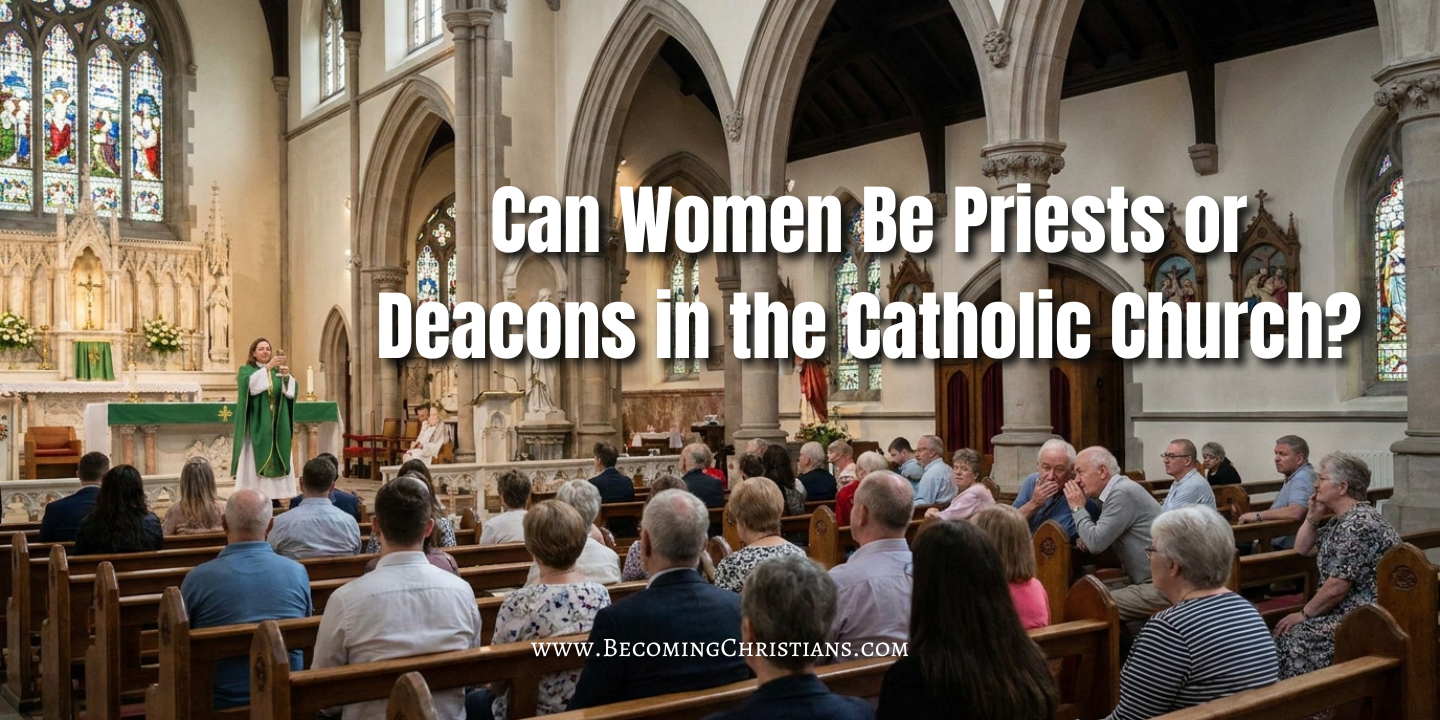
📌 Do you want to learn more about the Biblical role of women? Can women preach or not? What roles can they play in the church? Discover the answers to these questions and more by reading my full article, “In-Depth Study: What does the Bible Say About Women Being a Preacher or Pastor?“
Why Can’t Women Be Priests in the Catholic Church?
To understand this teaching clearly, you have to look at the foundation the Catholic Church stands on: Scripture, apostolic tradition, and authoritative teaching. These three work together, not separately.
1. The Example Set by Jesus Christ
The first and most foundational reason comes from the life and actions of Jesus Himself.
Jesus chose twelve apostles, and all of them were men. The Catholic Church teaches that this was not random or merely a reflection of cultural norms at the time. Instead, it sees this as a deliberate and meaningful choice.
What makes this significant is that Jesus often went against cultural expectations in other areas. He spoke publicly with women, taught them, and included them among His followers in ways that were uncommon in His society. Because of this, the Church concludes that His choice of male apostles was intentional, not accidental.
For the Catholic Church, the priesthood is closely connected to the apostles. Since the apostles were chosen directly by Christ, their pattern becomes the model for ordained ministry.
2. Apostolic Continuity and Unbroken Tradition
The second reason is what the Church calls apostolic continuity.
After Jesus’ resurrection and ascension, the apostles appointed successors to continue their mission. This laid the foundation for what would become the structure of bishops and priests in the Church.
From that point onward, the Church has consistently ordained men to the priesthood. This is not seen as a policy that can be changed, but as a tradition that has been faithfully preserved for centuries.
In Catholic understanding, the Church does not have the authority to alter what it believes was established by Christ and practiced by the apostles. Maintaining this continuity is seen as essential to preserving the integrity and identity of the priesthood.
3. Definitive Teaching of the Church
The third reason is the Church’s official and authoritative teaching on the matter.
In 1994, Pope John Paul II issued a document stating that the Church does not have the authority to ordain women as priests. This was not presented as a new rule, but as a clarification of what the Church has always believed.
This declaration is considered definitive within Catholic doctrine. In other words, it is not open to revision or debate in terms of official teaching.
For Catholics, this carries significant weight because it reflects the Church’s role as a guardian of what it understands to be divine truth, not an institution that can reshape doctrine based on cultural trends.
Bringing It All Together
When you put these three together, the reasoning becomes clearer:
- The example of Christ
- The consistent practice of the apostles
- The confirmed teaching of the Church
These form a unified foundation for why the Catholic Church does not ordain women as priests.
Even for those who wrestle with this teaching, understanding these reasons helps move the conversation from confusion to clarity.
Can Women Be Deacons in the Catholic Church?
This is where the discussion becomes more nuanced. Unlike the question of women as priests, which the Catholic Church considers settled, the question of women as deacons has a more complex history and ongoing conversation.
1. The Current Position of the Catholic Church
As of today, the Catholic Church does not ordain women as deacons.
In Catholic teaching, the diaconate is part of the sacrament of Holy Orders, alongside bishops and priests. Because of this, many theologians argue that the same reasoning used to reserve priesthood to men also applies to the diaconate.
So in practice, only baptized men can be ordained as deacons. These men serve in various roles such as proclaiming the Gospel, assisting in liturgy, performing baptisms, witnessing marriages, and engaging in charitable ministry.
At the same time, it’s important to note that women already serve in many of these areas in non-ordained capacities. This is part of what keeps the conversation alive.
2. Historical Evidence: Deaconesses in the Early Church
When people explore this topic, they often point to the early Church.
There are historical references to women called “deaconesses.” One commonly cited example is Phoebe in Romans 16:1, who is described using a Greek word that can be translated as “servant” or “deacon.”
Early Christian writings also mention women who assisted in specific ministries, particularly those involving other women. For example, they helped prepare women for baptism, especially in a time when baptisms were conducted differently than today.
However, this is where the debate begins.
Some scholars argue that these deaconesses held a role similar to ordained male deacons. Others maintain that their function was distinct and not sacramental, meaning they were not ordained in the same sense as male clergy.
Because the historical evidence is not entirely clear or uniform, different interpretations have emerged.
Top 3 Christian Books for Women in April 2026

3. Ongoing Study and Discussion
In recent years, this topic has received renewed attention.
Pope Francis has commissioned study groups to examine the historical and theological question of women deacons more closely. These commissions have been tasked with reviewing early Church practices and determining whether they provide a basis for any development today.
So far, no official change has been made to Church teaching or practice. Women are still not ordained as deacons.
However, the fact that the Church continues to study the issue shows that it is being approached carefully, thoughtfully, and with a desire to remain faithful to both Scripture and tradition.
Why This Matters
This discussion is not just about roles or titles. It touches on deeper questions about how the Church understands ministry, authority, and faithfulness to its origins.
For some, the historical presence of deaconesses suggests a possibility for development. For others, the sacramental nature of ordination sets clear boundaries that cannot be crossed.
What remains clear is this: the Church seeks to be consistent with what it believes was handed down from the apostles, while also carefully examining historical evidence and present-day realities.
A Balanced Perspective
So where does that leave us?
- Women are not currently ordained as deacons
- There is historical evidence of women serving in roles called “deaconesses”
- The exact nature of those roles is debated
- The Church continues to study the question, but no changes have been made
Understanding this balance helps avoid oversimplification. It also invites deeper study rather than quick conclusions.
In the end, this topic reminds us that not every theological question has a simple yes-or-no answer. Some require patience, humility, and a willingness to wrestle with both history and doctrine.
What Roles Can Women Have in the Catholic Church?
Even though women are not ordained as priests or deacons, their impact in the Church is profound.
Women serve as:
- Theologians and Bible teachers
- Missionaries and evangelists
- Catechists and spiritual mentors
- Leaders in Catholic ministries and organizations
One of the most powerful examples is Mother Teresa, whose life of service transformed countless lives and demonstrated the depth of influence a woman can have in the Church.

Biblical Perspective on Women in Ministry
When this topic comes up, many people naturally turn to the Bible. That’s the right place to begin, because any meaningful conclusion should be grounded in Scripture, not just tradition or modern opinion.
What we find in the New Testament is both clear and, at times, complex. There are passages that highlight the active involvement of women in ministry, alongside others that raise questions about leadership roles.
1. Women in the Early Church
One of the most frequently discussed passages is Romans 16:1, where the apostle Paul writes:
“I commend to you Phoebe our sister, who is a servant of the church in Cenchrea…” (NKJV)
The word translated as “servant” is the Greek term diakonos, which can also be translated as “deacon.” This is significant because the same word is used elsewhere for recognized ministry roles in the church.
Because of this, some interpret Phoebe as holding an official position similar to a deacon. Others believe Paul was simply describing her as a faithful servant, not necessarily someone who held an ordained office.
Beyond Phoebe, the New Testament mentions several women who were actively involved in ministry:
- Priscilla, who, along with her husband, helped teach Apollos (Acts 18:26)
- Lydia, a key supporter of the early church (Acts 16:14–15)
- Euodia and Syntyche, who labored alongside Paul in the gospel (Philippians 4:2–3)
These examples make one thing clear: women were not passive observers. They were deeply involved in the mission and growth of the early Church.
2. Interpreting the Text: Leadership or Service?
This is where interpretation becomes important.
Some readers see passages like Romans 16:1 as evidence that women held formal leadership roles, possibly even positions equivalent to deacons. They argue that the use of diakonos suggests recognized ministry authority.
Others take a more cautious approach. They point out that diakonos is a broad term that can simply mean “servant” or “minister” in a general sense. In this view, Phoebe’s role was significant but not necessarily ordained or authoritative in the same way as male church leaders.
The discussion becomes even more layered when you consider other passages, such as:
- 1 Timothy 2:12, which addresses teaching authority
- 1 Corinthians 14:34–35, which discusses order in worship
These texts are often brought into the conversation, leading to different conclusions depending on how they are understood in context.
3. Holding the Tension
What makes this topic challenging is that Scripture presents both:
- Clear evidence of women actively serving and contributing to ministry
- Passages that seem to place limits on certain roles
Because of this, sincere believers often arrive at different conclusions.
Some emphasize the active ministry of women and see broader opportunities for leadership. Others focus on the structural patterns they believe are established in the New Testament and maintain distinctions in roles.
4. What Can We Say with Confidence?
Even with differing interpretations, a few things stand out clearly:
- Women played a vital role in the early Church
- They were trusted, valued, and involved in gospel work
- Their contributions were essential to the spread of Christianity
This helps us avoid two extremes: minimizing the role of women or reading more into the text than it clearly states.
5. Why This Matters Today
This is not just an academic discussion. It affects how people understand calling, leadership, and service in the church today.
The key question becomes: What is the Bible actually teaching, and how should we faithfully apply it?
That requires careful study, humility, and a willingness to examine both Scripture and assumptions.
Final Thought
The Bible gives us a rich picture of women actively serving in God’s mission. At the same time, it invites us to think deeply about how roles and responsibilities are defined.
Rather than rushing to conclusions, this topic calls for thoughtful reflection, grounded in Scripture and guided by a sincere desire to follow God’s design.
Common Misconceptions
“The Church Is Against Women”
This is a misunderstanding. The Catholic Church teaches that men and women are equal in dignity, even if they have different roles.
“This Teaching Will Change Soon”
The teaching on priesthood is considered settled and not open to change, based on how the Church understands its authority.
What Does This Mean for Christians Today?
This question matters because it shapes how we understand calling, service, and identity in the body of believers.
First, it reminds us that purpose is not limited to a title. Whether someone is ordained or not, what truly matters is faithfulness to God’s calling.
Second, it challenges modern assumptions. Today’s culture often equates equality with identical roles. But Scripture frequently presents equality in value alongside diversity in function.
Third, it invites deeper study. Instead of reacting emotionally, this topic pushes believers to go back to the Bible, examine context, and understand God’s design more clearly.
Finally, it highlights something important: God uses both men and women powerfully. The question is not who gets a specific role, but how each person faithfully serves where they are called.
Frequently Asked Questions
Can a woman become a Catholic priest?
No. The Catholic Church teaches that only baptized men can be ordained to the priesthood. This is considered part of the Church’s sacramental tradition, not a practice that can be changed based on time or culture.
Why can’t women be priests?
The Church grounds this teaching in the example of Jesus Christ, who chose twelve male apostles, as well as the consistent practice of the early Church. It is understood as a matter of faithfulness to what was established from the beginning of apostolic ministry.
Can women be deacons in the Catholic Church?
Currently, women are not ordained as deacons in the Catholic Church. However, the topic remains under theological and historical study, and discussions continue about the role of women in the early Church and whether any development is possible.
Did women serve as deacons in the Bible?
There are biblical references such as Phoebe in Romans 16:1, who is described using a term often translated as “servant” or “deacon.” However, scholars differ on whether this indicates an official ordained role or a general ministry of service within the church community.
Will the Catholic Church ever allow women priests?
According to Pope John Paul II, the Church does not have the authority to ordain women as priests. Because of this, the teaching is considered definitive within Catholic doctrine and not open to future change.
Final Thoughts
The Catholic Church’s position on women as priests or deacons is clear, rooted in its understanding of Scripture and tradition. At the same time, this topic opens the door for meaningful discussion about roles, calling, and biblical truth.
For many Christians, this isn’t just a theological issue. It’s personal. It affects how we see leadership, service, and our place in God’s plan.
Want to Go Deeper?
If you’re serious about understanding this issue from a biblical perspective, don’t stop here.
I’ve written a deeper, Scripture-focused study that examines this topic more thoroughly, including key passages, common objections, and practical insights.
👉 Read next: In-Depth Study: What Does the Bible Say About Women Being a Preacher or Pastor?
This will help you move beyond surface-level answers and truly understand what the Bible teaches.
Discover more from Becoming Christians
Subscribe to get the latest posts sent to your email.