Many people ask, “What does 1 Corinthians 14:34-35 really mean, and can women speak in church?” The short, direct answer is this: in this passage, the apostle Paul teaches that women are not to speak in an authoritative or governing way within the church assembly. This instruction is connected to maintaining order in worship and reflects a broader biblical pattern where teaching authority and pastoral leadership are entrusted to men.
That said, this does not mean women are without value, voice, or ministry in the church. Scripture shows that women play vital, active, and meaningful roles in God’s work. The issue in 1 Corinthians 14 is not about worth, but about God-ordained roles and structure within the church.
In this article, we will carefully examine what 1 Corinthians 14:34-35 says in its proper context, what “keep silent” truly means, and how this passage fits with the rest of the Bible’s teaching. We will also address common misunderstandings and explain how this connects to the question of women serving as pastors or preachers today.
📢 If you wish to learn more, I highly recommend you read my full article, “In-Depth Study: What does the Bible Say About Women Being a Preacher or Pastor?“
What Does 1 Corinthians 14:34-35 Say?
Here is the passage in the New King James Version (NKJV):
“Let your women keep silent in the churches, for they are not permitted to speak; but they are to be submissive, as the law also says.
And if they want to learn something, let them ask their own husbands at home; for it is shameful for women to speak in church.” (1 Corinthians 14:34–35, NKJV)
At first glance, this may seem like a very strict or even controversial command. However, when read carefully, the apostle Paul is addressing order within the church gathering, not the general value or spiritual ability of women.
The broader context of 1 Corinthians 14 is about maintaining decency and order in worship services. Paul gives instructions about speaking in tongues, prophecy, and taking turns so that the church is edified. Within this structure, he places a limitation on women speaking in a way that would disrupt authority and order.
In simple terms, this passage teaches that women are not to take on authoritative speaking roles in the assembled church, particularly in ways that would challenge or override established leadership.
What Does “Keep Silent in the Churches” Mean?
The phrase “keep silent” is often misunderstood. It does not mean that women must be completely mute in church under all circumstances. If that were the case, it would contradict other parts of Scripture where women are seen praying or participating in ministry.
Instead, “silent” must be understood in its immediate context. Earlier in the same chapter, Paul tells tongue-speakers and prophets to also “keep silent” at certain times (1 Corinthians 14:28, 30). In those cases, silence means refraining from speaking in specific situations to preserve order, not absolute silence at all times.
Therefore, when Paul instructs women to “keep silent,” he is referring to a restriction on speaking in an authoritative or governing manner within the church assembly. This would include teaching or judging in a way that exercises authority over the congregation.
Common Misunderstandings
1. “Women cannot speak at all in church.”
This is an overstatement. The context shows that Paul is regulating how and when certain people speak, not banning all participation.
2. “This was only a cultural issue in Corinth.”
While Corinth had its cultural challenges, Paul appeals to a broader principle of submission and order, suggesting that his instruction is not merely cultural but rooted in a consistent biblical pattern.
3. “Paul contradicts himself elsewhere.”
Some point to other passages where women pray or prophesy. However, those instances do not necessarily involve authoritative teaching roles within the assembled church, which is the focus here.
In summary, “keep silent” is best understood as a call for women not to assume authoritative teaching or leadership roles during the church gathering, aligning with the Bible’s broader teaching on church order and leadership.
Top 3 Christian Books for Women in April 2026


The Context of 1 Corinthians 14
To properly understand 1 Corinthians 14:34–35, we must step back and look at the full context of the chapter. Paul’s main concern is not singling out women, but establishing order, clarity, and edification in the church gathering.
Order in Worship
Throughout the chapter, Paul emphasizes that worship should not be chaotic or confusing. In verses 26–33, he gives specific instructions:
- Only a few should speak in tongues, and only with interpretation
- Prophets should speak one at a time
- Everything must be done “decently and in order” (v. 40)
This shows that Paul is correcting a disorderly situation in the Corinthian church. People were speaking out of turn, interrupting, and creating confusion. His goal is to ensure that the church gathering builds up believers rather than distracts or overwhelms them.
Speaking Roles
Within this structure, Paul regulates who speaks and when. Not everyone is free to speak at any time or in any way. Tongue-speakers, prophets, and others are all given boundaries.
When Paul addresses women in verses 34–35, he is continuing this same theme. Just as others are told to remain silent in certain situations, women are also given a restriction, particularly in relation to authoritative or evaluative speaking roles within the assembly.
This reinforces the idea that the issue is not participation in general, but orderly participation according to God’s design.
Authority Structure
Another key theme in this chapter, and in Paul’s writings overall, is authority within the church. The instruction for women to be “submissive” points to a recognized structure of leadership.
This is consistent with other passages that outline qualifications for church leaders and assign teaching authority to men in the context of the gathered church. In 1 Corinthians 14, Paul is not introducing a new rule, but applying an already established pattern to ensure harmony and order.
In short, the context makes it clear: this passage is about maintaining proper roles and authority so that worship remains edifying and God-honoring.
Does This Mean Women Can Never Speak in Church?
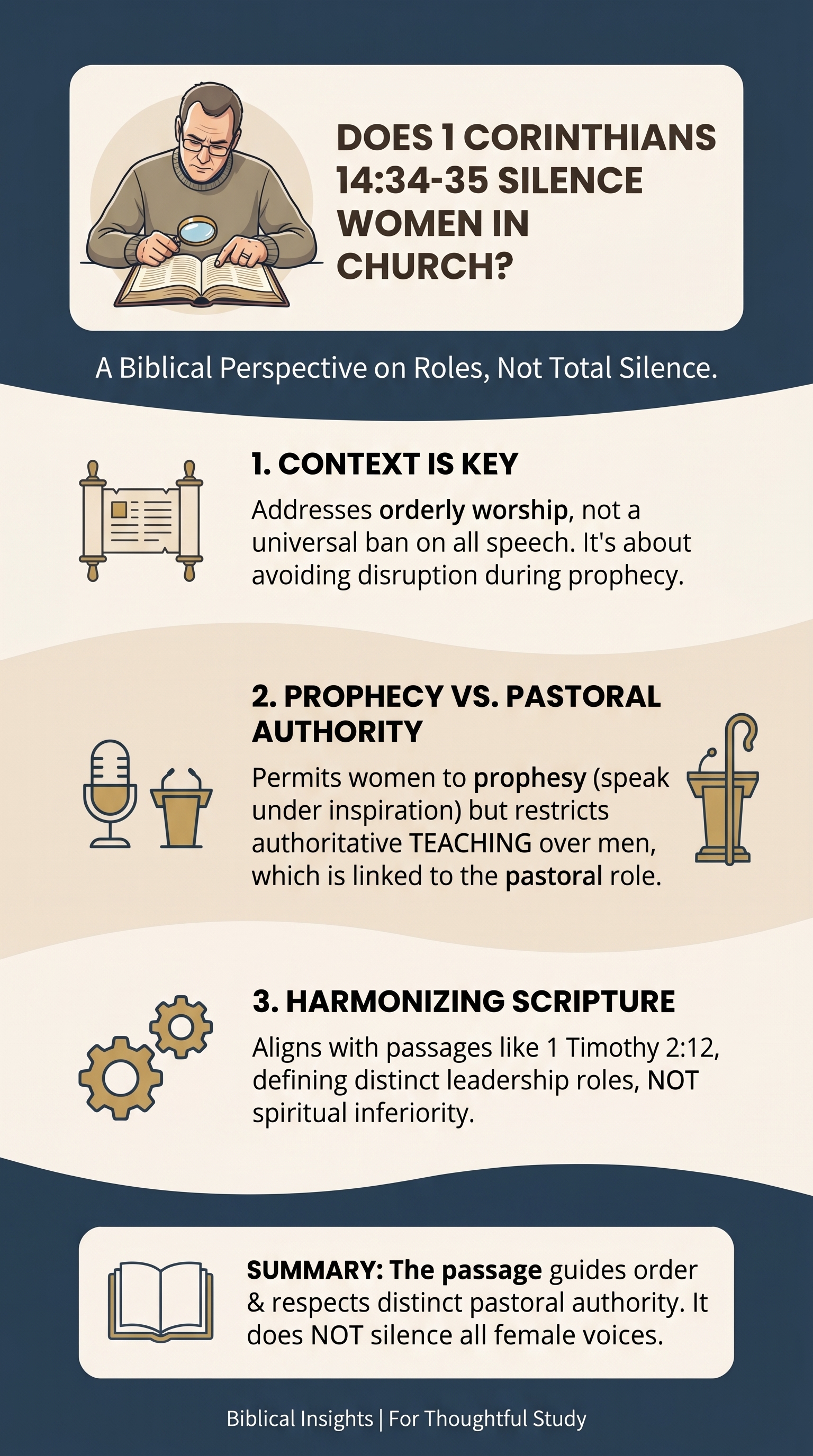
A common reaction to 1 Corinthians 14:34–35 is to assume that women must remain completely silent at all times in church. However, this is an overgeneralization that does not align with the full teaching of Scripture.
The Difference Between Speaking and Authority
The key distinction to understand is the difference between speaking and speaking with authority.
The Bible shows that women can:
- Pray
- Sing
- Encourage others
- Teach in appropriate settings (such as instructing other women or children)
What is restricted in this passage is not all forms of speech, but authoritative teaching or leadership within the gathered church, particularly roles that involve governing or instructing the entire congregation.
This aligns with the broader biblical pattern where pastoral leadership and doctrinal authority are entrusted to qualified men, while women still play essential and active roles in the life of the church.
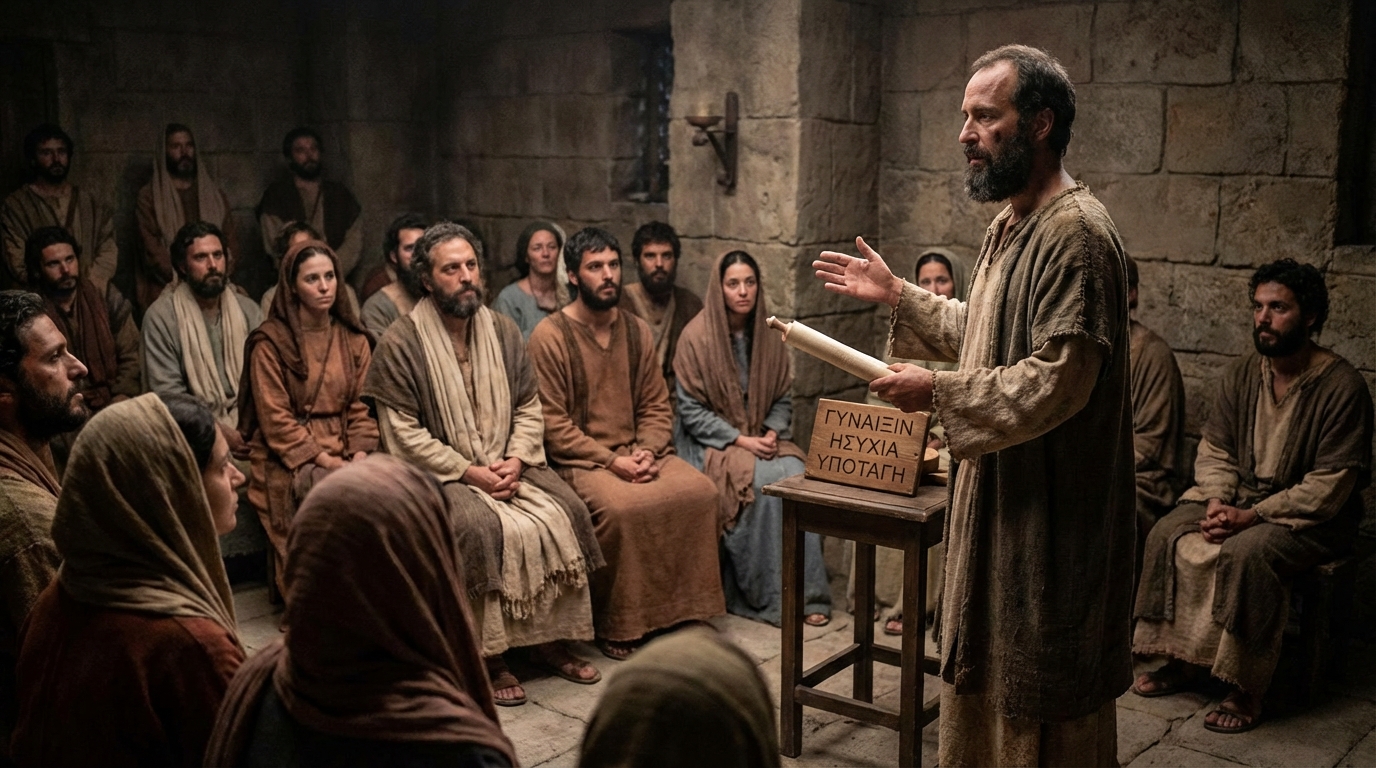
Avoiding Overgeneralization
It is important not to push this passage beyond what it actually says. Paul is not diminishing women, nor is he suggesting they are incapable or unimportant. Instead, he is emphasizing God’s design for order and roles within the church.
Misinterpreting this as a total ban on women speaking can lead to unnecessary extremes and confusion. On the other hand, ignoring the passage entirely removes an important part of biblical teaching on church structure.
A balanced understanding recognizes both truths:
- Women are valuable, gifted, and active in ministry
- Certain roles, particularly those involving authority over the congregation, are reserved according to God’s design
This careful distinction helps us remain faithful to Scripture without adding or subtracting from its message.
How This Relates to Women Pastors
When we connect 1 Corinthians 14:34–35 to the broader discussion of church leadership, it becomes clear that Paul is not dealing with a small, isolated issue. He is pointing to a consistent pattern of authority within the church gathering, which directly relates to the question of women serving as pastors.
Connect to Leadership Roles
A pastor is not merely someone who speaks in church. A pastor carries spiritual oversight, teaching authority, and responsibility for doctrine and direction within the congregation. This includes guiding the church, correcting error, and guarding the truth of the gospel.
In 1 Corinthians 14, Paul places limits on speaking that involves authority in the assembly. When this principle is combined with other New Testament teachings, it becomes evident that leadership roles in the church are structured with defined responsibilities.
From this perspective, the passage supports the idea that women are not assigned the role of authoritative teaching or governing leadership over the assembled church, which is central to pastoral ministry.
Why Pastoral Authority Is Restricted
The restriction is not based on value, ability, or worth. Scripture consistently affirms the dignity and spiritual gifts of women. Instead, the issue is order and divine design in church leadership.
Pastoral authority involves:
- Teaching doctrine to the whole church
- Exercising spiritual oversight
- Correcting and guiding believers
- Representing authority in matters of faith and practice
The New Testament presents this responsibility within a specific leadership structure. 1 Corinthians 14 contributes to this by emphasizing that church speech and participation must align with God-ordained order, not personal preference or cultural trends.

Comparing Other Key Bible Passages
To fully understand 1 Corinthians 14:34–35, it must be read alongside other passages that address church leadership and teaching authority. These texts reinforce a consistent biblical framework.
1 Timothy 2:11–12
This passage states:
“Let a woman learn in silence with all submission. And I do not permit a woman to teach or to have authority over a man, but to be in silence.”
Here, Paul clearly distinguishes between learning and exercising teaching authority over men in the church setting. The emphasis is not on limiting knowledge, but on defining roles within teaching and authority structures.
This aligns closely with 1 Corinthians 14, where order and submission in church speech are emphasized.
Titus 1:5–9
In this passage, Paul gives qualifications for elders (church leaders). He states that an elder must be:
- “the husband of one wife”
- “blameless”
- able to teach and refute error
The repeated masculine language and family structure assumptions reflect a leadership pattern centered on qualified men serving as elders and overseers.
This reinforces the idea that pastoral leadership is not presented as a gender-neutral role in the New Testament.
Role Distinctions
When these passages are viewed together, a consistent picture emerges:
- Women are highly valued in the church and actively involved in ministry
- However, teaching authority over the assembled church and pastoral oversight are assigned to men
- Church order is built on defined roles that support unity and doctrinal stability
Rather than diminishing women, this structure highlights complementary roles within God’s design for the church, where both men and women contribute meaningfully, but in distinct ways according to Scripture.
Common Objections and Misinterpretations
Because 1 Corinthians 14:34–35 is a challenging passage for many readers, several objections are often raised. These need to be addressed carefully so the text is not misunderstood or dismissed.
Cultural Argument
One common claim is that Paul’s instruction was simply a cultural practice of ancient Corinth and does not apply today. While it is true that Corinth had specific cultural issues affecting worship, Paul does not ground his instruction in culture alone. Instead, he appeals to broader principles of order, submission, and church conduct that appear consistently throughout his letters.
If the instruction were purely cultural, it would be difficult to explain why similar principles about authority and teaching appear in other New Testament writings as well.
“This Was Only for Corinth”
Another argument is that this passage was intended only for the Corinthian church because of its unique problems. However, Paul’s language does not limit the instruction to a single congregation. He frames it as part of a wider teaching on how churches should conduct themselves in worship gatherings.
In fact, Paul often addresses specific churches while still establishing principles meant for broader application. The instructions about order, speech, and authority in 1 Corinthians 14 align with teachings found in other epistles, suggesting a consistent pattern rather than an isolated rule.
“Paul Contradicts Himself”
Some point to passages where women pray or prophesy and claim Paul is contradicting himself. However, this assumes that all forms of speaking are the same in function and authority.
A closer reading shows that Paul distinguishes between:
- Participation in spiritual gifts
- And authoritative teaching or governing roles in the church
There is no contradiction when these roles are properly understood in their context. Instead, Paul maintains a consistent distinction between participation and leadership authority.

Why This Teaching Still Matters Today
Although written nearly two thousand years ago, 1 Corinthians 14:34–35 still carries important implications for the modern church.
Church Order
One of the strongest themes in this passage is the need for order in worship. Without structure, church gatherings can become confusing, disorderly, or centered on individuals rather than God’s Word.
Paul’s instruction helps establish a framework where:
- Worship is conducted peacefully
- Teaching is clear and accountable
- Leadership functions are properly defined
This remains relevant in any church setting, regardless of culture or time period.
Faithfulness to Scripture
Another key reason this teaching still matters is the call to remain faithful to God’s Word as written. The challenge for every generation is to submit modern preferences and cultural pressures to biblical authority.
Even when a passage is difficult, it invites believers to:
- Study Scripture carefully
- Interpret it in context
- Align practice with biblical truth
This approach protects the church from drifting away from God’s design for leadership and order.
In this way, 1 Corinthians 14:34–35 is not just about one issue in one church, but about maintaining faithfulness to the full counsel of Scripture in how the church is structured and led.
Read More: Women Pastors in the Bible
For a deeper and more comprehensive study on this topic, including a full examination of related passages and theological implications, read the full article:
👉 In-Depth Study: What does the Bible Say About Women Being a Preacher or Pastor?
Frequently Asked Questions
What does 1 Corinthians 14:34-35 mean?
This passage teaches that church gatherings should be marked by order and structure. In context, Paul is addressing the way speaking functions in the assembly and emphasizes that women are not to take authoritative speaking roles over the church. It is part of his broader instruction on maintaining proper order in worship.
Does this verse mean women cannot speak at all in church?
No. The passage is not a blanket prohibition on all speech. Women are seen elsewhere in Scripture praying, prophesying, and participating in ministry. The instruction is focused on authoritative teaching and governing speech in the church gathering, not everyday participation or general involvement.
Can a woman be a pastor according to the Bible?
From a complementarian reading of Scripture, pastoral leadership is reserved for qualified men. Passages like 1 Corinthians 14:34–35, 1 Timothy 2:11–12, and Titus 1:5–9 are understood to teach that the role of elder or pastor involves spiritual authority over the church, which is assigned to men according to the New Testament pattern.
Is Paul’s instruction cultural or universal?
While the letter addresses a specific church in Corinth, Paul grounds his teaching in broader principles of order, submission, and church authority. Because similar instructions appear in other New Testament writings, many understand this teaching as universal for church order rather than a purely cultural rule.
How does this relate to modern churches?
This passage continues to inform how many churches structure leadership and worship today. It emphasizes the importance of order, clear authority, and faithful adherence to biblical teaching. Churches that follow this interpretation apply it to pastoral roles and teaching authority while still valuing the full participation of women in many other areas of ministry.
Discover more from Becoming Christians
Subscribe to get the latest posts sent to your email.