Junia (Romans 16:7) was a first-century Jewish woman, one of the earliest followers of Jesus, and a missionary commended by the Apostle Paul as “outstanding among the apostles.” She was imprisoned for her faith, believed in Christ before Paul did, and likely served alongside her partner Andronicus as a church-planting missionary. While her story is remarkable, the word “apostle” in her case refers to a sent missionary — not the pastoral office reserved for qualified men in 1 Timothy 3. Junia is proof that women have always been essential to the gospel mission — equal in dignity before God, and equally called to courageous, Spirit-empowered service.
📢 Do you want to learn more about how God designed church government? If yes, check out our article, “In-Depth Study: What does the Bible Say About Women Being a Preacher or Pastor?“
If you have ever read through the closing chapter of Paul’s letter to the Romans, you may have passed over a single verse without much thought — Romans 16:7. And yet, tucked inside that one sentence is a woman whose story has sparked centuries of scholarly debate, theological wrestling, and quiet wonder.
Her name is Junia.
In a letter where Paul greets dozens of fellow believers, he singles out Junia (along with a man named Andronicus) with a commendation so glowing that the early church could not stop talking about it. She was, Paul said, “outstanding among the apostles” — a woman who had been imprisoned for her faith, who had believed in Christ before Paul himself did, and who was deeply respected in the earliest Christian communities.
So who was Junia? What do we actually know about her? And what does her story mean for how we understand women in the church today?
This article answers those questions honestly, engaging both the historical evidence and the theological conversation — including what her life means from a complementarian perspective that affirms the equal dignity of women before God while also recognizing that God has established distinct and beautiful roles for men and women in the church.
The Only Verse: Romans 16:7
Everything we know about Junia from the Bible comes from a single verse:
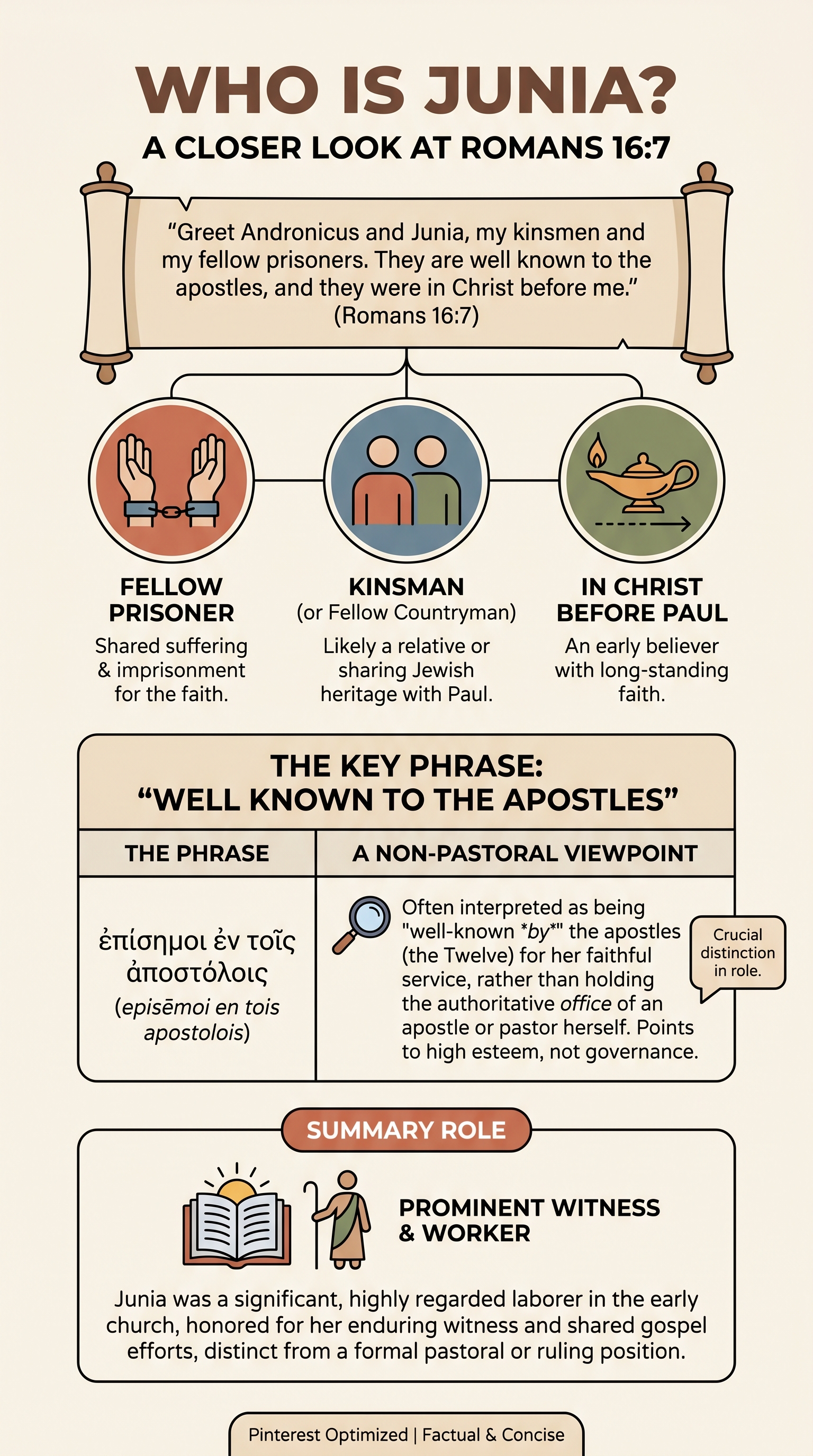
“Greet Andronicus and Junia, my fellow Jews who have been in prison with me. They are outstanding among the apostles, and they were in Christ before I was.” — Romans 16:7 (NIV)
It is brief. But it is packed.
In just one sentence, Paul tells us five remarkable things about Junia:
- She was connected to Andronicus — almost certainly his wife, though possibly a sister or close relative.
- She was Jewish by birth, like Paul himself.
- She had been imprisoned for her faith — making her one of the earliest known believers to be arrested for following Christ.
- She was “in Christ” before Paul — meaning she came to faith in Jesus before Paul’s Damascus Road conversion, placing her among the very first generation of Christians.
- She was “outstanding among the apostles” — a phrase that has been the center of much debate, as we will explore.

Was Junia Actually a Woman? The Name Debate
Before we can discuss what Paul said about Junia, we need to address the question that has shadowed her story for centuries: was “Junia” actually a woman’s name?
The short answer, based on overwhelming historical evidence, is yes.
The name Junia (Latin: Iunia) was one of the most common women’s names in the Roman world. Scholars have identified over 250 inscriptions from the early church era bearing the feminine name Junia, and no confirmed ancient evidence for a masculine version of the name (“Junias”) has ever been found outside of one late and disputed reference.
Early church fathers — including Origen, Jerome, John Chrysostom, and Peter Abelard — universally understood the name to refer to a woman. Chrysostom, writing in the fourth century, praised her explicitly: “How great the wisdom of this woman, that she should be even counted worthy of the appellation of apostle!”
It was not until the medieval period — particularly the 13th century, when Giles of Rome reinterpreted the name as masculine — that “Junia” began to be treated as a man’s name in some manuscript traditions. This change accelerated in the 19th and 20th centuries, when many English translations used “Junias” (masculine), only for most modern translations to restore the feminine “Junia” once scholarship caught up to the ancient evidence.
Today, the scholarly consensus — including among many complementarian scholars such as Douglas Moo and Thomas Schreiner — is that Junia was a woman. The name debate, for most serious Bible students, is settled.
What Does “Outstanding Among the Apostles” Really Mean?
This is where the real theological conversation begins.
The Greek phrase in Romans 16:7, episēmoi en tois apostolois, has been translated two ways:
- Inclusive reading: “Outstanding among the apostles” — meaning Junia herself was an apostle, and a notable one.
- Exclusive reading: “Well known to the apostles” — meaning Junia was highly regarded by the apostolic circle, but was not herself an apostle.
Most scholars — including a majority of complementarian commentators — favor the inclusive reading, holding that Paul is affirming both Andronicus and Junia as apostles in some sense. The native Greek speakers of the early church read it that way, and the linguistic evidence leans in that direction.
But this raises an important follow-up question: what did Paul mean by “apostle” here?
Two Kinds of Apostles in the New Testament
This is the key insight that much of the popular debate about Junia misses — and it is where a careful, complementarian reading of her story is most illuminating.
The New Testament uses the word “apostle” (apostolos) in at least two distinct ways:
1. The Twelve — the foundational apostles These were the twelve men Jesus personally chose and commissioned during his earthly ministry. They held a unique, unrepeatable office grounded in their eyewitness testimony of Christ’s resurrection (Acts 1:21–22). This foundational office was exclusive and is not replicated today.
2. Apostles in the broader sense — “sent ones” or missionaries Paul uses “apostle” more broadly to describe commissioned missionaries and church planters. Barnabas is called an apostle (Acts 14:14). Epaphroditus is called an apostle (Philippians 2:25, the Greek word translated “messenger”). Silas and Timothy are referred to apostolically (1 Thessalonians 2:6). In this broader sense, an apostle is simply one who is sent out — to proclaim the gospel, to plant churches, and to serve the advance of the kingdom.
It is almost certainly this second, broader sense in which Junia is called an apostle. She and Andronicus were likely a pioneering missionary couple — similar to Priscilla and Aquila — who traveled together, proclaimed the risen Christ, and helped establish early Christian communities. Given that they were “in Christ before Paul,” they may well have been eyewitnesses of the risen Jesus themselves, which would have given them significant credibility as messengers of the gospel.
To affirm Junia as an apostle in this missionary sense is not controversial from a complementarian perspective. As complementarian pastor Phil Whittall has noted: “Andronicus and Junia were an outstanding missionary couple who no doubt planted churches. Arguably they were apostles both because they witnessed the risen Christ and because they were sent. As a complementarian pastor I have absolutely zero problem with this.”
Junia and the Question of Women in Pastoral Leadership
Here is where we must be honest about the theological stakes of Junia’s story — and where this article parts ways with many others you will find online.
Many egalitarian writers cite Junia as definitive proof that women can and should hold the office of senior pastor or elder in the church today. The argument goes: if Paul honored a woman as an apostle, surely there can be no restriction on women holding any church leadership role.
But this argument moves too fast, and it glosses over several important distinctions.
First, as discussed above, Junia was not an apostle in the same sense as the Twelve. Being a sent missionary — however honored and effective — is not equivalent to holding the office of elder or pastor in a local church.
Second, Paul’s own letters — written by the same man who praised Junia in Romans 16 — contain clear and carefully reasoned instructions about the specific role of elder/overseer in the church. In 1 Timothy 2:12 and 3:1–7, Paul connects male eldership not to cultural convention but to the order of creation and the pattern established in Genesis. This is not incidental. Paul grounds his teaching in a theological reality that transcends time and culture.
Third, Junia’s commendation in Romans 16 should not be read in isolation from the rest of Paul’s teaching. The same letter that praises Junia also contains Paul’s rich theology of distinct gifts and roles within the body of Christ (Romans 12). The same apostle who honored women as coworkers also gave careful instruction about the pattern of male leadership in the gathered church.
Junia is not a contradiction of complementarianism — she is an example of its fullest vision.
Top 3 Christian Books for Women in April 2026


What Junia Teaches Us About Women in the Church
Far from diminishing women, Junia’s story — read carefully and honestly — reveals a vision of women’s ministry that is both extraordinary and completely consistent with a complementarian understanding of Scripture.
Consider what we know about her:
She was a courageous witness. Junia did not come to faith quietly and stay at home. She was arrested and imprisoned for her beliefs — among the very first followers of Christ to face that cost. Her courage was real, visible, and costly.
She was a gospel worker. Whether as a church planter, evangelist, or missionary, Junia was “sent” in the fullest sense. Her work was not marginal. Paul held her up to the entire Roman church as someone worthy of greeting and honor.
She was a woman of deep theological standing. She believed in Christ before Paul. She had likely seen the risen Lord. She was someone whose testimony about Jesus carried weight among the earliest Christians.
She was honored alongside her partner. Whether Andronicus was her husband or a close relative, Junia worked in partnership with another person — a picture of the kind of co-laboring that the church, at its best, has always celebrated.
None of this requires Junia to have held the office of elder or pastor for us to be moved by her story. In fact, it is more powerful to recognize that Junia accomplished all of this within a framework where God has set distinct roles for men and women — not because women are lesser, but because God, in his wisdom, designs the church to reflect a particular kind of order that points to something beyond itself.
The New Testament is full of women like Junia. Phoebe was a deaconess and the trusted carrier of Paul’s letter to the Romans (Romans 16:1–2). Priscilla taught Apollos alongside her husband (Acts 18:26). Philip’s daughters prophesied (Acts 21:9). Mary “worked hard” for the Roman church (Romans 16:6). Lydia hosted a church in her home (Acts 16:40). These women were not silenced, sidelined, or diminished. They were celebrated, commissioned, and essential to the mission of the early church.
The Bible’s vision is not that women should do less — it is that women and men, working from their God-given roles, together accomplish something greater than either could alone.
Could Junia Be the Same Person as Joanna?
One intriguing thread in recent scholarship deserves mention: could Junia and the Joanna mentioned in Luke’s Gospel be the same person?
Luke 8:1–3 introduces Joanna, the wife of Chuza (a manager in Herod’s household), as one of the women who traveled with Jesus and supported his ministry financially. Luke 24:10 identifies Joanna as one of the women who discovered the empty tomb and announced the resurrection — making her, in a real sense, one of the first witnesses to the risen Christ.
Some scholars, including Richard Bauckham, have proposed that “Joanna” may have adopted the Roman name “Junia” — a common practice for Jewish people living in the Roman world (just as “Saul” became “Paul”). If true, this would make Junia not only an apostolic missionary but an eyewitness of the resurrection — someone whose faith in the risen Christ came from her own direct experience.
This identification remains speculative, but it is consistent with Paul’s note that Junia was “in Christ before I was.” If she followed Jesus during his earthly ministry, her Christian faith would predate Paul’s by several years.
Why Junia Was Hidden — and Why She Matters Now
For much of modern church history, Junia was effectively erased. Her name was changed to the masculine “Junias” in many translations, stripping her of her identity. Her story was minimized. Her commendation was softened.
This is worth acknowledging honestly. Whatever one’s theological convictions about gender roles, the historical effort to obscure Junia’s identity was not a reflection of faithful biblical scholarship — it was a reflection of bias. And complementarians who care about Scripture should be among the first to say so.
Recovering Junia’s story is not a concession to egalitarianism. It is a commitment to honesty about what the Bible actually says. Junia was a woman. She was honored by Paul. She served the gospel with courage and distinction. Her name belongs in the conversation about the great women of the New Testament.
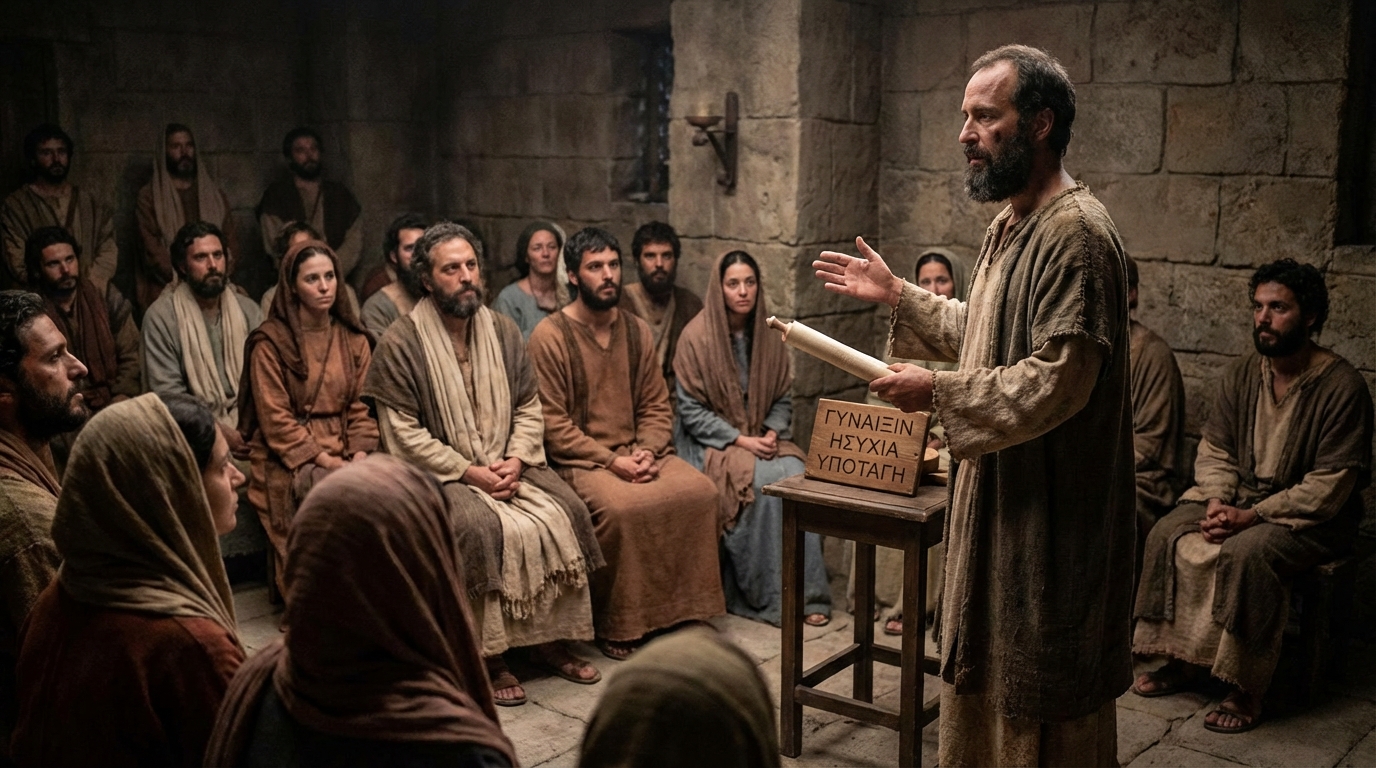
At the same time, recovering Junia’s story also means reading it fully — not just the parts that fit a predetermined agenda on either side of the gender debate. When we do that, we find a woman whose life reflects exactly what complementarians have always believed: that women are fully equal in dignity and worth before God, capable of extraordinary service and sacrifice, and called to roles of gospel ministry that are honored, celebrated, and essential — even while God has reserved the specific office of elder/pastor for qualified men.
Conclusion: Junia, Remembered and Honored
Junia deserves to be remembered.
She was among the earliest followers of Jesus. She endured imprisonment for her faith. She was commended by the Apostle Paul as outstanding in her work. And for much of Christian history, her identity was systematically obscured.
Her story does not resolve the debate about women’s roles in the church — but it enriches it. It reminds us that women have always been on the front lines of the gospel. It challenges us to honor and celebrate the women in our own churches who serve with courage, faithfulness, and grace.
And it calls us to read the Bible honestly — neither inflating Junia’s story beyond what the text says, nor diminishing it below what Paul clearly intended.
Junia was great. Her greatness fits within God’s good design. And that is a story worth telling.
What’s Next?
Junia’s story raises a question that every serious Bible student eventually faces: What does Scripture actually say about women in pastoral leadership? Not what culture says. Not what tradition assumes. What the Bible itself says — carefully, honestly, and in full context. If Junia’s life stirred something in you, don’t stop here.
📖 [Read Next: In-Depth Study — What Does the Bible Say About Women Being a Preacher or Pastor?]
Frequently Asked Questions About Junia in the Bible
Yes. Junia is mentioned by name in Romans 16:7, and early church writers reference her consistently. She is one of the most well-attested women in the New Testament outside of Mary.
Romans 16:7 is the only direct mention of Junia by name in the New Testament. Some scholars believe she may be the same person as Joanna in Luke 8:3 and 24:10, but this identification is not certain.
Most scholars believe Junia and Andronicus were a married couple, similar to Priscilla and Aquila. Paul’s reference to them together, and his use of the word “relatives” (which may indicate close associates rather than blood relatives), supports this view.
Most scholars interpret this as meaning Junia was herself an apostle — likely in the broader New Testament sense of a commissioned missionary or church planter, rather than one of the original Twelve.
No. Junia’s apostolic role was that of a missionary — a “sent one” who proclaimed the gospel and likely helped plant churches. This is distinct from the office of elder/pastor in a local church, for which Paul gives specific qualifications in 1 Timothy 3 and Titus 1 that point toward male leadership.
Beginning in the medieval period and accelerating in the 19th and 20th centuries, some Bible translators rendered the name as the masculine “Junias,” likely due to the assumption that a woman could not be an apostle. Most modern translations have now restored the original feminine name “Junia.”
Discover more from Becoming Christians
Subscribe to get the latest posts sent to your email.