Walk into four different Christian churches and you might notice something interesting.
They may all talk about Jesus. They may all use the Bible. They may all sing Christian songs, pray, preach, and encourage people to follow God.
Yet their teachings can be surprisingly different.
A Pentecostal church may emphasize the gifts of the Holy Spirit and speaking in tongues. A Baptist church may strongly emphasize baptism by immersion and salvation by faith. A Presbyterian church may emphasize God’s sovereignty and covenant theology. A Methodist church may emphasize holy living, sanctification, and practical Christian discipleship.
So what exactly is the difference?
Are these simply different styles of Christianity, or do they actually teach different things?
The answer is both.
Pentecostals, Baptists, Presbyterians, and Methodists all come from the broader Protestant Christian tradition, but they developed from different historical movements and have different understandings of baptism, salvation, church government, predestination, the Holy Spirit, spiritual gifts, and Christian living.
Most importantly, we should not simply ask, “Which denomination is right?”
We should ask a more important question:
What does the Bible actually teach?
Let’s examine each tradition and then compare them.
📢 Do you want to learn more about the Bible? If yes, join our FREE online community where you will receive daily reflections, podcasts, and videos to help you grow in the grace and knowledge of Christ!
1. Pentecostals
Pentecostalism is one of the more recent major movements within Protestant Christianity.
It developed primarily in the early twentieth century and places a strong emphasis on the supernatural work of the Holy Spirit.
Pentecostal Christians generally believe that the spiritual gifts described in the New Testament are still available to Christians today.
These may include:
- Speaking in tongues
- Interpretation of tongues
- Prophecy
- Healing
- Miracles
- Words of knowledge
- Other spiritual gifts
One of the distinctive teachings of many Pentecostal churches is the idea of a special experience commonly called the baptism in the Holy Spirit.
Many Pentecostals associate speaking in tongues with this experience.
However, Pentecostalism is not completely uniform. Some Pentecostals teach that speaking in tongues is the initial evidence of Spirit baptism, while other charismatic Christians have different views.
What about speaking in tongues?
This is one area where careful Bible study is especially important.
The New Testament certainly speaks about speaking in tongues.
For example:
“And they were all filled with the Holy Spirit and began to speak with other tongues, as the Spirit gave them utterance.”
Acts 2:4, NKJV
But what were these tongues?
Acts 2 provides an important clue. The people who heard the apostles were from different nations and heard them speaking in their own languages.
The miracle allowed people from different linguistic backgrounds to understand the message.
Paul also discussed the gift of tongues in 1 Corinthians 12 to 14.
But Paul did not teach that every Christian must speak in tongues.
He asked:
“Do all speak with tongues?”
1 Corinthians 12:30, NKJV
The expected answer is no.
Paul had already explained that the Holy Spirit gives different gifts to different people:
“But one and the same Spirit works all these things, distributing to each one individually as He wills.”
1 Corinthians 12:11, NKJV
This is important.
The Bible does teach spiritual gifts, but it does not teach that every Christian must possess the same gift.
Paul also emphasized that spiritual gifts must be exercised properly and orderly.
“Let all things be done decently and in order.”
1 Corinthians 14:40, NKJV
Therefore, when examining Pentecostal practices, the question should not simply be, “Is this supernatural?”
The question should be:
Does this practice agree with Scripture?
2. Baptists
Baptist churches have roots reaching back several centuries, although Baptist history is complex and different Baptist groups developed in different ways.
One of the most recognizable Baptist teachings is believer’s baptism.
Baptists generally reject the practice of baptizing infants.
Instead, they believe baptism should follow a person’s conscious faith in Christ.
This is commonly performed by immersion.
The reasoning comes from passages such as Acts 2:38, Acts 8:36-38, and Romans 6:3-4.
For example:
“Then those who gladly received his word were baptized.”
Acts 2:41, NKJV
The pattern is significant.
People heard the message, believed, repented, and were baptized.
Baptists and salvation
Baptists generally emphasize salvation by grace through faith rather than salvation through religious works.
Many Baptist churches strongly emphasize the teaching commonly called eternal security or once saved, always saved.
However, Baptists differ considerably on this issue.
Some Baptist traditions teach that a genuinely saved person cannot ultimately lose salvation. Others emphasize perseverance and the evidence of genuine faith.
This is an area where we should carefully distinguish between what the Bible says and theological systems built around particular passages.
Scripture certainly teaches that salvation is God’s gift and that we cannot earn it through works.
But the Bible also repeatedly warns Christians about falling away, continuing in faith, resisting God, and overcoming.
Jesus Himself said:
“But he who endures to the end shall be saved.”
Matthew 24:13, NKJV
So Christians should not use the doctrine of grace as an excuse for careless living.
Grace does not eliminate obedience.
Jesus said:
“If you love Me, keep My commandments.”
John 14:15, NKJV
You should also read:
3. Presbyterians
Presbyterianism grew out of the Protestant Reformation, particularly through the work and influence of John Calvin and the Reformed tradition.
The name “Presbyterian” comes from the Greek word presbyteros, meaning elder.
This gives us a clue about Presbyterian church government.
Rather than having each congregation completely independent, Presbyterian churches are generally governed through groups of elders.
Their theology has historically been strongly influenced by Reformed theology.
One of the major distinctive teachings is an emphasis on God’s sovereignty.
Traditional Reformed theology often emphasizes doctrines commonly summarized through concepts such as:
- Human depravity
- God’s election
- Predestination
- Effectual calling
- Perseverance of the saints
Different Presbyterian denominations express these doctrines differently, and not every Presbyterian today holds precisely the same theological position.
Presbyterianism and predestination
Predestination is one of the most significant differences between Presbyterian theology and many other Protestant traditions.
Traditional Calvinist theology teaches that God sovereignly chooses those who will ultimately be saved.
This raises an obvious question:
What about human free will?
Reformed theology generally answers by emphasizing God’s sovereignty over salvation, while explaining human responsibility within that sovereignty.
Other Christians understand biblical passages about election and predestination differently.
For example, Paul wrote:
“For whom He foreknew, He also predestined to be conformed to the image of His Son.”
Romans 8:29, NKJV
The Bible unquestionably talks about God’s foreknowledge, election, calling, and predestination.
The question is how those passages should be understood alongside the many Scriptures that call human beings to repent, choose, obey, and remain faithful.
Joshua famously declared:
“Choose for yourselves this day whom you will serve.”
Joshua 24:15, NKJV
Scripture therefore presents both God’s sovereignty and human responsibility.
We should be careful not to force one group of verses to cancel out another.
Grow Closer to God…

4. Methodists
Methodism developed from the eighteenth-century revival movement associated especially with John Wesley.
Wesley emphasized practical Christian discipleship, holiness, sanctification, and a transformed life.
This is one of the major characteristics of Methodist theology.
Methodists generally place considerable emphasis on what is often called sanctification, meaning the process by which a Christian grows in holiness and becomes increasingly conformed to God’s will.
John Wesley famously taught about Christian perfection or entire sanctification, although Methodist groups today differ in how they understand these concepts.
Methodism also historically emphasizes God’s grace working in a person’s life.
Wesleyan theology generally differs from strict Calvinism in its understanding of free will, election, and salvation.
A common Wesleyan concept is prevenient grace, meaning God’s grace works in a person before conversion and enables the person to respond to God.
Methodists also tend to emphasize the possibility of genuine Christian growth.
The Christian life is not merely about saying a prayer and waiting for heaven.
It involves becoming more like Christ.
Paul wrote:
“But speaking the truth in love, may grow up in all things into Him who is the head, Christ.”
Ephesians 4:15, NKJV
This emphasis on Christian growth is one of the stronger aspects of the Wesleyan tradition.
Top 3 Best-Selling Christian Books for October 2026


So What Are the Biggest Differences?
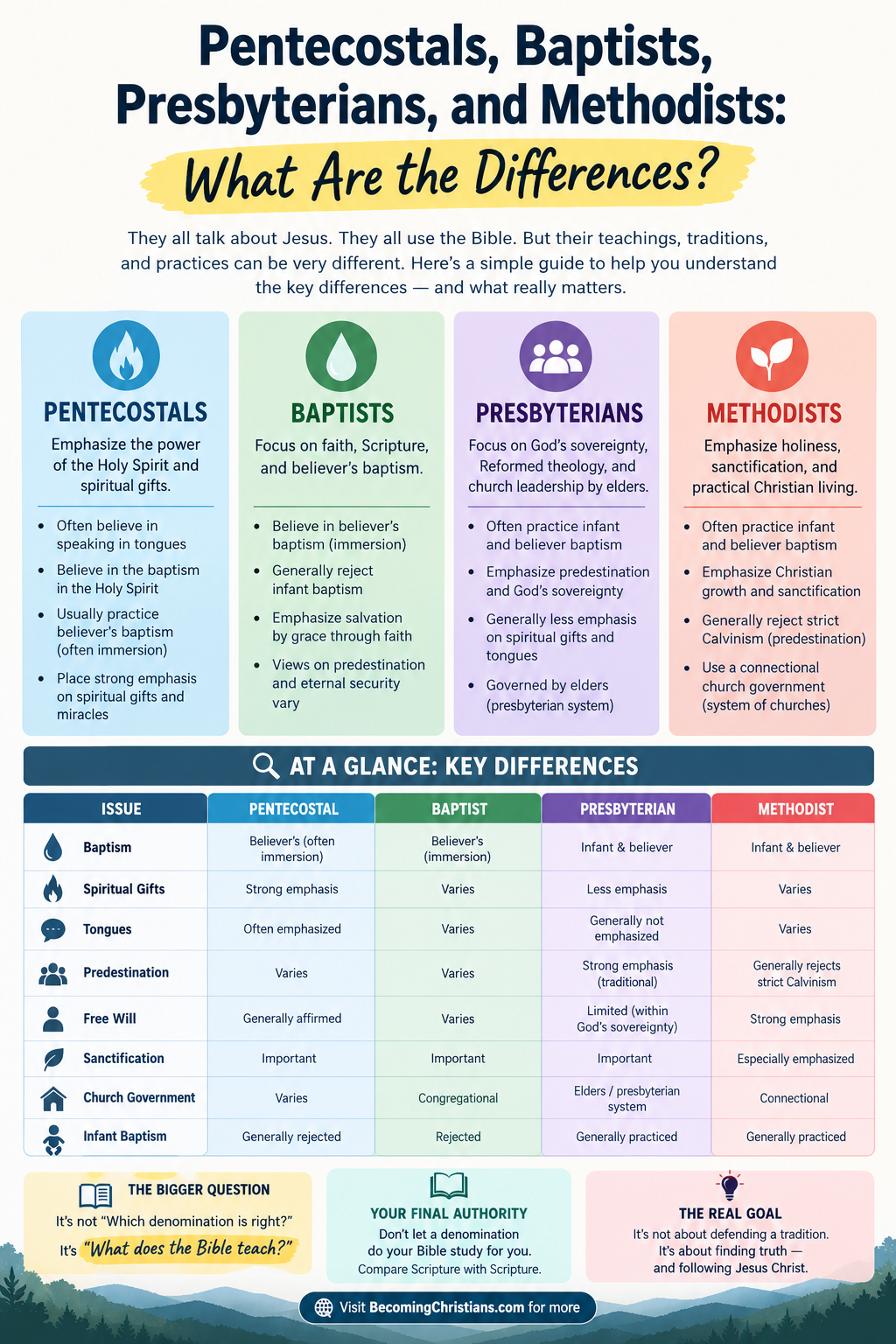
Let’s put the major differences together.
| Issue | Pentecostal | Baptist | Presbyterian | Methodist |
|---|---|---|---|---|
| Historical roots | Pentecostal revival | Baptist movement | Reformed/Calvinist tradition | Wesleyan revival |
| Baptism | Generally believers, often immersion | Believers, immersion | Usually infant and believer baptism | Usually infant and believer baptism |
| Spiritual gifts | Strong emphasis | Varies, often more cautious | Generally less emphasis | Varies |
| Tongues | Often accepted and emphasized | Varies | Generally not emphasized | Varies |
| Predestination | Varies | Varies | Historically strong emphasis | Generally rejects strict Calvinism |
| Free will | Generally affirmed | Varies | Traditionally limited within God’s sovereignty | Strong emphasis |
| Sanctification | Important | Important | Important | Especially emphasized |
| Church government | Varies | Usually congregational | Elders/presbyterian system | Connectional system |
| Infant baptism | Generally rejected | Rejected | Generally practiced | Generally practiced |
This table gives us a general picture, but there are many exceptions.
For example, there are Baptist churches that are Calvinistic, Pentecostal churches that differ significantly from one another, Presbyterians who do not hold every traditional Calvinist doctrine, and Methodists who understand Wesleyan theology differently.
Denominational labels can therefore tell us something about a church, but they cannot tell us everything.
What About Baptism?
Baptism is one of the clearest differences.
Baptists and most Pentecostals generally practice believer’s baptism.
Presbyterians and Methodists generally practice both infant baptism and believer’s baptism.
The disagreement comes down partly to how they understand the biblical role of baptism and the relationship between the Old and New Covenants.
Those who practice infant baptism often connect baptism with covenant theology.
Those who practice believer’s baptism emphasize the New Testament pattern of repentance, faith, and baptism.
Consider the Ethiopian eunuch.
After Philip explained the gospel to him, the eunuch asked:
“See, here is water. What hinders me from being baptized?”
Acts 8:36, NKJV
Philip then baptized him.
The repeated New Testament pattern of people hearing the gospel, believing, repenting, and then being baptized is an important consideration.
But baptism itself does not magically produce salvation.
The thief who died beside Jesus was not baptized, yet Jesus promised him a place in His coming Kingdom.
The important issue is therefore not simply which denomination has the correct baptismal tradition.
The deeper question is:
What does baptism represent, and what does God require from those who seek Him?
What About the Holy Spirit?
Here the differences become particularly noticeable.
Pentecostal Christianity places considerable emphasis on the Holy Spirit and supernatural gifts.
Other Protestant traditions may acknowledge the Holy Spirit while placing less emphasis on miraculous manifestations.
But there is another important biblical question.
Who or what is the Holy Spirit?
Many Christian denominations teach that the Holy Spirit is the third person of a Trinity.
However, the Bible repeatedly describes God’s Spirit in terms of God’s power, presence, breath, mind, and activity.
Paul wrote:
“For what man knows the things of a man except the spirit of the man which is in him? Even so no one knows the things of God except the Spirit of God.”
1 Corinthians 2:11, NKJV
The Holy Spirit is God’s Spirit.
It is through God’s Spirit that He works in His people, reveals truth, strengthens them, and transforms their lives.
Therefore, when comparing denominations, we should not simply ask which group talks most about the Holy Spirit.
We should ask:
What does Scripture actually reveal about God’s Spirit?
What About the Trinity?
This is another major theological issue that goes beyond the differences between these four traditions.
Pentecostals, Baptists, Presbyterians, and Methodists generally accept the traditional doctrine of the Trinity, although Pentecostalism includes different movements and formulations, including Oneness Pentecostalism, which rejects the traditional Trinitarian formulation.
Traditional Trinitarian Christianity teaches that God is one Being who exists eternally as three persons: Father, Son, and Holy Spirit.
But if we want to establish doctrine from Scripture, we should carefully examine what the Bible actually says about the Father, the Son, and the Holy Spirit rather than simply accepting a theological formula because it has been repeated for centuries.
Jesus Himself clearly distinguished Himself from the Father.
He prayed to the Father.
He said the Father sent Him.
And after His resurrection, He said:
“I am ascending to My Father and your Father, and to My God and your God.”
John 20:17, NKJV
The Bible reveals the Father and the Son as distinct divine beings within the God Family, while the Holy Spirit is God’s Spirit and power working through them.
This is an important area where simply identifying as “Protestant” does not settle the question.
Which One Is the Biblical Church?
At this point, someone might ask:
“So which denomination is correct?”
There is a danger in approaching Christianity this way.
Jesus did not command His followers to become Baptists, Pentecostals, Presbyterians, or Methodists.
Those denominational labels came much later.
The early Christians were called Christians because they followed Christ.
The question we should therefore ask is not:
“Which denomination should I join?”
but:
“Am I following Jesus Christ according to the Word of God?”
A church can have excellent music, a friendly congregation, powerful preaching, and thousands of members while still teaching doctrines that are not supported by Scripture.
Likewise, a small congregation can have biblical truth without having impressive facilities, programs, or numbers.
Jesus warned:
“And in vain they worship Me, Teaching as doctrines the commandments of men.”
Mark 7:7, NKJV
That is why Christians must examine what they are taught.
Don’t Let a Denomination Do Your Bible Study for You
There is nothing wrong with learning about church history.
It is helpful to understand where Pentecostalism, Baptists, Presbyterianism, Methodism, Catholicism, Orthodoxy, and other Christian movements came from.
But our final authority should not be a denomination.
It should be the Word of God.
The Bereans provide an excellent example.
When Paul preached to them, they did not simply accept everything because Paul was an apostle.
They searched the Scriptures.
Luke wrote:
“These were more fair-minded than those in Thessalonica, in that they received the word with all readiness, and searched the Scriptures daily to find out whether these things were so.”
Acts 17:11, NKJV
That is an excellent principle for every Christian.
Don’t believe something simply because a Pentecostal preacher says it.
Don’t believe something simply because a Baptist pastor says it.
Don’t believe something simply because a Presbyterian theologian says it.
Don’t believe something simply because a Methodist minister says it.
And don’t believe something simply because I say it.
Open your Bible.
Read the passages.
Examine the context.
Compare Scripture with Scripture.
Then determine whether the teaching is actually biblical.
The Bigger Question
Pentecostals, Baptists, Presbyterians, and Methodists have genuine differences.
Some are relatively minor.
Others are major theological disagreements.
They differ over baptism, spiritual gifts, predestination, free will, church government, sanctification, and other doctrines.
But there is a lesson that is even more important than understanding these differences.
A Christian should never allow a denominational label to replace personal Bible study.
You may have been raised Baptist.
Perhaps your family is Methodist.
Maybe you attend a Presbyterian church.
Perhaps you grew up Pentecostal.
Those things may describe your religious background.
But they do not automatically establish biblical truth.
Jesus said:
“Sanctify them by Your truth. Your word is truth.”
John 17:17, NKJV
The goal should therefore not be to defend a denomination.
The goal should be to seek truth.
And when we discover that one of our beliefs does not agree with Scripture, we should have enough humility to change our belief rather than changing the Scripture to protect our tradition.
After all, the question is not, “What does my church teach?”
The question is:
“What does the Bible teach?”
Discover more from Becoming Christians
Subscribe to get the latest posts sent to your email.