If you’ve spent time studying the Bible, you may have heard a surprising claim:
The Ethiopian Bible has 81 books.
If the Protestant Bible has only 66 books, does that mean something is missing?
Are there books that were removed from the Bible?
And does the Ethiopian Bible preserve the original Scriptures that other Christians lost?
These are fascinating questions, but they require careful examination. The difference between the Ethiopian and Protestant Bibles is real, but the story is more complicated than simply saying that one Bible has “more books” than the other.
Let’s take a closer look.
📢 Do you like to learn more about the Bible? If yes, join our free thriving online community where I share informative articles, engaging podcasts, and highly visualized videos to help us grow together in the grace and knowledge of Yeshua.
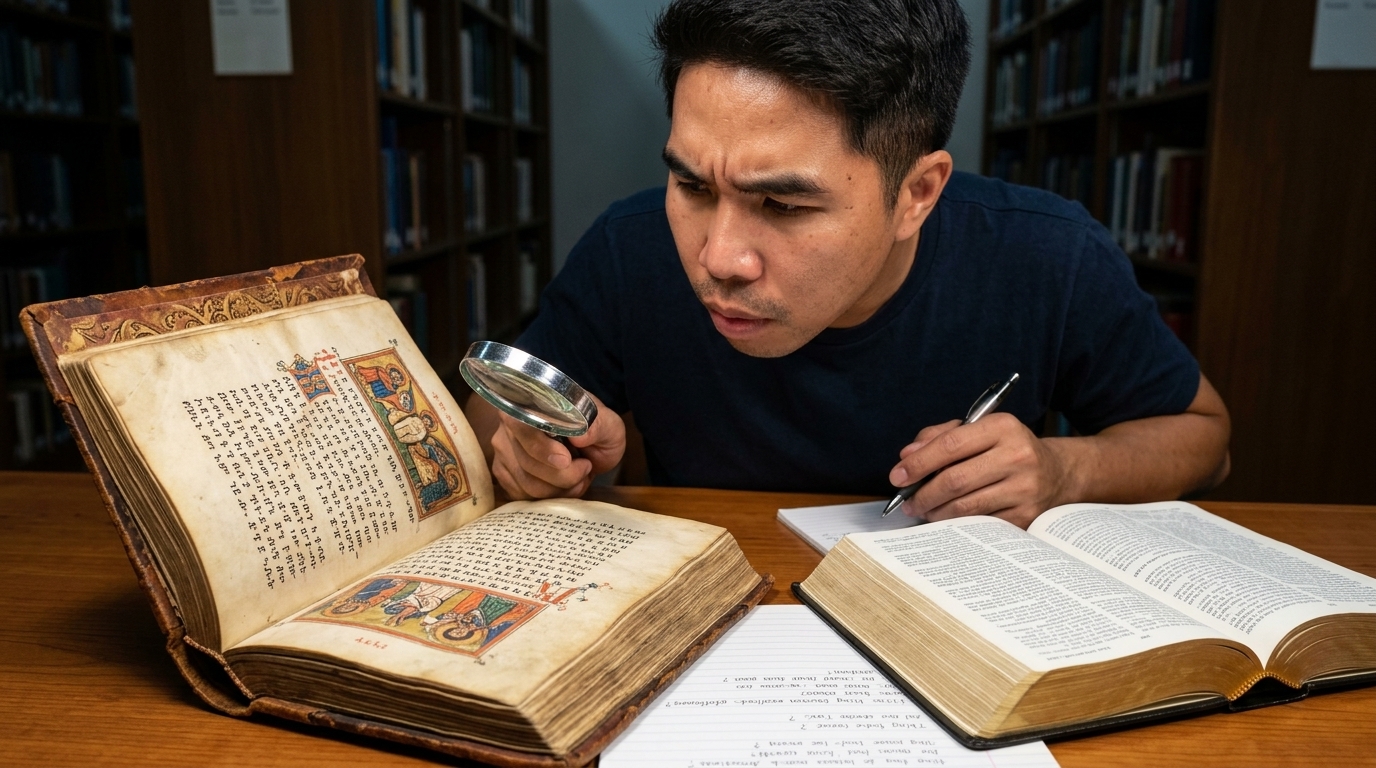
What is the Ethiopian Bible?
The Ethiopian Bible refers primarily to the collection of biblical books recognized by the Ethiopian Orthodox Tewahedo Church, one of the world’s oldest Christian traditions.
Christianity has a very ancient history in Ethiopia. The Ethiopian eunuch mentioned in Acts 8 was already reading the prophet Isaiah when Philip encountered him:
“So he said, ‘How can I understand it, unless someone guides me?’ And he asked Philip to come up and sit with him.”
Acts 8:31, NKJV
The Ethiopian Christian tradition later developed its own distinctive biblical canon.
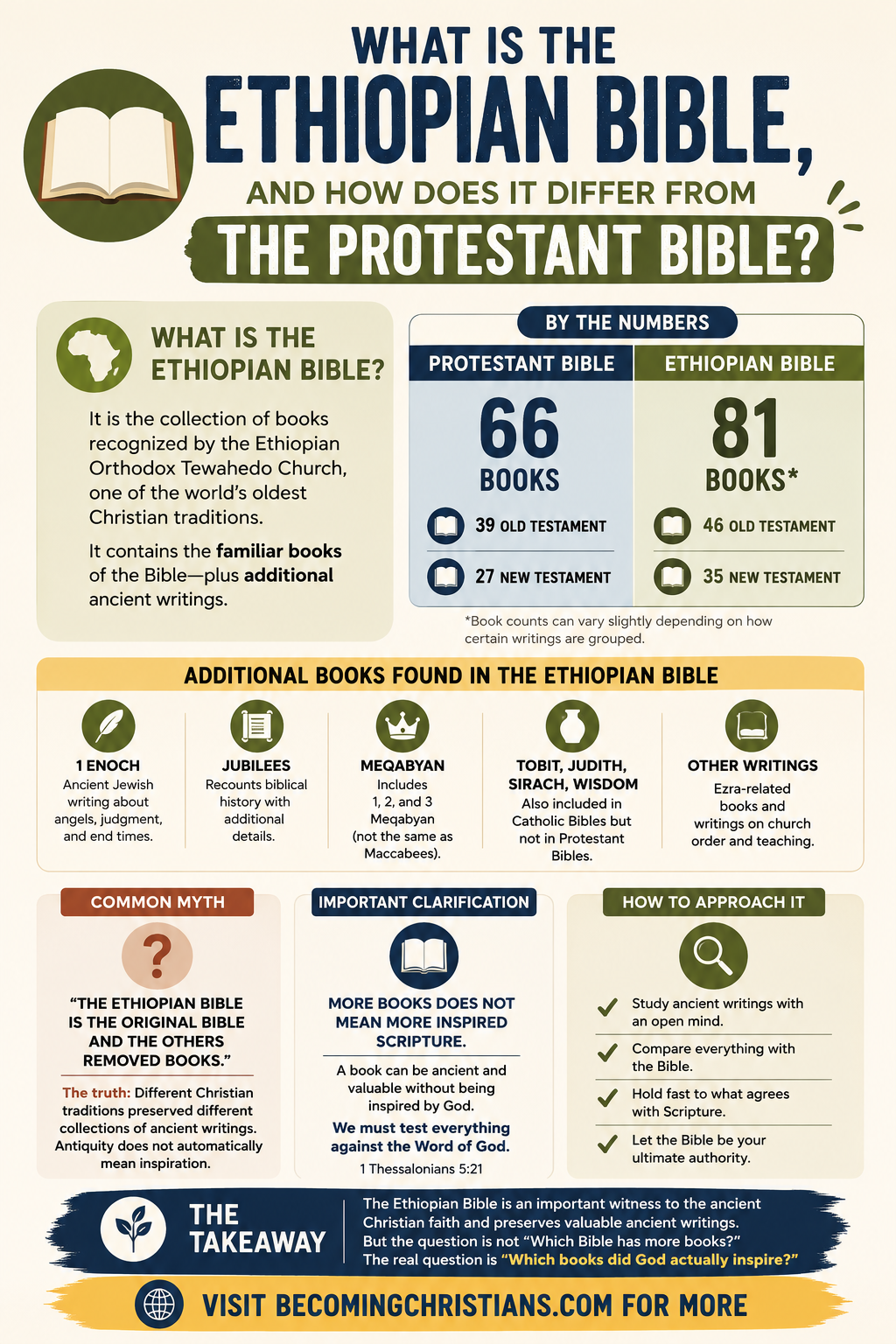
The Ethiopian Orthodox Church traditionally recognizes 81 books, although the exact way the books are counted and grouped can vary.
By comparison, the Protestant Bible contains 66 books:
- 39 books in the Old Testament
- 27 books in the New Testament
The Ethiopian Bible contains the familiar books of Scripture, but it also includes additional writings that are not found in the Protestant canon.
Some of the most notable are 1 Enoch, Jubilees, and 1, 2, and 3 Meqabyan, along with several other books and writings.
This immediately raises an important question:
Does having more books automatically mean having more inspired Scripture?
Not necessarily.
Why does the Ethiopian Bible have more books?
The answer has to do with the history of how different Jewish and Christian communities preserved and recognized sacred writings.
The Bible did not originally arrive as one leather-bound volume containing a table of contents.
The Old Testament developed as a collection of sacred writings among the people of Israel. The New Testament writings were produced by the apostles and their associates and were gradually recognized and circulated among Christian communities.
Different Christian traditions eventually came to recognize somewhat different collections of books.
The Ethiopian Church preserved a broader collection than the Protestant churches.
This does not mean that the Protestant Bible simply “removed” 15 books from the Ethiopian Bible.
It is more accurate to say that different Christian traditions developed different canons.
That distinction matters.
What books are different?
The Protestant Old Testament contains 39 books, beginning with Genesis and ending with Malachi.
The New Testament contains 27 books, beginning with Matthew and ending with Revelation.
The Ethiopian biblical tradition contains all the familiar books of the Bible but also recognizes additional writings.
Among the best-known are:
- 1 Enoch
- Jubilees
- 1 Meqabyan
- 2 Meqabyan
- 3 Meqabyan
- Additional Ezra-related writings
- Other writings associated with church order and Christian teaching
The Ethiopian books called Meqabyan should not be confused with the books of Maccabees found in Catholic Bibles. They are different works.
This is one reason why claims about the Ethiopian Bible can become confusing very quickly. Simply comparing book numbers does not tell the whole story.
What is the Book of Enoch?
Perhaps the most famous additional Ethiopian book is 1 Enoch.
Enoch is an ancient Jewish work that discusses subjects such as angels, judgment, heavenly beings, visions, and the coming judgment of the wicked.
It is particularly interesting to Christians because the New Testament book of Jude contains a prophecy that closely corresponds to a passage in 1 Enoch.
Jude writes:
“Now Enoch, the seventh from Adam, prophesied about these men also, saying, ‘Behold, the Lord comes with ten thousands of His saints…'”
Jude 14, NKJV
Because Jude refers to Enoch, some people conclude:
“If Jude quoted Enoch, then the entire Book of Enoch must be inspired Scripture.”
But that conclusion does not necessarily follow.
A biblical writer can quote or refer to a statement without declaring the entire work from which that statement came to be inspired Scripture.
Paul provides an interesting example.
In Acts 17:28, Paul quoted Greek poets when speaking to the people of Athens. Yet that does not mean the entire works of those Greek poets became Scripture.
Therefore, Jude’s reference to Enoch demonstrates that Jude knew and used a tradition associated with Enoch. It does not, by itself, establish that every word in the Book of Enoch was inspired by God.
That distinction is extremely important.
Grow Closer to God…

Does the Ethiopian Bible prove that Enoch belongs in the Bible?
No.
The fact that the Ethiopian Orthodox Church recognizes 1 Enoch as Scripture is historically significant. It shows that this ancient Christian tradition preserved and valued the book in a way that most other Christian traditions did not.
But church acceptance alone does not prove divine inspiration.
If we are going to call a book “Scripture,” the more important question is whether we have good reason to believe that God actually inspired it.
The Bible repeatedly tells us to test what we hear rather than blindly accept every spiritual claim.
Paul wrote:
“Test all things; hold fast what is good.”
1 Thessalonians 5:21, NKJV
That principle should apply to our study of ancient religious writings as well.
We should not reject a book simply because it is unfamiliar.
But neither should we accept a book simply because it is ancient or because a particular religious tradition considers it canonical.
Is the Ethiopian Bible the oldest Bible?
You may also encounter another claim online:
“The Ethiopian Bible is the oldest Bible in the world.”
There is some truth behind the fascination, but the statement can be misleading.
Ethiopia has an extraordinarily ancient Christian tradition, and Ethiopian Christianity preserved biblical manuscripts and ancient writings that are extremely valuable for understanding the history of Christianity.
However, that does not prove that the Ethiopian canon of 81 books represents the exact canon used by the earliest Christians.
The existence of an ancient Christian tradition is not the same thing as proof that every book preserved by that tradition was originally inspired Scripture.
We need to separate antiquity from inspiration.
A book can be very old without being Scripture.
Likewise, a manuscript can be historically valuable without every word in it being divinely inspired.
Were books removed from the Protestant Bible?
This is probably the biggest misconception surrounding the subject.
You will sometimes hear:
“The Catholic Church removed books.”
Or:
“The Protestant Church removed books.”
Or:
“The Ethiopian Bible contains the books that Western Christianity deliberately took out.”
These statements are too simplistic.
The history of the biblical canon is much more complicated.
The Protestant Old Testament is based on the books traditionally recognized within the Hebrew Scriptures, arranged into 39 books in Protestant Bibles.
Catholic Bibles include additional Old Testament books commonly called the Deuterocanonical books.
The Ethiopian tradition contains an even broader collection.
So instead of imagining one original 81-book Bible that someone later cut down to 66 books, it is better to understand that different communities preserved and recognized different collections of ancient writings.
The question then becomes:
Which writings should actually be regarded as inspired Scripture?
That is the question worth investigating.
More books does not necessarily mean a more complete Bible
Imagine finding an ancient library containing hundreds of religious writings.
Would we conclude that every document in the library must be Scripture?
Of course not.
The number of books does not determine inspiration.
The same principle applies to the Ethiopian Bible.
Having 81 books does not automatically make it more complete than the Protestant Bible.
Likewise, having 66 books does not automatically prove that every other ancient religious writing is worthless.
There is a middle ground.
Some ancient writings can be historically useful. Some can provide cultural background. Some may preserve traditions that help us understand what ancient Jews or Christians believed.
But useful is not the same as inspired.
What should Christians do with books like Enoch and Jubilees?
I believe Christians can study them without automatically accepting them as Scripture.
In fact, studying them can sometimes help us understand the world in which the Bible was written.
But there should be a clear distinction between saying:
“This is an ancient religious writing worth studying.”
and saying:
“This is the inspired Word of God.”
Those are two very different claims.
When we encounter teachings from these ancient writings, we should compare them carefully with the Scriptures we already recognize.
Isaiah gives us an important principle:
“To the law and to the testimony! If they do not speak according to this word, it is because there is no light in them.”
Isaiah 8:20, NKJV
The Bible should remain our standard.
What about the 66-book Protestant Bible?
The Protestant Bible contains 66 books, but that number should not be treated as though it magically dropped from heaven.
The important issue is not the number 66.
The important issue is which books are genuinely inspired by God.
The Protestant Old Testament preserves the books of the Hebrew Scriptures, while the New Testament contains the 27 writings that became recognized as authoritative among Christians.
These include the four Gospels, Acts, the apostolic letters, and Revelation.
Interestingly, the Ethiopian tradition also recognizes these familiar New Testament writings.
The major differences arise from the additional writings included in the Ethiopian canon.
So the Ethiopian Bible and the Protestant Bible are not two completely unrelated Bibles.
They share the overwhelming majority of their biblical material.
The primary difference is the scope of the canon.
Does this mean we should reject the Ethiopian Bible?
Not at all.
There is much to learn from the ancient Ethiopian Christian tradition.
Its preservation of ancient writings is historically fascinating, and books such as Enoch and Jubilees can provide valuable insight into the religious world surrounding the biblical period.
But we should be careful not to confuse the Ethiopian Orthodox Church’s tradition with the inspired Word of God itself.
The Ethiopian Church has its own theological traditions and interpretations. We do not have to accept all of those teachings simply because Ethiopia preserved ancient biblical writings.
Our ultimate authority should be God’s Word.
As Paul told Timothy:
“All Scripture is given by inspiration of God, and is profitable for doctrine, for reproof, for correction, for instruction in righteousness.”
2 Timothy 3:16, NKJV
The real question is not:
“Which Bible has more books?”
The better question is:
“Which books did God actually inspire?”
So, which Bible should you read?
If you normally read the Protestant Bible, discovering the Ethiopian Bible does not mean you suddenly need to abandon the Scriptures you have been studying.
You can continue studying Genesis through Revelation while also examining ancient writings such as Enoch or Jubilees if you want to understand their contents and historical background.
But keep the distinction clear.
The Ethiopian Bible is an important witness to an ancient Christian tradition.
Its additional books are fascinating ancient writings.
But their inclusion in the Ethiopian canon does not, by itself, prove that they are inspired Scripture.
And perhaps that is the most important lesson from this entire discussion.
We should never determine truth simply by asking what a church, tradition, scholar, or popular teacher says.
We should search the Scriptures carefully.
The Bereans provide a wonderful example:
“These were more fair-minded than those in Thessalonica, in that they received the word with all readiness, and searched the Scriptures daily to find out whether these things were so.”
Acts 17:11, NKJV
That is the attitude we should have when studying the Ethiopian Bible, Enoch, Jubilees, or any other ancient religious writing.
Don’t be afraid to investigate.
Don’t be afraid to ask questions.
But above all, test everything against the Word of God.
What’s Next?
📖 Want to go deeper into the Bible and grow in your walk with Yeshua?
You don’t have to study alone.
Join our free, thriving online community, where we explore God’s Word together through thought-provoking articles, engaging podcasts, and highly visualized videos designed to make biblical truths easier to understand, remember, and apply.
Come ask questions. Come learn. Come grow.
Let’s encourage one another as we grow together in the grace and knowledge of Yeshua.
👉 Join us today. It’s completely free!
Discover more from Becoming Christians
Subscribe to get the latest posts sent to your email.