Summary | Why God killed Uzzah: God struck Uzzah dead because he violated God’s clear command not to touch the Ark of the Covenant, a sacred object that symbolized God’s holy presence (Numbers 4:15). Although Uzzah may have had good intentions, the deeper issue was that Israel, led by David, had already ignored God’s instructions by transporting the Ark on a cart instead of having the Levites carry it on poles as commanded. Uzzah’s death was not an arbitrary act of divine anger, but a powerful reminder that God’s holiness must never be treated casually and that sincere intentions do not excuse disobedience. The incident teaches that God is perfectly holy, His commands are to be taken seriously, and true worship requires reverence, humility, and obedience.
Introduction
“Then the anger of the LORD was aroused against Uzzah, and God struck him there for his error; and he died there by the ark of God.” (2 Samuel 6:7, NKJV)
Few passages in the Bible leave readers more shocked than the death of Uzzah.
At first glance, it seems unfair.
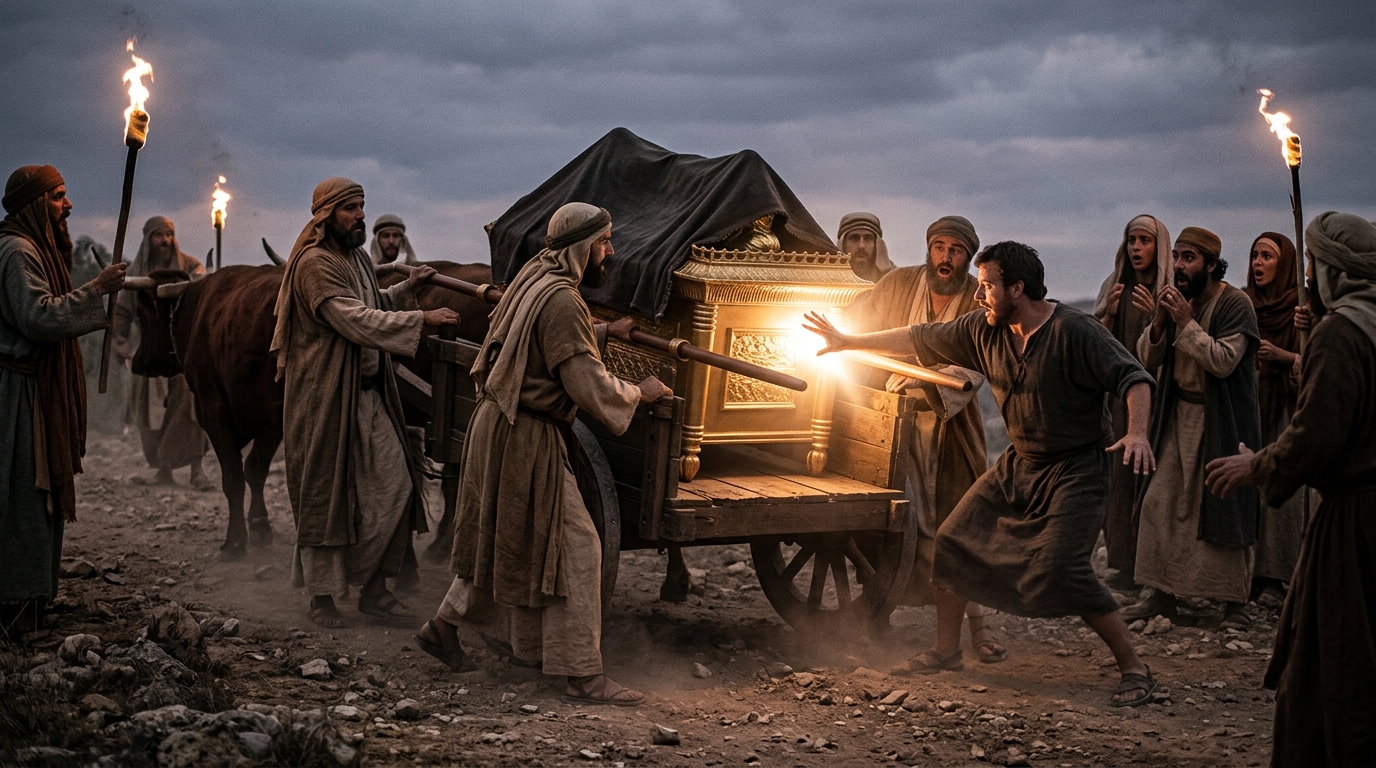
The Ark of the Covenant was about to fall. Uzzah instinctively reached out to steady it. He was trying to help. Yet, God immediately struck him dead.
Many skeptics point to this account as evidence that God is harsh, unreasonable, or even cruel.
But is that really what happened?
When we carefully examine the biblical context, we discover that this event was not about God punishing a well-meaning man for a split-second mistake. Instead, it reveals profound truths about God’s holiness, man’s tendency to treat sacred things casually, and the importance of obeying God exactly as He commands.
This story is not primarily about the Ark.
It is about how we approach the holy God.
The Story of Uzzah
The account is found in 2 Samuel 6:1-11 and 1 Chronicles 13.
King David wanted to bring the Ark of the Covenant to Jerusalem. This was a wonderful goal. The Ark represented God’s presence among His covenant people.
The Ark had been kept for many years in the house of Abinadab. Uzzah and his brother Ahio accompanied it as it was transported.
However, instead of carrying the Ark as God had instructed, David placed it on a new cart pulled by oxen.
As the oxen stumbled, the Ark shifted.
Uzzah reached out to steady it.
Instantly, he died.
David himself was shocked and afraid.
At first, he could not understand why this happened.
Later, however, David realized the real problem.
Was Uzzah Innocent?
Many people assume Uzzah was an innocent victim.
The Bible presents a different picture.
Uzzah was not a random bystander.
He had grown up in the house where the Ark had been kept for decades (1 Samuel 7:1-2). He likely knew the laws concerning it better than most Israelites.
His action was not merely accidental.
It reflected a deeper disregard for God’s explicit instructions.
God Had Already Given Clear Instructions
The death of Uzzah was not without warning.
Centuries earlier, God had given very specific commands regarding the Ark.
The Ark Was Never to Be Touched
God instructed Moses:
“They shall not touch any holy thing, lest they die.” (Numbers 4:15, NKJV)
The Levites responsible for transporting the Ark knew this command.
The warning could not have been clearer.
Touching the Ark meant death.
The Ark Was Never to Be Transported on a Cart
God also commanded that the Ark be carried by poles placed through rings attached to its sides (Exodus 25:12-15).
It was to be carried on the shoulders of the Kohathites, a specific family within the Levites (Numbers 7:9).
The poles were never to be removed.
Yet David ignored these instructions.
Instead, the Ark was placed on a cart, exactly as the Philistines had done years earlier (1 Samuel 6).
Israel copied the method of pagans instead of following God’s Word.
The problem began long before Uzzah reached out his hand.
David Later Admitted Their Mistake
One of the strongest pieces of evidence comes later.
After Uzzah’s death, David carefully studied God’s instructions.
He confessed:
“For because you did not do it the first time, the LORD our God broke out against us, because we did not consult Him about the proper order.” (1 Chronicles 15:13, NKJV)
Notice David’s words.
He did not accuse God of overreacting.
Instead, he admitted they had failed to follow God’s commands.
The next time they moved the Ark, they did it exactly as God required.
No one died.
Why Was Touching the Ark Such a Serious Sin?
1. The Ark Represented God’s Holy Presence
The Ark was not magical.
It was not an idol.
It symbolized God’s throne among Israel.
The mercy seat was where God said He would meet with His people (Exodus 25:22).
Treating the Ark carelessly was ultimately treating God’s presence carelessly.
2. Holiness Cannot Be Approached Casually
Throughout Scripture, God teaches that holiness is not something to take lightly.
Examples include:
- Nadab and Abihu offering unauthorized fire (Leviticus 10:1-3)
- The men of Beth Shemesh looking into the Ark (1 Samuel 6:19)
- Ananias and Sapphira lying to the Holy Spirit (Acts 5:1-11)
These judgments remind us that God does not change.
He is loving.
He is merciful.
He is also perfectly holy.
3. Good Intentions Do Not Replace Obedience
Many people defend Uzzah by saying:
“He meant well.”
Perhaps he did.
But throughout Scripture, sincerity alone never justifies disobedience.
Consider these examples:
- Saul sincerely wanted to offer sacrifices himself.
- Moses struck the rock instead of speaking to it.
- Nadab and Abihu likely believed they were worshiping God.
Good motives cannot cancel God’s commands.
Obedience matters.
Grow Closer to God…
Wasn’t the Ground Dirtier Than Uzzah’s Hand?
This is one of the most common objections.
People ask:
“If the Ark had fallen into the dirt, wouldn’t that have been worse than touching it?”
The question assumes something the Bible never teaches.
The issue was never whether dirt is morally cleaner than human skin.
The issue is that God never authorized Uzzah to touch the Ark.
Ironically, the symbolism runs even deeper.
Throughout Scripture, mankind came from the dust (Genesis 2:7).
Humanity is corrupted by sin.
The earth simply obeys God’s created order.
The greater problem was not the ground.
It was sinful mankind presuming to handle what God had declared untouchable.
Did God Overreact?
From a human perspective, the punishment seems severe.
But this assumes we fully appreciate God’s holiness.
The Bible consistently teaches that God’s holiness is infinitely greater than we imagine.
Every sin deserves judgment.
What surprises us should not be that God judged Uzzah.
What should amaze us is how patient God usually is with all of us.
Every day He shows mercy to sinners who deserve judgment.
The cross of Messiah demonstrates both truths:
- God’s justice against sin.
- God’s incredible mercy toward repentant sinners.
Top 3 Best-Selling Christian Books for October 2026


Why Didn’t God Simply Give Uzzah a Warning?
He already had.
The warning had been recorded centuries earlier in the Law of Moses.
The Israelites possessed these instructions.
God was not introducing a new rule on that day.
They ignored one He had already given.
Why Didn’t God Prevent the Ark from Falling?
God certainly could have.
In fact, the Ark never actually fell.
God did not need Uzzah’s protection.
The Creator of heaven and earth is fully capable of preserving His own glory.
Sometimes we mistakenly think God needs our disobedience to accomplish His purposes.
He does not.
What About David’s Responsibility?
David also bore responsibility.
As king, he should have ensured that God’s commands were followed.
His desire to honor God was genuine.
But zeal without obedience led to tragedy.
This explains why David later corrected the mistake by following God’s instructions precisely (1 Chronicles 15).
The lesson is clear.
Good goals should never be pursued through unbiblical methods.

Lessons Christians Should Learn Today
1. God Is Still Holy
God has not become less holy under the New Covenant.
While believers now have direct access to the Father through Yeshua the Messiah, we are still called to approach Him with reverence and godly fear (Hebrews 12:28-29).
Grace should deepen our respect for God, not diminish it.
2. Obedience Matters
Modern Christianity sometimes emphasizes sincerity while minimizing obedience.
The Bible teaches both.
Yeshua said:
“If you love Me, keep My commandments.” (John 14:15, NKJV)
Love is demonstrated by faithful obedience.
3. Familiarity Can Lead to Irreverence
Uzzah lived near the Ark for years.
What was extraordinary had become ordinary.
Christians face the same danger.
We can become so familiar with prayer, Bible reading, worship, and sacred truths that we lose our sense of awe.
Never allow God’s holiness to become commonplace.
4. We Should Worship God His Way
David’s mistake reminds us that enthusiasm is not enough.
God determines how He is to be worshiped.
Our responsibility is not to invent our own methods, but to submit to His revealed will.
5. God Does Not Need Our Disobedience to Help Him
Sometimes people justify sinful actions by claiming they are advancing God’s work.
The story of Uzzah reminds us that God’s purposes are never accomplished by violating His commands.
Addressing Common Objections
“The punishment didn’t fit the crime.”
The severity of a crime depends not only on the act but also on the One against whom it is committed.
Touching an ordinary box would mean nothing.
Disregarding the explicit command of the holy Creator is entirely different.
“God is cruel.”
The Bible consistently describes God as compassionate, patient, merciful, and slow to anger.
Yet He is also just.
If God never judged sin, people would accuse Him of ignoring evil.
This event reveals His justice, not cruelty.
“Uzzah was just trying to help.”
Helping God in ways He has forbidden is not true obedience.
Scripture repeatedly teaches that God’s commands must be respected even when our intentions seem noble.
“This makes God seem unpredictable.”
Actually, the opposite is true.
God acted exactly as He had warned centuries earlier.
The event demonstrates His consistency, not unpredictability.
The Bigger Picture
The death of Uzzah teaches us something about ourselves.
We often believe our intentions are enough.
God teaches that reverence, humility, and obedience matter.
At the same time, this account points us toward our need for a perfect Mediator.
Under the Old Covenant, sinful people could not casually approach God’s holy presence.
Today, believers have confidence to approach the Father because of the sacrifice and priestly work of Yeshua the Messiah (Hebrews 10:19-22). Our access is not based on our own righteousness, but on His.
That privilege should produce gratitude and reverence, not carelessness.
Frequently Asked Questions
Did Uzzah go to heaven?
The Bible does not tell us what became of Uzzah after his death. His physical judgment does not, by itself, reveal his ultimate standing before God. Scripture simply records that God judged his disobedience at that moment.
Why was the Ark so holy?
The Ark symbolized God’s throne among Israel and contained items associated with His covenant, including the stone tablets of the Law. Because it represented God’s holy presence, He gave strict instructions regarding its care and transportation.
Why was the Ark transported on a cart?
David and the Israelites copied the method previously used by the Philistines instead of following God’s instructions. The Ark should have been carried on the shoulders of the Kohathite Levites using the poles God had prescribed.
Why didn’t God spare Uzzah since he meant well?
Scripture never says Uzzah’s intentions excused his actions. God had already made His command clear. The lesson is that sincere intentions cannot replace faithful obedience.
Does this story mean God is unloving?
No. The same God who judged Uzzah is repeatedly described throughout Scripture as merciful, gracious, and patient. His love does not cancel His holiness, and His holiness does not diminish His love. Both are perfectly expressed in His character.
Does God still judge people like this today?
God remains the same in character, but He does not always execute immediate judgment in this age. There are instances in the New Testament, such as Ananias and Sapphira (Acts 5), where God acted swiftly to impress upon the early church the seriousness of holiness. More often, however, God is patient, giving people time to repent. His patience should never be mistaken for approval of sin (Romans 2:4).
Final Thoughts
The story of Uzzah is not meant to convince us that God is unreasonable. It is meant to remind us that God is holy beyond our imagination.
Uzzah’s death was not the result of an arbitrary outburst of divine anger. It followed clear commands that had been ignored, beginning with the improper transportation of the Ark and ending with a direct violation of God’s instruction not to touch it.
The account challenges every believer to ask an important question:
Do I approach God on my own terms, or on His?
God desires our love, our faith, and our worship. But He also calls us to reverence, humility, and obedience. When we remember both His holiness and His mercy, we develop a deeper appreciation for the privilege of drawing near to Him through Yeshua the Messiah, who makes it possible for sinners to approach the Holy One with confidence and gratitude.

About the Author
Joshua Infantado is a Christian blogger and Bible teacher who has been writing faith-based content since 2013. He is the founder of Becoming Christians, where he shares blogs, books, videos, and online courses to help believers grow in truth and grace. Joshua lives in Davao City, Philippines, with his wife, Victoria, and their son, Caleb. Contact him at joshuainfantado@gmail.com.
Discover more from Becoming Christians
Subscribe to get the latest posts sent to your email.