Throughout church history, Christians have faced more than persecution, political conflicts, and divisions. They have also faced something that can be far more difficult to recognize: teachings that appear religious, sound convincing, and even use the Bible, yet distort important biblical truths.
Some of these teachings challenged the identity of Jesus Christ. Others questioned the goodness of God’s creation, changed the understanding of salvation, or blurred the distinction between genuine repentance and religious compromise.
What makes a heresy especially dangerous is not necessarily how strange it sounds. Sometimes, the most dangerous teachings are those that sound almost biblical but subtly change the meaning of God’s Word.
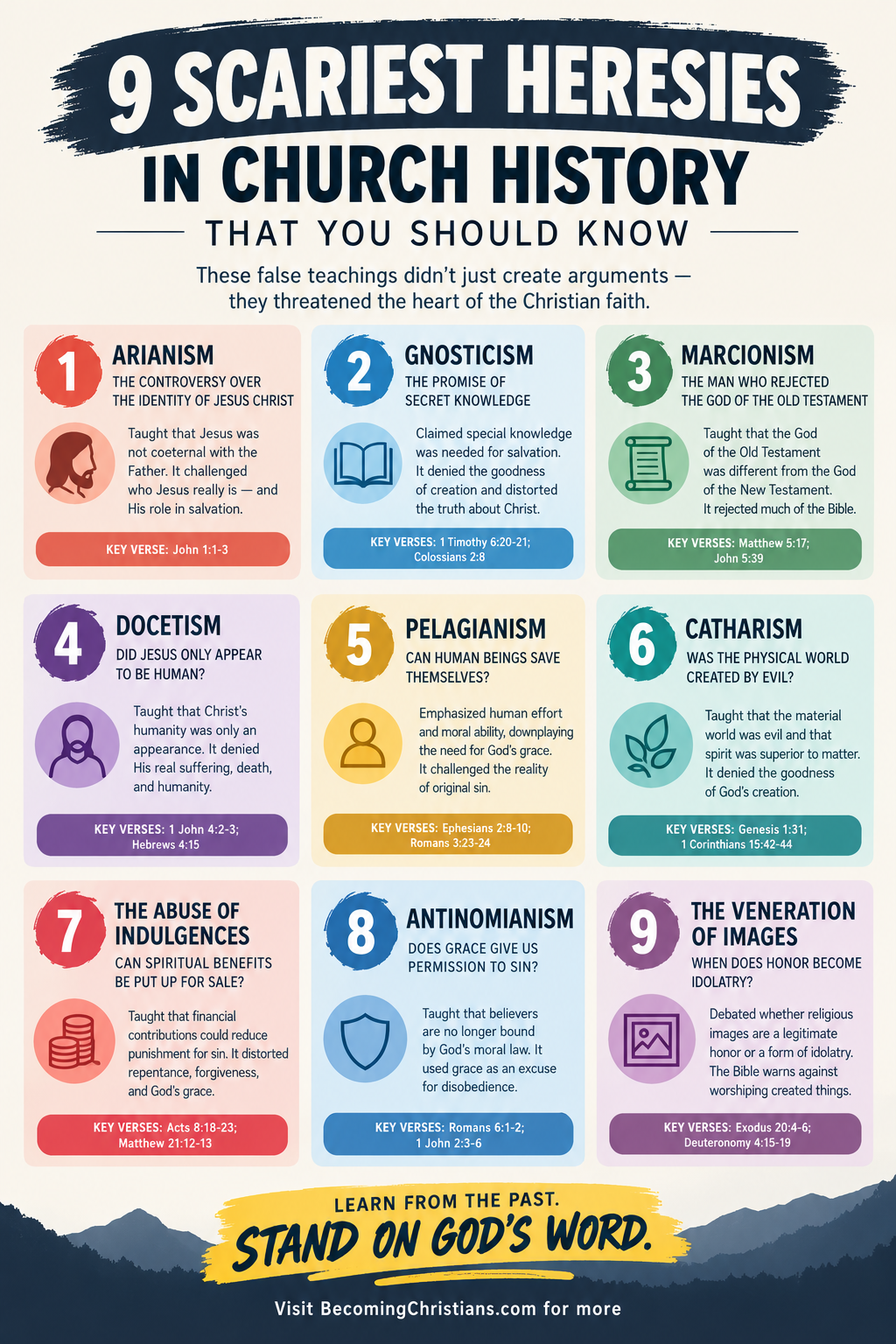
In this article, we will explore nine of the most alarming heresies and controversial teachings in church history, examine what their proponents believed, and consider the biblical questions they raise.
Do you want to learn more about Biblical truths? If yes, join our online Bible school where you will receive daily lessons in the form of podcasts, articles, and videos.

1. Arianism: The Controversy Over the Identity of Jesus Christ
Imagine a teaching that accepts Jesus Christ as the Son of God, honors Him as the Messiah, and recognizes His extraordinary authority, yet denies that He is eternal in the same sense as the Father.
That was the central issue behind Arianism.
In the early fourth century, a Christian teacher named Arius argued that the Son was not coeternal with the Father. According to the position attributed to him, the Son came into existence through the Father’s will and therefore was not equal to the Father in the way traditional Trinitarian Christianity would later define.
The controversy became so serious that Emperor Constantine convened the Council of Nicaea in AD 325. The council rejected Arian teaching and affirmed that the Son was of the same substance as the Father.
The controversy did not end there. Disputes about the Son’s nature continued for decades, involving bishops, emperors, and entire church communities.
Why was Arianism so significant?
Because the identity of Jesus Christ affects how Christians understand His relationship with the Father, His role in creation, and the significance of His work of salvation.
Consider John 1:1-3, which identifies the Word as being with God and as God, and says that all things were made through Him. John 17:5 also records Jesus speaking of the glory He had with the Father before the world existed.
These passages invite serious examination of Christ’s preexistence and identity.
Arianism demonstrates how a disagreement over a few seemingly technical theological questions can develop into a major controversy about the person of Jesus Christ.
The lesson: Never assume that a teaching is biblically sound merely because it honors Jesus in some respects. Examine what it actually teaches about Him and compare those claims with Scripture.
2. Gnosticism: The Promise of Secret Knowledge
What if someone told you that ordinary Christians did not possess the full truth about salvation, but that a select group could discover hidden spiritual knowledge unavailable to everyone else?
That idea resembles a recurring feature of several ancient movements commonly grouped under the name Gnosticism.
Gnostic movements were diverse, and not all taught precisely the same doctrines. Many emphasized special knowledge as the means of spiritual liberation. Some taught that the material world was the work of an inferior creator, distinct from the supreme divine being.
Certain Gnostic teachers also presented Christ in ways that conflicted with the biblical testimony about His genuine humanity.
These ideas alarmed early Christian writers because they challenged fundamental teachings about creation, Christ, and salvation.
Why was Gnosticism dangerous?
The problem was not the pursuit of spiritual understanding itself. Scripture encourages believers to grow in knowledge and wisdom.
The danger arose when secret knowledge became a substitute for the truth revealed through God’s Word and the message of Jesus Christ.
Paul warned Timothy about false teaching and what was falsely called knowledge in 1 Timothy 6:20-21.
In Colossians 2:8, Paul also warned believers not to be taken captive through philosophy and empty deceit according to human traditions rather than Christ.
These warnings remain relevant whenever a teacher claims to possess exclusive spiritual insights that place his followers above ordinary believers or contradict the biblical message.
The lesson: Spiritual knowledge should lead us toward the truth of God, not toward pride, exclusivity, or teachings that contradict Scripture.
Top 3 Best-Selling Christian Books for October 2026


3. Marcionism: The Man Who Rejected the God of the Old Testament
One of the most striking controversies in early Christianity involved a man named Marcion of Sinope.
During the second century, Marcion promoted a sharp distinction between the God revealed in the Old Testament and the God revealed through Jesus Christ. He rejected the Old Testament Scriptures and accepted a restricted collection of Christian writings, including an edited version of Luke’s Gospel and several Pauline letters.
The church’s opposition to Marcion was not simply a disagreement over which books should be read. The controversy involved the very identity of God.
Marcion believed that the God associated with the Old Testament was different from the loving God revealed by Jesus.
Why was this teaching so troubling?
The Bible presents the Old and New Testaments as parts of a larger story of God’s dealings with humanity.
Jesus Himself appealed to the Scriptures that Christians now call the Old Testament. In Matthew 5:17, He said that He did not come to destroy the Law or the Prophets but to fulfill them.
In John 5:39, Jesus directed His listeners to the Scriptures that testified about Him.
The God who made promises to Abraham, delivered Israel from Egypt, and spoke through the prophets is not presented in the New Testament as a different deity from the Father whom Jesus revealed.
The relationship between God’s justice, mercy, commandments, and promises deserves careful study. We should not resolve difficult passages by simply dismissing an entire portion of Scripture.
The lesson: We must allow the whole Bible to inform our understanding of God rather than accepting a version of Christianity that discards inconvenient parts of His Word.
4. Docetism: Did Jesus Only Appear to Be Human?
Christianity rests on the testimony that Jesus Christ truly came into the world, lived among human beings, suffered, and died.
But what if His physical humanity was only an appearance?
That is the central idea associated with Docetism, a teaching found in certain early Christian circles. The term comes from a Greek word meaning “to seem” or “to appear.”
Some forms of this teaching claimed that Christ only seemed to possess a physical body or only appeared to suffer.
Such ideas conflicted with the biblical testimony about the real humanity and suffering of Jesus.
Why does Christ’s humanity matter?
The New Testament does not present Jesus as someone who merely looked human. It describes Him experiencing hunger, weariness, pain, and death.
John 1:14 declares that the Word became flesh and dwelt among us.
Hebrews 2:14 teaches that the children share in flesh and blood and that Christ likewise partook of the same. Hebrews 4:15 describes Him as being tempted in all points as we are, yet without sin.
These passages make the reality of Christ’s human experience central to the biblical account.
The apostle John also warned about teachings that denied the truth about Jesus Christ’s coming in the flesh. See 1 John 4:2-3 and 2 John 7.
The lesson: We must not reshape Jesus into an imaginary or merely spiritual figure. The biblical testimony about His genuine humanity is essential to understanding who He is and what He accomplished.
Support Our Work
Support us by joining the Becoming Christians Membership program! As a member, you’ll receive daily inspiring devotionals, insightful articles, and impactful videos. Sign up today and grow in your faith with us!

5. Pelagianism: Can Human Beings Save Themselves Through Their Own Efforts?
Pelagianism emerged from controversies surrounding Pelagius, a Christian teacher active around the late fourth and early fifth centuries.
Pelagius strongly emphasized moral responsibility and the ability of human beings to obey God’s commandments. He opposed certain teachings about inherited sin and humanity’s dependence on divine grace.
The views associated with Pelagius and some of his followers were condemned by church authorities because they were considered incompatible with the church’s understanding of original sin and grace.
It is important to distinguish Pelagius’s own positions from the more extreme claims sometimes attributed to Pelagianism.
What makes this controversy important?
The issue concerns the relationship between human responsibility and God’s grace.
Does obedience matter? Absolutely. Does Scripture call believers to repent, change their conduct, and pursue righteousness? Yes.
But Scripture also teaches that human beings need God’s grace.
Ephesians 2:8-10 explains that salvation is by grace through faith, not the result of works, while also teaching that believers are created in Christ Jesus for good works.
Romans 3:23-24 teaches that all have sinned and are justified freely by God’s grace through the redemption found in Christ Jesus.
These passages do not encourage spiritual laziness. Instead, they show that good works must be understood in the context of God’s saving work rather than as a means of making ourselves independent of Him.
The lesson: We should neither minimize obedience nor imagine that our own efforts eliminate our need for God’s grace.
6. Catharism: Was the Physical World Created by Evil?
During the Middle Ages, Catharism became influential in parts of Western Europe, particularly in southern France.
Cathar beliefs varied, but many Cathar groups held dualistic views that sharply distinguished the spiritual realm from the material world. Some taught that the physical world was the work of an evil power rather than the good God.
These beliefs affected their views of the human body, marriage, food, and salvation. Certain groups practiced severe asceticism, seeking liberation from the material world.
The movement was condemned by the medieval Catholic Church and became the target of intense persecution, including the Albigensian Crusade.
Why does this matter biblically?
The question is whether the material creation should be regarded as inherently evil.
Genesis 1 repeatedly describes God’s creation as good, culminating in His declaration that everything He had made was very good in Genesis 1:31.
The Bible certainly teaches that sin has corrupted human life and that creation suffers. But that is not the same as saying that matter itself is evil or that the Creator is wicked.
The New Testament also teaches the resurrection of the dead. In 1 Corinthians 15, Paul explains that the resurrection involves a transformed body, not merely the escape of a soul from physical existence.
The lesson: Do not confuse the corruption caused by sin with the goodness of God’s original creation. The biblical hope is not simply escape from the physical world but God’s ultimate victory over sin and death.
7. The Abuse of Indulgences: Can Spiritual Benefits Be Put Up for Sale?
Few controversies in Western church history became as influential as the dispute over indulgences during the Protestant Reformation.
In medieval Catholic theology, an indulgence concerned the remission of temporal punishment associated with sins whose guilt had already been forgiven. It was not officially defined as purchasing the forgiveness of sins themselves.
However, the promotion and sale of indulgences in certain historical settings encouraged serious abuses and gave many people the impression that spiritual benefits could be obtained through financial contributions.
These practices helped provoke Martin Luther’s objections in 1517 and contributed to the events that developed into the Protestant Reformation.
Why was this controversy so serious?
The issue raises a vital question: What happens when religious authority and money become entangled in ways that distort people’s understanding of repentance and forgiveness?
In Acts 8:18-23, Simon attempted to purchase the power to impart the Holy Spirit. Peter rebuked him sharply, explaining that God’s gift could not be bought with money.
Jesus also condemned the misuse of the temple for commercial gain in Matthew 21:12-13.
These passages do not mean that churches cannot receive voluntary financial support. Rather, they challenge attempts to turn God’s gifts or spiritual authority into commodities.
The lesson: Money must never become a substitute for genuine repentance, and religious leaders must not exploit people’s fear or spiritual uncertainty for financial gain.
8. Antinomianism: Does Grace Give Us Permission to Sin?
What if a person believes that because Jesus Christ died for our sins, obedience to God no longer matters?
This is one of the most important questions raised by antinomianism.
The term refers broadly to views that reject or minimize the continuing relevance of God’s moral law. Historically, the label has been used in different ways, and it should not be applied carelessly to every Christian who emphasizes salvation by grace.
Nevertheless, extreme forms of antinomian thinking suggest that believers need not concern themselves with obedience because they are already saved.
Why is this teaching dangerous?
It can turn God’s mercy into an excuse for continuing in sin.
Paul directly addressed a similar objection in Romans 6:1-2:
“What shall we say then? Shall we continue in sin that grace may abound? Certainly not!”
Paul’s answer could hardly be clearer. God’s grace is not permission to remain enslaved to sin.
John also connects knowing Christ with obedience. In 1 John 2:3-6, he explains that keeping God’s commandments is evidence that we know Him and that those who claim to abide in Christ should walk as He walked.
Obedience does not purchase God’s grace. But neither should grace be used to dismiss the importance of obedience.
A balanced understanding must account for both God’s gracious provision and His call for His people to turn away from sin.
The lesson: Grace is not an excuse to abandon righteousness. It is no reason to treat sin lightly or to reject the transformation God desires in our lives.
9. The Veneration of Images: When Does Religious Honor Become Idolatry?
For centuries, Christians have disagreed over the proper use of religious images.
The controversy became especially intense during the eighth and ninth centuries, when the Byzantine Empire experienced periods of iconoclasm, the rejection or destruction of religious images.
Some Christians argued that venerating icons was a legitimate way to honor the persons represented. Others believed that such practices risked violating biblical prohibitions against making and worshiping images.
The Second Council of Nicaea in AD 787 defended the veneration of icons, distinguishing it from the worship due to God alone. Many Christians accepted that distinction, while others continued to reject religious images in worship.
The disagreement continues in different forms among Christian traditions today.
What does the Bible say?
In Exodus 20:4-6, God prohibits making images for the purpose of bowing down to them and serving them as gods.
Deuteronomy 4:15-19 warns Israel against making representations of God and worshiping created things.
At the same time, the Bible records the use of certain images in the tabernacle and temple, including the cherubim associated with the ark of the covenant. Therefore, the question is not simply whether an image exists, but how it is used and whether it becomes an object of worship.
Christians differ in how they apply these passages to icons, statues, and other religious imagery. A careful examination should distinguish the official teaching of a tradition from the practices of individual believers.
The lesson: Religious symbols should never take the place of God Himself. Every practice involving images should be examined in light of Scripture, with particular attention to worship, idolatry, and the honor due to the Creator.
What Can We Learn From These Heresies?
Looking at these nine historical controversies reveals an important pattern. Disputes over Christian teaching often concern foundational questions:
- Who is Jesus Christ, and what does the Bible say about His identity?
- Is the whole of Scripture trustworthy and relevant to understanding God?
- How does salvation relate to grace, faith, repentance, and obedience?
- Is God’s creation good, and what does the Bible teach about resurrection?
- How should believers evaluate religious authority, traditions, and worship practices?
These questions are not merely historical curiosities. They continue to influence how Christians understand the Bible and practice their faith.
However, studying church history requires care. Not every teaching that one group calls heretical is understood in the same way by every Christian tradition. Nor should we assume that an entire movement held every belief attributed to it by its opponents.
The best approach is to investigate the historical evidence, understand what the people involved actually taught, and examine the relevant Scriptures in context.
Most importantly, we must not assume that a teaching is true simply because it is old, popular, traditional, or promoted by an influential religious leader.
The Bereans provide a valuable example in Acts 17:11. They received Paul’s message eagerly but examined the Scriptures daily to determine whether what he taught was true.
That is the attitude we should cultivate: a willingness to learn, a readiness to examine our beliefs, and a commitment to testing religious claims against God’s Word.
Discover the Shocking Biblical Truth About the New Covenant
Have you ever wondered whether everything you’ve been taught about the New Covenant is actually supported by the Bible?
Many Christians hear about the New Covenant throughout their lives, yet never take the time to examine what Scripture truly says about it. What changed when Jesus Christ established the New Covenant? What promises does it contain? And what does it mean for our relationship with God and His commandments?
These are important questions that deserve careful biblical study.
That’s why I want to invite you to download my free eBook, The Shocking Biblical Truth About the New Covenant.
This free resource will help you examine this important biblical subject and discover what the Scriptures actually teach. Rather than simply accepting popular assumptions, you can study the subject for yourself and compare what you read with God’s Word.
Don’t settle for what you’ve always heard. Open your Bible, investigate the evidence, and discover the truth for yourself.
Download your free copy of The Shocking Biblical Truth About the New Covenant today and take another step toward understanding God’s Word more deeply.

Discover more from Becoming Christians
Subscribe to get the latest posts sent to your email.