What does it mean to have the fear of God? Summary answer: To have the fear of God means to live with a deep reverence, awe, and humble submission toward God because you recognize who He truly is: the holy Creator, sovereign King, righteous Judge, and loving Father. It is not a constant fear of punishment, but a wholehearted response to God’s holiness, power, justice, wisdom, and goodness that leads you to trust Him, love Him, obey His commandments, and hate sin. The fear of God shapes every area of life, influencing not only how you worship but also how you think, speak, make decisions, and respond to temptation. It is the foundation of true wisdom (Proverbs 9:10), the motivation for faithful obedience (Ecclesiastes 12:13), and the mark of a heart that desires to honor God above all else. Ultimately, fearing God means seeing Him as He truly is and allowing that vision to transform the way you live every day.
Introduction
If the fear of God is so important, why do so many Christians struggle to explain what it actually means?
Ask ten believers, and you’ll likely hear ten different answers. Some say it means being terrified of God. Others reduce it to simply “respecting God.” Still others avoid the subject altogether because the word fear sounds negative.
The Bible, however, presents a much richer picture.
The fear of God is not merely fear. It is not merely respect. It is a life-changing attitude that transforms how you think, speak, worship, make decisions, and respond to temptation.
Without the fear of God, true wisdom cannot begin. Genuine obedience becomes shallow. Worship becomes empty. Even faith can become self-centered.
So, what does it really mean to have the fear of God?
Let’s explore what Scripture teaches.
What Is the Fear of God?
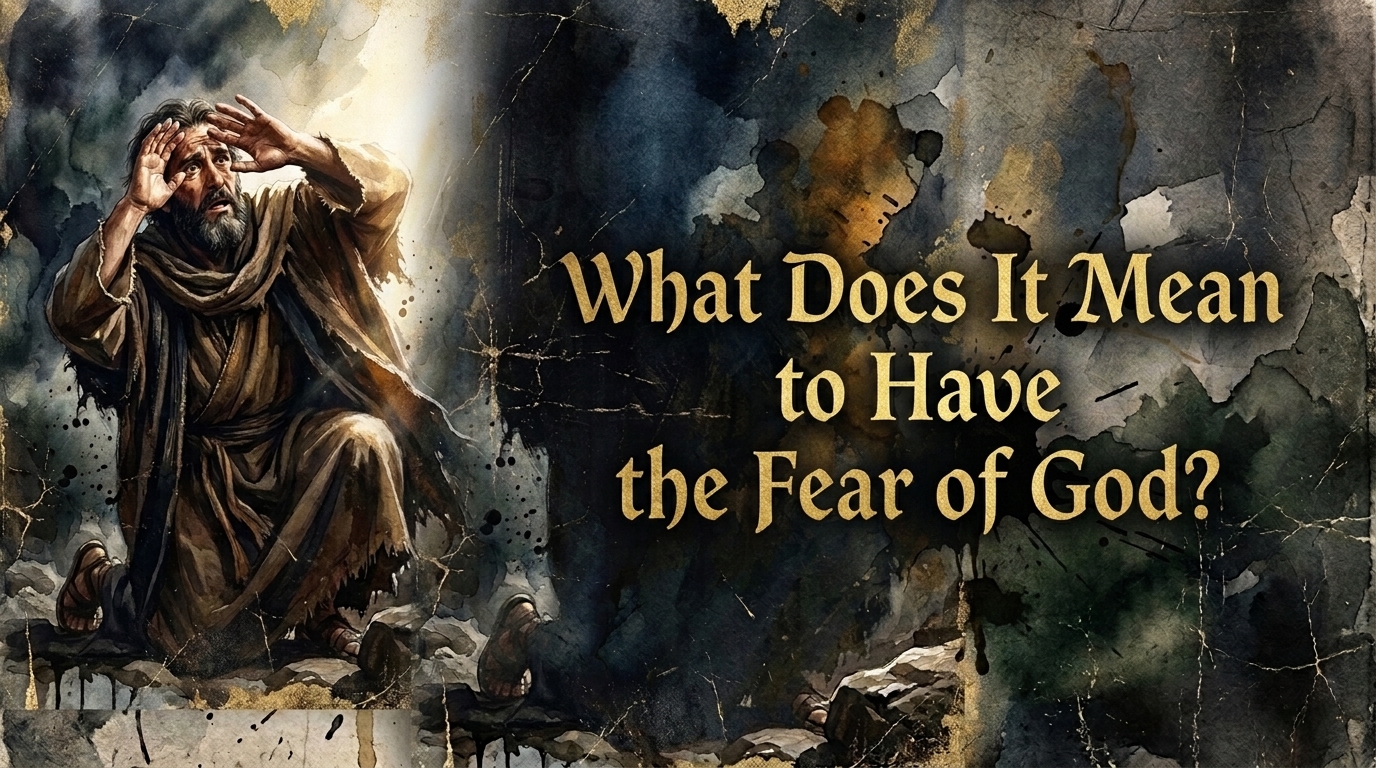
The fear of God is a deep awareness of God’s absolute holiness, supreme authority, perfect justice, limitless power, and overwhelming goodness that moves us to love Him, trust Him, obey Him, and hate sin.
It is not a fear that drives us away from God, but a holy reverence that draws us closer to Him. The more we understand who God truly is, the more we recognize how small we are in comparison. This realization does not produce despair. Instead, it produces worship, humility, and a sincere desire to honor Him in every area of life.
The fear of God begins with knowing God as He has revealed Himself in Scripture. He is not merely a loving Father. He is also the Creator of heaven and earth (Genesis 1:1), the Holy One of Israel (Isaiah 6:3), the righteous Judge (Psalm 9:7-8), the King of kings (1 Timothy 6:15), and “a consuming fire” (Hebrews 12:29). When these truths sink into our hearts, we cannot help but stand in awe before Him.
This is why Proverbs 9:10 says:
“The fear of the LORD is the beginning of wisdom, And the knowledge of the Holy One is understanding.” (NKJV)
Notice that wisdom begins, not with intelligence or education, but with the fear of the Lord. Until we acknowledge God’s rightful place as our Creator and King, we cannot truly understand life as it was meant to be lived.
The fear of God is both an inward attitude and an outward way of life.
It starts in the heart but becomes visible through our actions. A person who fears God does not simply think differently. He lives differently.
The biblical fear of God includes several inseparable qualities.
Reverence
To fear God is to hold Him in the highest honor. We recognize that He alone deserves our worship, praise, and complete devotion. We never approach Him casually or treat Him as though He were merely another person.
Hebrews 12:28 says:
“Therefore, since we are receiving a kingdom which cannot be shaken, let us have grace, by which we may serve God acceptably with reverence and godly fear.” (NKJV)
True worship always includes reverence because we are approaching the Sovereign of the universe.
Awe
The fear of God fills us with amazement at His greatness. His wisdom is beyond searching, His power has no limits, and His works declare His glory.
After witnessing God’s majesty, the psalmist declared:
“Let all the earth fear the LORD; Let all the inhabitants of the world stand in awe of Him.” (Psalm 33:8, NKJV)
A person who stands in awe of God no longer sees Him as small or ordinary. Instead, God becomes the greatest reality in his life.
Humility
The fear of God destroys pride because it reminds us that everything we have comes from Him. We realize that we are completely dependent upon His mercy, wisdom, and guidance.
Proverbs 22:4 teaches:
“By humility and the fear of the LORD Are riches and honor and life.” (NKJV)
Humility naturally follows when we recognize God’s greatness and our own limitations.
Submission
If God is truly our Lord, then His will must take priority over ours. Fearing God means surrendering our plans, opinions, and desires whenever they conflict with His commands.
Moses summarized God’s expectation of Israel by asking:
“And now, Israel, what does the LORD your God require of you, but to fear the LORD your God, to walk in all His ways and to love Him, to serve the LORD your God with all your heart and with all your soul.” (Deuteronomy 10:12, NKJV)
Notice how fearing God is directly connected with walking in His ways. Biblical fear always leads to submission.
Love
Some people assume that fear and love cannot exist together. The Bible teaches otherwise.
When we truly understand God’s holiness and mercy, our hearts respond with love. We love Him because He first loved us, and because we recognize that His commandments are for our good.
The fear of God does not compete with love. Rather, it protects our love from becoming shallow or careless.
A loving child does not want to disappoint a good father. Likewise, those who love God desire to honor Him in everything they do.
Trust
The fear of God also produces confidence.
This may seem surprising, but Scripture repeatedly connects fearing God with trusting Him. When we recognize God’s wisdom, power, and faithfulness, we learn to depend on Him instead of ourselves.
Proverbs 14:26 says:
“In the fear of the LORD there is strong confidence, And His children will have a place of refuge.” (NKJV)
The world seeks security in wealth, governments, careers, or human strength. Those who fear God find their security in Him.
Obedience
One of the clearest evidences of fearing God is obedience.
Anyone can claim to fear God, but genuine fear is demonstrated by keeping His commandments.
Ecclesiastes concludes with these well-known words:
“Let us hear the conclusion of the whole matter: Fear God and keep His commandments, For this is man’s all.” (Ecclesiastes 12:13, NKJV)
Notice that fearing God and obeying Him are inseparable.
Joseph provides one of the greatest examples of this principle. When tempted by Potiphar’s wife, he refused her advances, saying:
“How then can I do this great wickedness, and sin against God?” (Genesis 39:9, NKJV)
No one else was around to witness his decision, but Joseph knew that God was watching. His fear of God gave him the strength to resist temptation.
Hatred of Evil
Perhaps the most overlooked aspect of fearing God is that it changes our attitude toward sin.
Many people ask how they can overcome temptation. Scripture points us to the fear of the Lord.
Proverbs 8:13 says:
“The fear of the LORD is to hate evil; Pride and arrogance and the evil way And the perverse mouth I hate.” (NKJV)
Notice that the verse does not simply say to avoid evil. It says to hate it.
As we grow in the fear of God, we begin to see sin the way He sees it. We stop making excuses for it, minimizing it, or secretly enjoying it. Instead, we reject it because we love the One whom sin offends.
The Fear of God Is More Than an Emotion
Notice something important.
The Bible never treats the fear of God as merely an emotional feeling that comes and goes.
It is a lifestyle.
It shapes our thoughts, influences our decisions, guides our priorities, and transforms our character. It affects how we speak, how we work, how we worship, how we spend our money, how we treat our family, and how we respond when no one else is watching.
This is why Scripture often describes people as those who “fear God.” It identifies an entire way of life rather than a temporary emotion.
The fear of God is seen in Noah, who obeyed God’s warning and built the ark (Hebrews 11:7). It is seen in Joseph, who refused adultery (Genesis 39:9). It is seen in Job, who was described as “one who feared God and shunned evil” (Job 1:1, NKJV). It is seen in the early church, which “walked in the fear of the Lord” as it continued to grow (Acts 9:31, NKJV).
In every case, the fear of God was demonstrated by faithful living.
Ultimately, to fear God is to recognize Him for who He truly is and to allow that knowledge to transform every aspect of your life. It is not confined to worship services or religious activities. It becomes the foundation upon which every decision is made and every step is taken.
When the fear of God governs our hearts, we no longer ask, “What do I want?” Instead, we ask, “What pleases God?” That is the essence of living in the fear of the Lord.
Top 3 Best-Selling Christian Books for October 2026



Why “Respect” Is an Incomplete Definition
Many sermons simplify the fear of God by saying:
“It simply means respecting God.”
While respect is certainly part of it, that definition is far too weak.
People respect:
- Teachers
- Judges
- Parents
- Police officers
- National leaders
Yet no one would describe those relationships using the same language Scripture uses for God.
The Hebrew idea goes much deeper.
It describes standing before Someone infinitely greater than yourself.
Imagine Isaiah seeing God’s throne (Isaiah 6).
His immediate response was not casual admiration.
It was:
“Woe is me, for I am undone!” (Isaiah 6:5)
That is the fear of God.
God’s holiness exposed Isaiah’s sinfulness.
The closer we draw to God, the more aware we become of our need for His mercy.
The Biblical Meaning of Fear
To fully understand what it means to fear God, we need to examine how the Bible uses the word fear. One of the biggest reasons for confusion today is that the English word fear covers a wide range of meanings. We use it to describe everything from being afraid of spiders to being terrified during a natural disaster. As a result, many people assume that when the Bible commands us to “fear God,” it means living in constant dread or anxiety.
However, the biblical concept is much richer than that.
Both the Old and New Testaments use words that carry a broader meaning than mere terror. Depending on the context, they can describe fear, reverence, awe, respect, or even worshipful devotion.
The Old Testament: Yare’
The primary Hebrew word translated as “fear” in the Old Testament is yare’ (יָרֵא).
This word has a broad range of meanings, including:
- Reverence
- Awe
- Being overwhelmed by greatness
- Standing in holy respect
- Recognizing and submitting to authority
The exact meaning depends on the context.
For example, yare’ can describe ordinary fear. When Jacob learned that his brother Esau was coming with four hundred men, “Jacob was greatly afraid” (Genesis 32:7, NKJV). Here, the word refers to genuine fear of danger.
Yet the same Hebrew word is used in one of the Bible’s most famous verses:
“The fear of the LORD is the beginning of wisdom, And the knowledge of the Holy One is understanding.” (Proverbs 9:10, NKJV)
Clearly, Proverbs is not teaching that wisdom begins by being terrified of God. Instead, it speaks of a deep reverence that recognizes God’s greatness and willingly submits to His authority.
This shows that the same Hebrew word can describe either terror or reverence, depending on the situation.
The New Testament: Phobos
The primary Greek word translated as “fear” is phobos (φόβος), from which we get the English word “phobia.”
Like the Hebrew word yare’, phobos has a range of meanings.
Sometimes it refers to fright or terror.
For example, after Yeshua calmed the raging sea, His disciples responded with fear because they suddenly realized they were in the presence of Someone who had authority over nature itself.
Mark records:
“And they feared exceedingly, and said to one another, ‘Who can this be, that even the wind and the sea obey Him!'” (Mark 4:41, NKJV)
Their fear was not merely panic. It was astonishment and awe at Christ’s divine authority.
In other places, phobos refers to reverence toward God.
Luke describes the growth of the early church this way:
“Then the churches throughout all Judea, Galilee, and Samaria had peace and were edified. And walking in the fear of the Lord and in the comfort of the Holy Spirit, they were multiplied.” (Acts 9:31, NKJV)
The believers were certainly not living in constant terror. Instead, they conducted their lives with deep reverence for God, and this reverence shaped the way they worshiped, served, and obeyed Him.
Grow Closer to God…

Context Determines the Meaning
This highlights an important principle of Bible interpretation.
Words do not carry meaning by themselves. Context determines meaning.
Consider the English word run.
You can run a race.
A machine can run.
A river can run.
Your nose can run.
The spelling is identical, yet the meaning changes according to the context.
The same principle applies to the biblical words translated as fear.
Whenever you encounter the phrase “fear the LORD,” you should ask:
- Is the passage speaking about God’s judgment?
- Is it describing worship?
- Is it emphasizing obedience?
- Is it highlighting God’s holiness?
- Is it referring to sinful people or faithful believers?
The surrounding verses will usually make the meaning clear.
Does the Fear of God Ever Include Terror?
Yes, in certain contexts.
The Bible reveals God as both Savior and Judge.
For those who stubbornly reject Him and refuse to repent, there is every reason to fear His coming judgment.
Yeshua Himself warned:
“And do not fear those who kill the body but cannot kill the soul. But rather fear Him who is able to destroy both soul and body in hell.” (Matthew 10:28, NKJV)
This is a sober reminder that God alone possesses ultimate authority over life and final judgment.
Similarly, Hebrews declares:
“It is a fearful thing to fall into the hands of the living God.” (Hebrews 10:31, NKJV)
These passages remind us that God is not someone to be treated casually. His holiness and justice demand our utmost respect.
What Does Fear Mean for Faithful Believers?
When Scripture speaks of faithful believers fearing God, it is not describing the panic of a criminal awaiting sentencing.
Rather, it is describing the reverence of a faithful servant who deeply loves his Master and desires to honor Him in everything he does.
Consider Joseph.
When Potiphar’s wife repeatedly tempted him to commit adultery, Joseph replied:
“How then can I do this great wickedness, and sin against God?” (Genesis 39:9, NKJV)
Joseph was not running from God in terror.
He was running away from sin because he revered God.
Likewise, Job is introduced as:
“That man was blameless and upright, and one who feared God and shunned evil.” (Job 1:1, NKJV)
Notice the connection.
Job feared God.
Therefore, he shunned evil.
His fear was demonstrated by the choices he made every day.
Fear That Draws Us Closer to God
Perhaps the best way to summarize the biblical meaning of the fear of God is this:
There is a kind of fear that makes people run away from God.
There is another kind of fear that causes people to draw closer to Him.
The first is the fear of the guilty conscience that seeks to hide from God’s presence, just as Adam and Eve hid after they sinned (Genesis 3:8-10).
The second is the reverent fear of those who recognize God’s holiness, trust His goodness, and desire to live in a way that pleases Him.
That is the fear the Bible repeatedly commands believers to cultivate.
It is not the fear that destroys our relationship with God.
It is the fear that deepens it.
Is the Fear of God Being Afraid of Him?
The answer is both yes and no.
This distinction is one many articles miss.
| Biblical Fear of God | Mere Respect | Terror of Punishment |
|---|---|---|
| Rooted in love for God | Rooted in admiration | Rooted in dread |
| Produces joyful obedience | Produces polite behavior | Produces avoidance |
| Motivates holiness | Motivates good manners | Motivates self-preservation |
| Recognizes God’s holiness | Recognizes authority | Recognizes danger |
| Draws us closer to God | Keeps an appropriate distance | Pushes people away from God |
| Leads to wisdom (Proverbs 9:10) | May produce knowledge | Rarely produces wisdom |
| Hates sin because it dishonors God | Dislikes wrongdoing when noticed | Fears consequences more than sin |
| Lasts throughout a believer’s life | Can change with circumstances | Usually disappears when danger is gone |
No, God’s faithful people do not live in constant terror.
God does not want His children living in panic every day.
He invites us to approach Him confidently through Christ.
He is compassionate.
He is merciful.
He is patient.
He is loving.
Yes, God is also to be feared.
Scripture never removes God’s power to judge.
He remains:
- Holy
- Sovereign
- Righteous
- Judge of all humanity
The same God who forgives sin also condemns persistent rebellion.
Healthy fear recognizes both sides.
Many people today emphasize God’s love while forgetting His holiness.
Others emphasize judgment while forgetting His mercy.
The Bible teaches both.
The Fear of God Begins with Seeing God Correctly
Most people think the fear of God starts with us.
It doesn’t.
It starts with God.
Your view of God shapes your fear of Him.
If God is merely viewed as:
- A cosmic therapist
- A divine vending machine
- A grandfather who overlooks everything
then biblical fear disappears.
But when we understand His:
- Holiness
- Eternal existence
- Perfect justice
- Infinite wisdom
- Unlimited authority
our hearts naturally respond with reverence.
A small view of God produces a small fear of God.
A great view of God produces deep worship.
Why the Fear of God Is Called the Beginning of Wisdom
Proverbs repeats this truth several times.
Why?
Because wisdom begins by recognizing reality.
Reality is this:
God is Creator.
We are creation.
He defines right and wrong.
We do not.
The person who ignores God may accumulate knowledge, degrees, wealth, or influence, but Scripture says true wisdom begins only when someone acknowledges God’s rightful place.
Without that foundation, knowledge can become pride.
Intelligence can become arrogance.
Success can become idolatry.
The Fear of God Produces Obedience
One of the clearest evidences of fearing God is obedience.
Consider Joseph.
When tempted by Potiphar’s wife, he asked:
“How then can I do this great wickedness, and sin against God?” (Genesis 39:9)
Notice something remarkable.
No one was watching.
No church members.
No pastor.
No family.
Yet Joseph refused.
Why?
Because he feared God.
The fear of God restrains us when no one else is looking.
Character is revealed most clearly in private.
The Fear of God Makes Sin Look Different
People often ask:
“How can I overcome temptation?”
One answer is rarely discussed.
Develop a greater fear of God.
When we truly recognize who God is, sin loses much of its attraction.
Imagine someone offering you a brief pleasure that would permanently destroy your family.
Most people would immediately refuse.
Why?
Because they understand the consequences.
Likewise, the fear of God helps us see sin through God’s eyes rather than our own desires.
The Fear of God Is Closely Connected to Love
Some think fear and love cannot exist together.
The Bible presents them together.
A devoted child both loves and honors a wise father.
A faithful husband loves his wife while refusing to betray her.
Love without reverence often becomes casual.
Reverence without love becomes cold.
Biblical faith contains both.
When we truly love God, we desire not to grieve Him.
That desire grows from holy fear.
The Fear of God Leads to Humility
Pride says:
“I know best.”
The fear of God says:
“God knows best.”
Humility is not thinking poorly of yourself.
It is recognizing your proper place before your Creator.
The proud resist correction.
Those who fear God welcome His instruction because they know His wisdom exceeds their own.
The Fear of God Changes Everyday Decisions
Many imagine the fear of God only matters in church.
Scripture shows otherwise.
It affects:
- How you speak.
- How you spend money.
- How you treat your spouse.
- How you raise your children.
- How you conduct business.
- How you use social media.
- How you respond when offended.
- How you handle success.
- How you face suffering.
The fear of God transforms ordinary moments into opportunities for faithful living.
Signs You Are Growing in the Fear of God
Ask yourself these questions:
- Do I hate sin more than I used to?
- Do I obey even when no one notices?
- Am I becoming more humble?
- Do I care more about pleasing God than impressing people?
- Do I quickly repent after sinning?
- Do I value God’s Word above popular opinion?
- Am I becoming more honest in private?
Growth in the fear of God is usually gradual.
It shapes the entire direction of life.
| Situation | A Person Who Fears God… | A Person Who Does Not Fear God… |
|---|---|---|
| Tempted to lie | Chooses truth even if it costs them | Lies for personal gain |
| Offered unethical profit | Refuses dishonest income | Prioritizes money over integrity |
| No one is watching | Acts with integrity | Does whatever benefits them |
| Corrected by Scripture | Humbly repents | Makes excuses |
| Suffers injustice | Trusts God instead of seeking revenge | Takes matters into their own hands |
| Uses social media | Speaks with grace and truth | Speaks carelessly and harshly |
| Makes major decisions | Seeks God’s will first | Relies only on personal desires |
| Encounters temptation | Thinks, “Would this honor God?” | Thinks only about immediate pleasure |
What Happens When People Lose the Fear of God?
The Bible repeatedly links moral decline to the absence of the fear of God.
When people stop fearing God:
- Sin becomes normalized.
- Truth becomes negotiable.
- Pride increases.
- Worship becomes superficial.
- Self replaces God at the center of life.
One of the most dangerous spiritual conditions is becoming comfortable with sin.
The fear of God awakens our conscience before sin hardens our hearts.
Practical Ways to Develop the Fear of God
The fear of God is not something we manufacture through emotion. It grows as we know God more deeply and respond to Him faithfully.
Here are practical ways to cultivate it.
1. Spend time studying God’s character
Do not focus only on what God gives.
Study who He is.
Meditate on His holiness, justice, wisdom, faithfulness, mercy, and power.
A higher view of God produces deeper reverence.
2. Read Scripture with the intention to obey
Knowledge alone does not produce the fear of God.
Apply what you learn.
Every act of obedience strengthens a heart that fears God.
3. Take sin seriously
Do not excuse what God calls sin.
Confess it quickly.
Repent sincerely.
The fear of God grows where repentance becomes a habit.
4. Remember that God sees everything
Many sins happen because people think they are hidden.
Scripture reminds us that nothing is concealed from God.
Living with that awareness shapes integrity.
5. Pray for a teachable heart
Ask God to expose pride, correct wrong attitudes, and help you walk in humility.
Those who fear God remain eager to learn.
6. Learn from biblical examples
Study the lives of Joseph, Daniel, Noah, Job, Moses, and the apostles.
Notice how their reverence for God influenced difficult decisions.
7. Worship with gratitude and reverence
Worship is more than singing. It is acknowledging God’s greatness with your whole life.
Approach Him with joy, but never casually.
A Common Misunderstanding About the Fear of God
Many people think the fear of God is a temporary stage for new believers.
The Bible teaches the opposite.
The fear of God is not the starting line that you eventually leave behind.
It is a lifelong companion of spiritual maturity.
Even mature servants of God continued to fear Him.
The deeper they knew Him, the greater their reverence became.
Spiritual maturity does not reduce the fear of God.
It deepens it.
Final Thoughts
The fear of God is not about living in constant terror.
Neither is it merely showing polite respect.
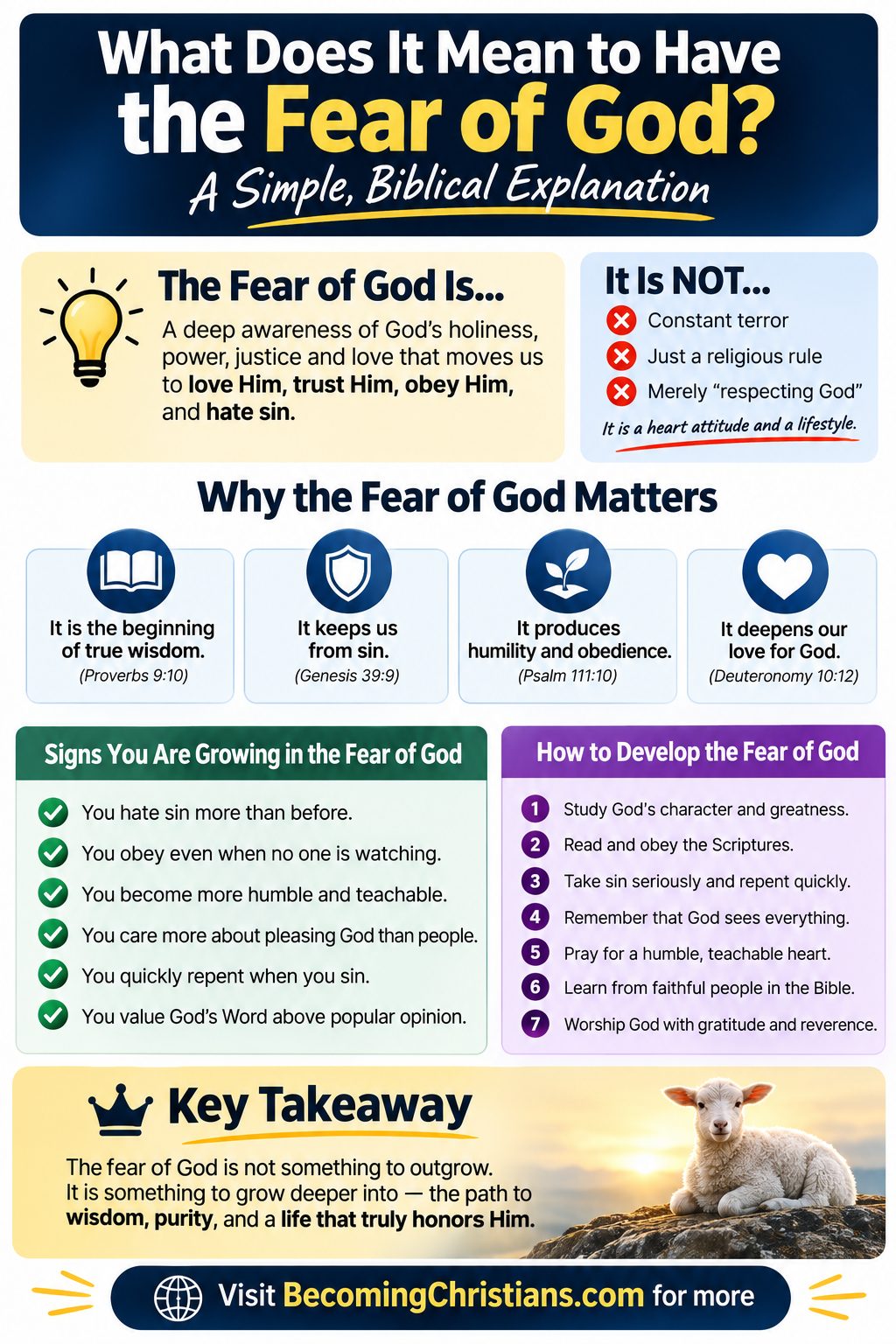
It is living every day with a heart that recognizes God’s holiness, trusts His wisdom, submits to His authority, loves His righteousness, and refuses to treat sin lightly.
When we fear God, we become wiser.
We become more humble.
We become more obedient.
Most importantly, we learn to place God where He rightly belongs: at the very center of our lives.
The fear of the Lord is not something to outgrow.
It is something to grow deeper into.
Frequently Asked Questions
What does the fear of God mean in simple terms?
The fear of God means living with deep reverence, awe, and submission toward God because you recognize His holiness, authority, justice, and love. It leads to obedience and a desire to avoid sin.
Is the fear of God the same as being scared?
Not exactly. While God is worthy of fear because He is the righteous Judge, believers are not meant to live in constant terror. Biblical fear includes reverence, humility, trust, and obedience.
Why is the fear of the Lord the beginning of wisdom?
Wisdom begins when we recognize God as Creator and submit to His authority. Without acknowledging God’s truth, human knowledge lacks the proper foundation.
How can I grow in the fear of God?
Study God’s character, read Scripture with a heart to obey, repent quickly when you sin, pray for humility, and remember that God sees every part of your life.
Does the fear of God mean God wants us to be afraid of Him?
God desires us to approach Him with confidence through Christ while never losing our reverence for His holiness and authority. Love and holy fear work together in a healthy relationship with God.
Can someone love God without fearing Him?
According to Scripture, genuine love for God includes reverence and obedience. A love that ignores God’s holiness can become casual and self-centered.
What are the blessings of fearing God?
The Bible associates the fear of God with wisdom, knowledge, protection, confidence, a hatred of evil, spiritual growth, and a life that honors God.
Which Bible verses talk about the fear of God?
Some of the most important passages include Proverbs 1:7, Proverbs 8:13, Proverbs 9:10, Ecclesiastes 12:13, Psalm 111:10, Deuteronomy 10:12, Job 28:28, Acts 9:31, and Revelation 14:7 (NKJV).
Discover more from Becoming Christians
Subscribe to get the latest posts sent to your email.