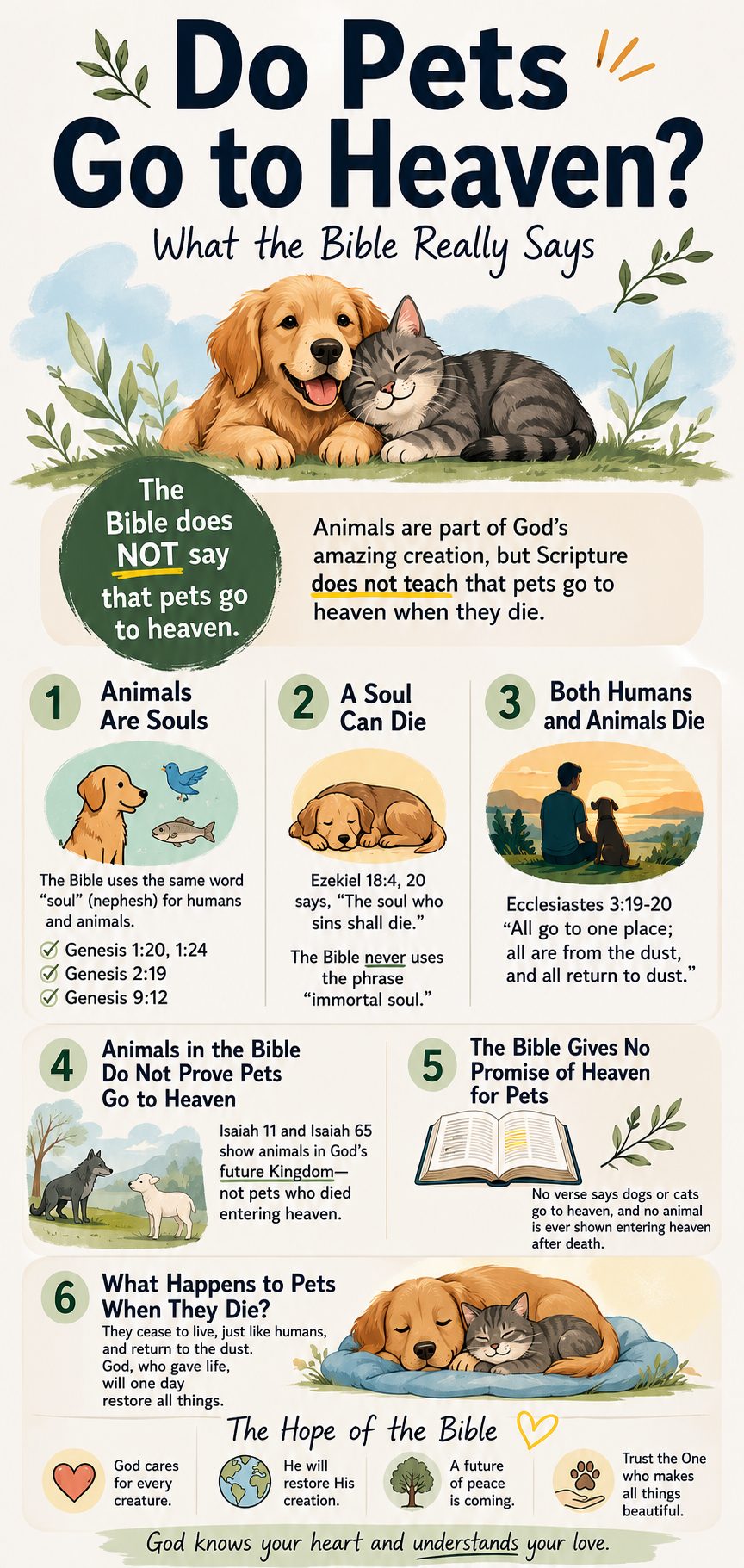
Summary: Do Pets Go to Heaven? The Bible never explicitly teaches that pets go to heaven when they die. While Scripture describes animals as living souls and shows God’s care for all His creation, it does not say that dogs, cats, or other pets possess immortal souls that continue living after death. Instead, the Bible teaches that animals, like humans, receive life from God and return to the dust when they die (Ecclesiastes 3:19-20; Psalm 104:29). Although the Bible portrays animals in God’s future restored creation, it does not promise that deceased pets go to heaven or will be resurrected.
Introduction
Few experiences are as heartbreaking as losing a beloved pet.
Whether it was a loyal dog who greeted you at the door every day, a playful cat who curled up beside you during difficult times, or another cherished companion, the loss can leave a hole in your heart that feels impossible to fill.
Pets are more than animals to many of us. They become part of our families.
They celebrate our happy moments. They comfort us during our darkest days. They become faithful companions on life’s journey.
That’s why when a beloved pet dies, one question often rises above all others:
“Will I see my pet again?”
It’s an emotional question. A deeply personal question.
And because we love our pets so much, many people naturally hope the answer is yes.
In fact, countless books, movies, articles, and social media posts assure grieving pet owners that their dogs, cats, and other pets are now running freely in heaven. While these messages may bring temporary comfort, they raise an important question:
What does the Bible actually say?
After all, our beliefs should be built on God’s Word, not merely on our emotions, traditions, or wishful thinking.
This is especially important when discussing subjects as significant as life, death, and the afterlife.
So rather than relying on popular opinions or sentimental stories, let’s open the Bible and carefully examine the evidence.
Do pets really go to heaven?
Do animals have souls?
And what happens to them when they die?
The answers may surprise you.

Why So Many People Believe Pets Go to Heaven
The belief that pets go to heaven is incredibly popular today.
In fact, many people accept it without ever stopping to ask whether the Bible actually teaches it.
Why?
One major reason is emotional attachment.
Anyone who has ever loved a pet understands how strong that bond can become. A dog may faithfully stay by your side for years. A cat may become a constant source of comfort and companionship. When they die, the grief can feel very similar to losing a close friend.
Because of this emotional connection, many people find it difficult to accept the possibility that their pets simply cease to exist after death.
As a result, they naturally gravitate toward the idea that their beloved companions are waiting for them somewhere in heaven.
Popular culture has also reinforced this belief.
Movies frequently portray deceased pets entering heaven or being reunited with their owners in the afterlife. Children’s books often depict dogs and cats living happily beyond death. Social media is filled with comforting messages claiming that “all dogs go to heaven” or that our pets are waiting for us on the other side.
Near-death experiences and personal testimonies have further strengthened this belief. Some individuals claim to have seen animals during visions or supernatural experiences, leading others to conclude that pets must be in heaven.
In addition, many Christians simply assume that if humans go to heaven, then surely their beloved pets must go there as well.
The problem is that assumptions—even sincere ones—are not the same as biblical truth.
As comforting as certain beliefs may sound, our responsibility is to ask a simple question:
What does Scripture actually teach?
Surprisingly, many of the articles, books, and videos discussing pets in heaven rely far more on emotion, tradition, and personal experiences than on careful biblical study.
If we truly want to know the answer, we must set aside assumptions and allow God’s Word to speak for itself.
And that brings us to a crucial question:
Does the Bible say animals have souls?

Does the Bible Say Animals Have Souls?
Many people are surprised to discover that the Bible actually describes animals as souls.
That statement may sound shocking because most people have been taught that only humans possess souls. However, a careful examination of Scripture reveals a different picture.
The key is understanding the Hebrew word often translated as “soul” in the Old Testament.
That word is nephesh.
Most people assume that a soul is an immortal entity that lives inside a person and survives death. However, that is not how the Bible uses the word nephesh.
In fact, the same Hebrew word is applied not only to humans but also to animals.
Animals Are Called “Souls” in the Bible
Notice what God said during the creation account:
“Then God said, ‘Let the waters abound with an abundance of living creatures…'” (Genesis 1:20).
The phrase “living creatures” comes from the Hebrew word nephesh.
A few verses later, God said:
“Let the earth bring forth the living creature according to its kind: cattle and creeping thing and beast of the earth…” (Genesis 1:24).
Again, the phrase “living creature” is translated from the same Hebrew word, nephesh.
The pattern continues throughout Scripture.
In Genesis 2:19, animals formed from the ground are described using the same Hebrew terminology. In Genesis 9:12, God refers to every living creature involved in His covenant with Noah after the Flood.
The point is significant.
The Bible does not reserve the word nephesh exclusively for human beings.
It applies the term to:
- Humans
- Birds
- Fish
- Cattle
- Wild animals
- Other living creatures
This may come as a surprise to many readers, but according to Scripture, animals are living souls just as human beings are living souls. The biblical definition of a soul is far different from the popular idea of an immortal spirit living independently of the body.
Understanding this truth is essential because it helps answer the larger question of whether animals continue living after death.
Before we can determine whether pets go to heaven, we must first understand what the Bible actually means when it talks about a “soul.”
And that is exactly what we’ll examine next.
What Is a Soul According to Scripture?
Before we can answer whether pets go to heaven, we need to answer a more fundamental question:
What exactly is a soul?
Many people assume they already know the answer.
They imagine a soul as an invisible, immortal entity living inside the body. According to this popular belief, when a person or animal dies, the soul simply leaves the body and continues living somewhere else.
But is that how the Bible defines a soul?
Let’s go back to the very beginning.
When God created Adam, we read:
“And the LORD God formed man of the dust of the ground, and breathed into his nostrils the breath of life; and man became a living being” (Genesis 2:7).
Many translations render the phrase “living being” as “living soul.”
Notice carefully what happened.
God first formed Adam’s body from the dust of the ground.
Then He breathed into him the breath of life.
The result was a living soul.
The biblical formula is remarkably simple:
Dust of the ground + breath of life = living soul
Notice what Genesis 2:7 does not say.
It does not say that God placed an immortal soul inside Adam.
It does not say that Adam possessed a separate conscious entity that could never die.
Rather, Adam became a living soul.
This distinction is crucial.
The Bible does not teach that humans have souls in the way many people assume. Instead, it teaches that humans are souls—living beings animated by the breath of life.
And what is true of humans is also true of animals.
As we saw earlier, the same Hebrew word nephesh is applied to both people and animals.
This brings us to another important question:
Can a soul die?
The answer may surprise many readers.
The prophet Ezekiel leaves no room for confusion.
God declared:
“Behold, all souls are Mine; the soul of the father as well as the soul of the son is Mine; the soul who sins shall die” (Ezekiel 18:4).
A few verses later, He repeats the same truth:
“The soul who sins shall die” (Ezekiel 18:20).
Those are straightforward statements.
If a soul can die, then a soul is not inherently immortal.
This aligns with the biblical teaching that life is a gift from God, not an inherent possession of either humans or animals.
The Bible Never Uses the Phrase “Immortal Soul”
This may come as a surprise, but if you search the Bible from Genesis to Revelation, you will never find the phrase “immortal soul.”
Not once.
While millions of people believe in the doctrine of an immortal soul, the exact expression never appears in Scripture. The Bible consistently presents immortality as something God possesses inherently and something human beings receive as a future gift from Him—not something we naturally possess from birth.
In fact, the Bible repeatedly teaches that souls can die.
Understanding this biblical definition of a soul helps us avoid confusion when discussing animals, death, and the afterlife.
If animals are souls and humans are souls, then the next question naturally follows:
What happens when a soul dies?
Top 3 Best-Selling Christian Books for October 2026



If Animals Are Souls, Can They Die?
The Bible’s answer is both simple and consistent.
Humans die.
Animals die.
And since both humans and animals are described as living souls, souls die.
This reality may seem obvious, yet it challenges many popular beliefs about the afterlife.
Every day we witness the cycle of life and death in the world around us.
People die.
Pets die.
Wild animals die.
No matter how much we love them, all living creatures eventually return to the dust from which they came.
The Bible never presents death as a doorway to a higher form of life for animals. Instead, it portrays death as the cessation of life itself.
This is why understanding the source of life is so important.
Neither humans nor animals possess life independently.
Both depend entirely upon God.
The Same Breath of Life Animates Humans and Animals
One of the most fascinating passages on this subject appears in Ecclesiastes.
Notice what Solomon wrote:
“For what happens to the sons of men also happens to animals; one thing befalls them: as one dies, so dies the other. Surely, they all have one breath; man has no advantage over animals; for all is vanity. All go to one place: all are from the dust, and all return to dust” (Ecclesiastes 3:19-20).
These verses highlight an important truth.
Humans and animals share the same physical life process.
Both depend upon the breath of life that God provides.
Both eventually die.
Both return to the dust.
This does not mean humans and animals have the same purpose or destiny. The Bible clearly teaches that God created human beings in His image and has a unique plan for humanity.
However, when it comes to physical life and death, Scripture emphasizes the similarities rather than the differences.
The same God who gives life to humans gives life to animals.
And when that life is withdrawn, both perish.
As the psalmist wrote concerning God’s creatures:
“You hide Your face, they are troubled; You take away their breath, they die and return to their dust” (Psalm 104:29).
The biblical picture is clear.
Life comes from God.
Death occurs when that life is removed.
And both humans and animals are completely dependent upon Him.
Do Animals Go to Heaven When They Die?
Now we come to the question that brings many readers here:
Do animals go to heaven when they die?
If you’ve recently lost a beloved pet, this question is probably more than theological.
It’s personal.
You miss the familiar bark at the door.
The comforting presence at your side.
The companionship that became part of your daily life.
Because of that bond, it is understandable why so many people hope their pets are now living somewhere in heaven.
But when we turn to Scripture, we must ask not what we hope is true, but what God has revealed.
The Bible consistently presents heaven as God’s dwelling place.
Jesus taught us to pray:
“Our Father in heaven” (Matthew 6:9).
Throughout Scripture, heaven is described as the place where God’s throne resides and from which He rules His creation.
Yet despite the Bible’s many references to heaven, there is a remarkable silence concerning deceased pets.
No passage explicitly states that dogs go to heaven.
No verse says cats enter heaven after death.
No biblical writer describes household pets ascending into heaven when they die.
In fact, there is not a single example in Scripture of a deceased animal entering heaven.
This is significant.
If the Bible intended to teach that pets automatically go to heaven after death, we would expect at least one clear statement or example.
Instead, we find none.
Now, this does not mean that God does not care about animals.
Far from it.
The Bible repeatedly shows God’s concern for His creation. He created animals, sustains them, and even included them in His covenant with Noah after the Flood.
God notices when a sparrow falls.
He feeds the birds of the air.
He cares for all the creatures He has made.
Yet God’s love for animals should not be confused with teachings the Bible never actually gives.
The comforting reality is that God is perfectly just, perfectly wise, and perfectly loving.
While Scripture does not teach that pets go to heaven when they die, it does teach that every aspect of God’s creation remains under His sovereign care.
And that leads us to another important question:
If animals do not go to heaven when they die, what do the Bible’s passages about animals in God’s future Kingdom actually mean?
What About the Animals Mentioned in Heaven?
At this point, some readers may be thinking:
“Wait a minute. Doesn’t the Bible mention animals in heaven?”
That’s a fair question.
In fact, there are several passages frequently cited as proof that animals go to heaven. However, when we examine these verses carefully, we’ll discover that they do not actually teach that deceased pets enter heaven after death.
Let’s look at the most common examples.
Isaiah’s Vision of the Wolf and the Lamb
One of the most beautiful prophecies in Scripture appears in Isaiah 11:
“The wolf also shall dwell with the lamb, the leopard shall lie down with the young goat… and a little child shall lead them” (Isaiah 11:6).
This remarkable passage paints a picture of peace, harmony, and restoration.
Predators no longer attack prey.
Violence disappears.
Creation functions as God originally intended.
Many people read this passage and conclude that it proves deceased animals are living in heaven.
However, that’s not what Isaiah is describing.
The context of Isaiah 11 focuses on the future reign of the Messiah and the restoration of God’s Kingdom. The passage says nothing about animals that previously died. Instead, it describes animals existing during a future age of peace.
In other words, Isaiah 11 demonstrates that animals will exist in God’s restored creation. It does not prove that pets who died centuries earlier are currently living in heaven.
Isaiah 65 and the Restored Creation
Another frequently cited passage appears in Isaiah 65:
“The wolf and the lamb shall feed together, the lion shall eat straw like the ox…” (Isaiah 65:25).
Again, the focus is not on deceased pets entering heaven.
The focus is on God’s future Kingdom.
Isaiah describes a transformed world where suffering, violence, and destruction are dramatically reduced. It is a picture of creation restored under God’s rule.
This passage provides wonderful insight into the future, but it does not answer the question of what happens to individual pets when they die.
The White Horses of Revelation
Some people also point to Revelation 19.
In this chapter, Christ returns riding a white horse, and the armies of heaven follow Him on white horses.
At first glance, someone might argue that these horses prove animals are in heaven.
However, this conclusion goes beyond what the text actually says.
The passage never identifies these horses as animals that previously lived and died on earth.
Nor does it suggest they were once family pets.
The existence of horses in a prophetic vision does not establish a doctrine that deceased animals go to heaven.
What These Passages Actually Prove
When we put all these passages together, one important conclusion emerges.
The Bible clearly teaches that animals have a place in God’s creation.
The Bible clearly portrays animals in prophetic visions of the future.
The Bible clearly demonstrates God’s concern for the animal world.
However, none of these passages explicitly teach that deceased pets go to heaven after death.
That distinction matters.
We should never build doctrine on assumptions.
Instead, we must allow Scripture to say exactly what it says—and avoid making it say what it does not.
Will God Create Animals in the Future Kingdom?
While the Bible does not teach that pets go to heaven when they die, it does reveal something beautiful about the future.
Animals appear prominently in God’s restored creation.
This is one reason many Bible readers find hope when studying prophecy.
The future God describes is not a cold, empty, or sterile world.
It is vibrant.
It is alive.
It is full of beauty.
And animals are part of that picture.
Isaiah 11 describes wolves, lambs, leopards, calves, lions, and other creatures living together in peace.
Isaiah 65 presents a similar vision of harmony throughout creation.
These prophecies reveal that God’s plan for the future includes the restoration of the natural world.
The violence, suffering, and corruption that entered creation because of sin will not last forever.
God intends to restore what has been broken.
This restoration extends beyond humanity.
It touches the entire created order.
For pet lovers, this truth offers a meaningful perspective.
Even though the Bible does not specifically promise the resurrection of deceased pets, it does reveal that animals have a place in God’s future Kingdom.
The God who created animals in the beginning has not forgotten them.
His future world includes a thriving and peaceful creation that reflects His wisdom, creativity, and goodness.
That is a far more hopeful picture than many people realize.
What Happens to Pets When They Die?
Now we come back to the question many grieving pet owners ask.
What actually happens when a pet dies?
Based on the biblical evidence we have examined, animals are living souls.
Like humans, they possess life because God gives them the breath of life.
And like humans, they eventually die.
Scripture consistently describes death as the end of conscious life.
Notice Solomon’s words:
“For what happens to the sons of men also happens to animals; one thing befalls them: as one dies, so dies the other… All go to one place: all are from the dust, and all return to dust” (Ecclesiastes 3:19-20).
This passage emphasizes that both humans and animals experience physical death.
Both return to the dust from which they came.
The psalmist echoes the same truth:
“You take away their breath, they die and return to their dust” (Psalm 104:29).
Life comes from God.
When God withdraws that breath, life ceases.
From this biblical perspective, animals do not continue living as conscious beings after death.
They do not suffer.
They do not experience pain.
They simply cease living and return to the dust.
While this answer may not satisfy every emotional desire, it reflects the consistent testimony of Scripture regarding life and death.
Why the Bible Never Promises That Pets Go to Heaven
This is perhaps the most important section of our discussion.
If the Bible truly teaches that pets go to heaven, we should expect clear evidence.
Yet when we search the Scriptures, several important facts emerge.
First, there is no verse that explicitly says:
- Dogs go to heaven.
- Cats go to heaven.
- Pets go to heaven.
- Animals enter heaven after death.
Not one.
Second, the Bible never records a deceased pet entering heaven.
Throughout Scripture, we find numerous discussions about life, death, resurrection, judgment, and God’s Kingdom.
Yet none of these passages describe deceased animals ascending to heaven.
Third, the Bible’s resurrection promises are directed toward humanity.
God repeatedly promises resurrection to men and women.
Jesus spoke of people rising from their graves.
The apostles preached the resurrection of believers.
The book of Revelation discusses the resurrection of the saints.
However, Scripture never extends this promise to animals.
This doesn’t mean God dislikes animals.
Quite the opposite.
The Bible repeatedly reveals God’s care for His creation.
But caring for animals is different from promising them eternal life.
The absence of such promises is significant.
If God intended believers to place their hope in seeing deceased pets again, we would expect clear biblical teaching on the subject.
Instead, Scripture remains silent.
And when Scripture is silent, wisdom requires humility.
We should avoid making promises that God Himself has not made.
A Better Question: Why Did God Give Us Pets?
Perhaps we’ve been asking the wrong question all along.
Instead of focusing only on what happens after our pets die, perhaps we should also ask:
Why did God give us pets in the first place?
The answer reveals something beautiful about God’s character.
Pets remind us that God is a generous Creator.
He could have made a purely functional world.
Instead, He filled it with astonishing variety, beauty, and life.
Think about the joy pets bring.
The excitement of a dog greeting its owner.
The comfort of a cat resting beside someone who feels lonely.
The fascination of watching animals interact, play, and express their unique personalities.
These experiences enrich our lives.
Pets also teach valuable lessons.
They demonstrate loyalty.
Trust.
Dependence.
Faithfulness.
Many pet owners can tell stories about the unwavering devotion of a beloved animal.
In addition, caring for animals teaches stewardship.
God entrusted humanity with responsibility over His creation. Looking after animals reminds us that we are caretakers of something that ultimately belongs to Him.
Most importantly, pets reflect God’s creativity.
Every species reveals something about the imagination and wisdom of the Creator.
They remind us that God delights in life, beauty, and diversity.
Perhaps that is one of the greatest gifts pets offer us.
They point beyond themselves to the One who made them.
What Hope Does the Bible Offer Pet Owners?
Losing a pet hurts.
There is no point pretending otherwise.
For many people, the grief is real and profound.
After years of companionship, the silence can feel overwhelming.
The empty bed.
The empty yard.
The absence of a familiar friend.
God understands loss.
He understands sorrow.
The Bible repeatedly portrays Him as compassionate toward those who grieve.
While Scripture does not promise that pets go to heaven, it does reveal several comforting truths.
First, animals matter to God.
He created them.
He sustains them.
He delights in His creation.
Second, God is perfectly loving and perfectly just.
We can trust Him even when we do not have answers to every question.
Third, the Bible points forward to a future restoration of creation.
The world we currently experience—with its suffering, death, and loss—is not God’s final plan.
A better world is coming.
A world marked by peace, harmony, and the restoration of all things under God’s rule.
That future hope does not erase the pain of losing a beloved pet.
But it reminds us that God’s story for creation is not ultimately one of loss.
It is a story of restoration.
And the God who created every bird, every horse, every dog, every cat, and every living creature has not forgotten the work of His hands.
That truth alone gives us reason to trust Him, even when some questions remain unanswered.
Frequently Asked Questions
Do dogs go to heaven?
The Bible never explicitly states that dogs go to heaven when they die. While Scripture describes animals as living souls and shows God’s care for all His creation, it does not teach that dogs possess immortal souls that continue living after death. Nor does it provide any example of a deceased dog entering heaven.
Do cats go to heaven?
No biblical passage specifically says that cats go to heaven after death. Although cats are part of God’s creation and are cared for by Him, Scripture does not promise eternal life or a heavenly existence for animals. The Bible’s promises of resurrection and eternal life are directed toward humanity.
Do animals have souls?
Yes. The Bible uses the Hebrew word nephesh (often translated as “soul” or “living creature”) for both humans and animals. Genesis 1:20, Genesis 1:24, Genesis 2:19, and Genesis 9:12 all use language showing that animals are living souls. However, this does not mean animals possess immortal souls. In Scripture, a soul is a living being, not an immortal entity living inside a body.
What happens to pets after death?
According to the Bible, pets experience death in much the same way humans experience physical death. Ecclesiastes 3:19-20 says that both humans and animals die and return to the dust. Psalm 104:29 states that when God takes away their breath, they die and return to the earth. Scripture does not describe pets continuing as conscious beings after death.
Will I see my dog again?
The Bible does not specifically promise that people will be reunited with their deceased pets. While many people hope to see their beloved animals again, Scripture does not provide a direct promise of a future reunion. What the Bible does promise is a future restoration of creation under God’s Kingdom, where animals will once again be part of a peaceful and thriving world.
Are pets mentioned in heaven?
The Bible contains several references to animals in prophetic visions and heavenly scenes. For example, Revelation 19 mentions white horses, and Isaiah’s prophecies describe animals living in harmony in God’s future Kingdom. However, these passages do not teach that deceased pets go to heaven after death. They simply show that animals have a place in God’s creation and future plans.
What Bible verses talk about animals after death?
Several passages help us understand what the Bible says about animals and death:
Ecclesiastes 3:19-20 — Humans and animals both die and return to dust.
Psalm 104:29 — Animals die when God withdraws their breath.
Genesis 1:20 and 1:24 — Animals are described as living creatures or living souls.
Genesis 9:12 — God’s covenant includes living creatures.
Isaiah 11:6-9 — Animals appear in God’s future Kingdom.
Isaiah 65:25 — Animals are part of the restored creation.
Together, these passages show that animals are part of God’s creation, depend on Him for life, and will have a place in the restored world He promises to establish.
If animals don’t go to heaven, why does God care about them?
The Bible repeatedly shows God’s concern for animals. He created them, sustains them, provides food for them, and includes them in His care for creation. Jesus even pointed to God’s care for birds as evidence of His loving attention to all living things. God’s love for animals does not necessarily mean He grants them eternal life, but it does demonstrate that they are valuable in His sight.
Why do so many Christians believe pets go to heaven?
Many Christians believe pets go to heaven because of emotional attachment, popular books, movies, personal experiences, and traditions that have become widely accepted. While these beliefs are understandable, they are often based more on hope and sentiment than on explicit biblical teaching. For this reason, it is important to examine what Scripture actually says rather than relying solely on popular opinion.
What is the biblical answer to “Do pets go to heaven?”
Based on the biblical evidence, Scripture does not teach that pets go to heaven when they die. The Bible describes animals as living souls that receive life from God and return to the dust when they die. While animals play an important role in God’s creation and will be present in His restored Kingdom, the Bible does not promise that deceased pets enter heaven or receive resurrection in the same way human beings are promised eternal life through God’s plan of salvation.

About the Author
Joshua Infantado is a Christian blogger and Bible teacher who has been writing faith-based content since 2013. He is the founder of Becoming Christians, where he shares blogs, books, videos, and online courses to help believers grow in truth and grace. Joshua lives in Davao City, Philippines, with his wife, Victoria, and their son, Caleb. Contact him at joshuainfantado@gmail.com.
Discover more from Becoming Christians
Subscribe to get the latest posts sent to your email.