Quick Answer: What Does the Bible Say About Interracial Marriage?
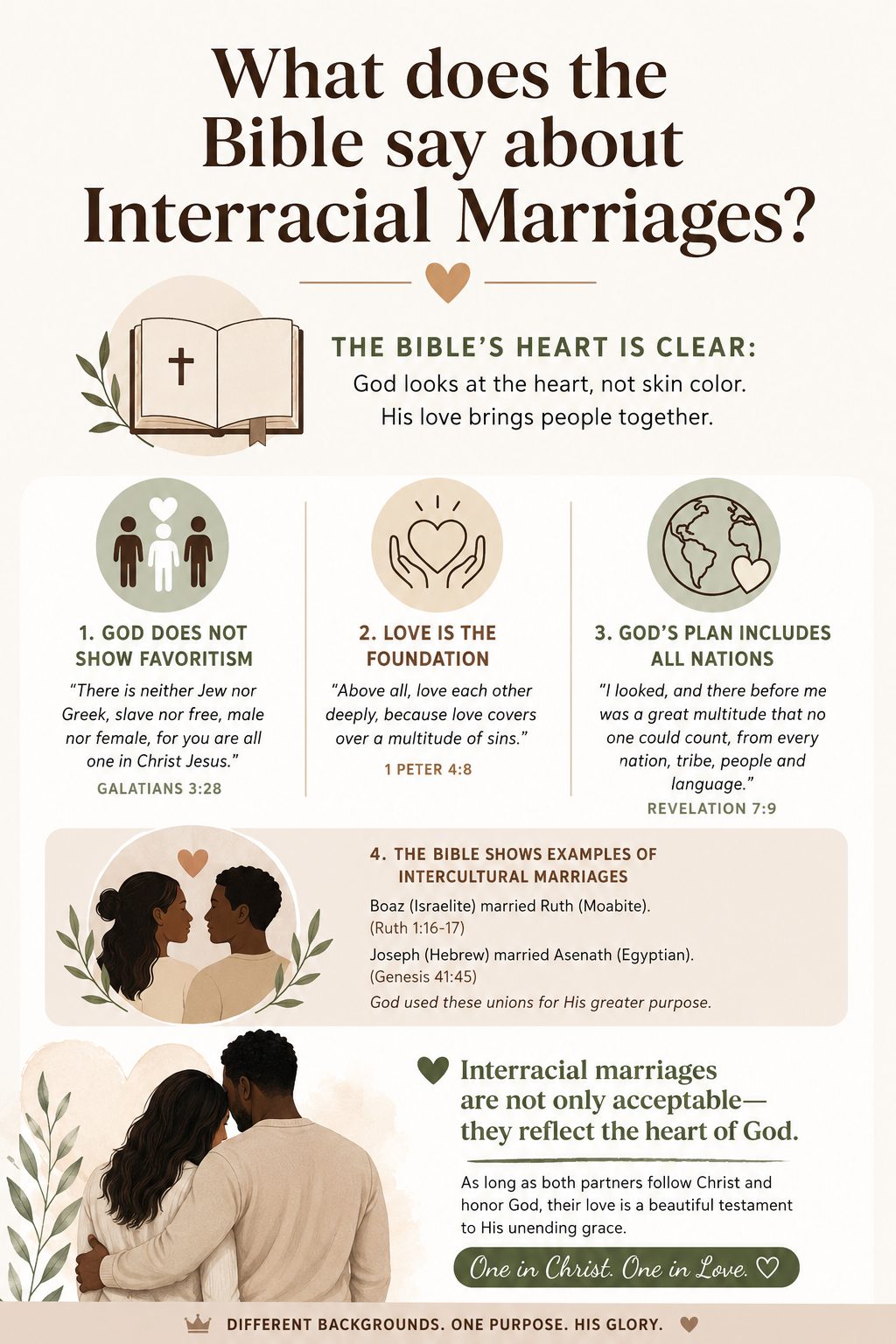
The Bible does not forbid interracial marriage. In the Old Testament, God prohibited the Israelites from marrying certain foreign nations — but the reason was religious, not racial. Those nations worshipped false gods and would lead Israel into idolatry. In the New Testament, that principle carries forward in a universal form: Christians are commanded not to be “unequally yoked” with unbelievers (2 Corinthians 6:14). The only biblical standard for a Christian choosing a spouse is shared faith in Jesus Christ — not skin color, ethnicity, or national origin.
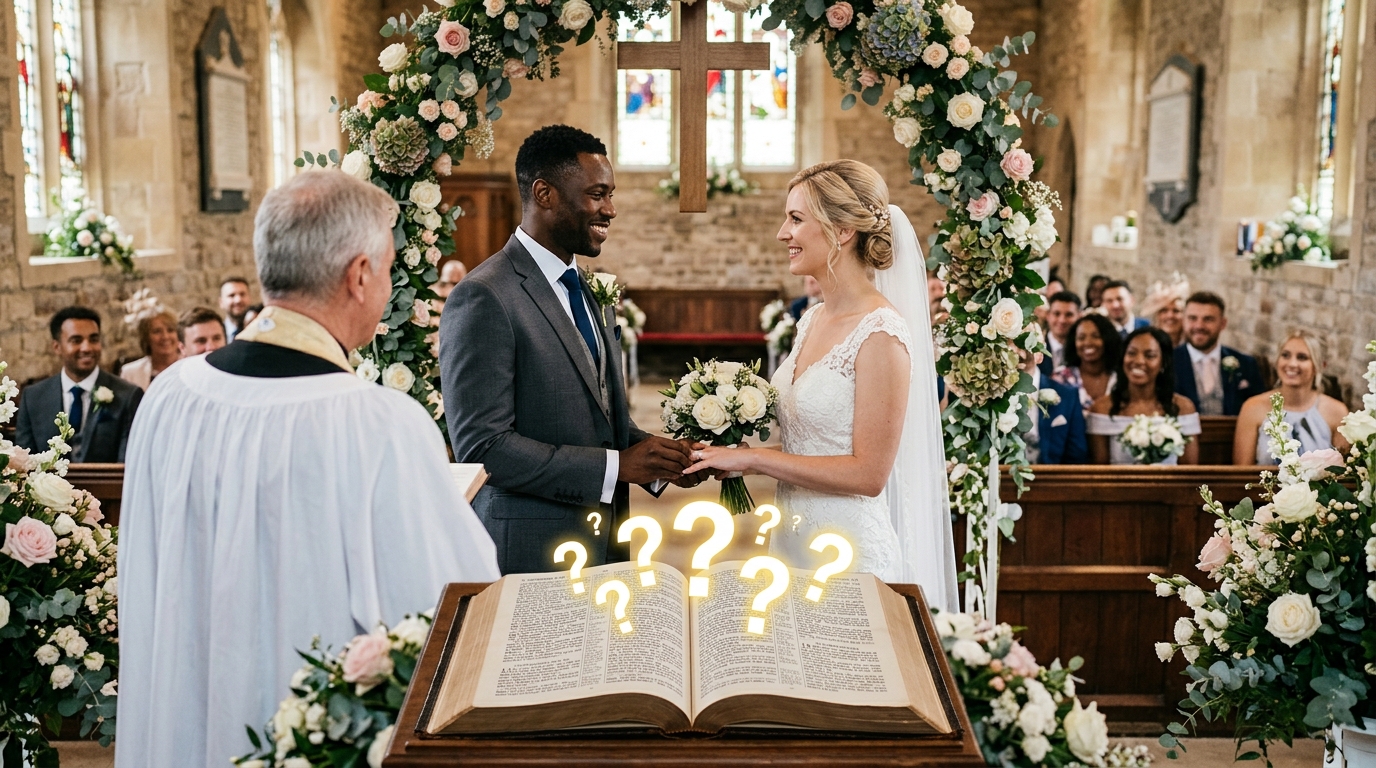
The Old Testament: What Was Actually Forbidden — and Why
When people ask whether the Bible condemns interracial marriage, they almost always start in the same place: Deuteronomy 7. And for good reason — it is direct, unmistakable, and at first glance, it sounds like a racial prohibition. But context changes everything.
“You shall not intermarry with them [the nations of Canaan], giving your daughters to their sons or taking their daughters for your sons, for they would turn away your sons from following me, to serve other gods. Then the anger of the LORD would be kindled against you, and he would destroy you quickly.” — Deuteronomy 7:3–4 (ESV)
Notice that God Himself explains His reason in the very next verse: “for they would turn away your sons from following me, to serve other gods.” The prohibition had nothing to do with ethnicity, bloodline, or skin color. It was entirely about idolatry and spiritual compromise.
Who Were the Forbidden Nations?
The specific nations listed in Deuteronomy 7:1 — the Hittites, Girgashites, Amorites, Canaanites, Perizzites, Hivites, and Jebusites — were not forbidden because of their race. They were forbidden because of their religious practices: child sacrifice, temple prostitution, and the worship of Baal, Asherah, Molech, and other false gods. These were practices that, if absorbed into Israelite family life through marriage, would corrupt the covenant community from within.
⚠️Key insight: The Israelites themselves were not a single “race.” They were a covenant people drawn from many ethnic origins, including Egyptians, Midianites, and others who joined them during the Exodus (Exodus 12:38). The criterion for belonging was always covenant loyalty to God, not ancestry.
What Happened When Israel Disobeyed?
The prophet Malachi confirms that when Israel did intermarry with idolaters, the damage was exactly what God warned about — not racial contamination, but spiritual corruption:
“Judah has been faithless, and abomination has been committed in Israel and in Jerusalem. For Judah has profaned the sanctuary of the LORD, which he loves, and has married the daughter of a foreign god.” — Malachi 2:11 (ESV)
“The daughter of a foreign god” — this is the defining phrase. The issue was the god she worshipped, not the people she came from.
What About Ruth, Rahab, and Zipporah?
If the Old Testament prohibition were racial, then some of the most celebrated figures in the Bible would stand condemned. Instead, they are honored — because they embraced the God of Israel.
Ruth, a Moabite, became the great-grandmother of King David and is listed in the genealogy of Jesus Christ (Matthew 1:5). Her famous declaration — “Your people shall be my people, and your God my God” (Ruth 1:16) — was a confession of faith, not a racial conversion.
Rahab, a Canaanite woman from Jericho, is also listed in the genealogy of Christ (Matthew 1:5). She too was accepted not because of her ethnicity but because of her faith.
Zipporah, Moses’ wife, was a Midianite (Exodus 2:21). When Moses’ own sister Miriam criticized the marriage, God’s response was swift and unmistakable — He struck Miriam with leprosy (Numbers 12:1–10). God did not condemn the interracial marriage; He condemned the prejudice against it.
The New Testament: The Only Standard That Remains
The New Testament does not repeat the ethnic marriage restrictions of the Old Testament. Those commands were part of the Mosaic covenant, given specifically to national Israel to preserve the covenant community from idolatrous corruption. In Christ, the boundaries of God’s people are no longer ethnic or national — they are defined by faith.
“There is neither Jew nor Greek, there is neither slave nor free, there is no male and female, for you are all one in Christ Jesus.”
Galatians 3:28 (ESV)
The New Testament does, however, carry forward the spiritual principle behind the Old Testament prohibition. The concern was never about race — it was about being spiritually mismatched with someone who does not share your devotion to God. That principle is now stated in universal terms:
“Do not be unequally yoked with unbelievers. For what partnership has righteousness with lawlessness? Or what fellowship has light with darkness?” — 2 Corinthians 6:14 (ESV)
What Does “Unequally Yoked” Mean?
The image of a yoke comes from farming. When two oxen are yoked together to pull a plow, they must be matched in size and strength. If they are mismatched, neither animal can work effectively — one pulls against the other, and the whole enterprise is frustrated.
Applied to marriage, Paul’s point is that a Christian and a non-Christian are fundamentally misaligned in their deepest values, their ultimate loyalty, and their vision for life. The most intimate human relationship is built on a shared foundation — and for a Christian, that foundation is Jesus Christ.
✅ The clear New Testament principle: A Christian may marry a person of any ethnicity, nationality, or cultural background — provided that person is also a genuine believer in Jesus Christ. Faith is the criterion. Race is irrelevant.
Top 3 Christian Books on Marriage June 2026
What Colossians 3:11 Adds
“Here there is not Greek and Jew, circumcised and uncircumcised, barbarian, Scythian, slave, free; but Christ is all, and in all.” — Colossians 3:11 (ESV)
Paul lists every social, ethnic, and national distinction that divided people in the ancient world — and declares that in Christ, none of those distinctions carry ultimate weight. The same Lord is Lord of all, blessing all who call on Him (Romans 10:12). This is the vision of the church: a community of people from every tribe, tongue, and nation, unified in Christ.
3. Interracial Couples in the Bible
The Bible does not use the term “interracial marriage,” but it records numerous cross-ethnic and cross-cultural marriages — and notably, God’s response to those unions is always driven by the spiritual faithfulness of the individuals involved, never by their ethnic background.
| Names | Bible Verses | Explanation |
|---|---|---|
| Moses & Zipporah | Numbers 12:1 | Exodus 2:21 | Moses, an Israelite, married Zipporah, a Midianite. When Aaron and Miriam criticized the marriage, God rebuked them — not Moses. |
| Ruth & Boaz | Ruth 1:16 | Matthew 1:5 | Ruth, a Moabite, married Boaz, an Israelite. Their union placed them directly in the genealogy of Jesus Christ — one of the highest biblical honors. |
| Rahab & Salmon | Joshua 2 | Matthew 1:5 | Rahab, a Canaanite from Jericho, married Salmon of Israel. She is listed as an ancestor of Christ and praised for her faith in Hebrews 11:31. |
| Solomon & the Shulamite | Song of Songs 1:5–6 | The Shulamite woman describes her dark skin (“I am dark, but lovely”). God’s inspired record shows no disapproval — on the contrary, the relationship is celebrated. |
| Joseph & Asenath | Genesis 41:45 | Joseph, a Hebrew patriarch, was given an Egyptian wife by Pharaoh. Their sons, Manasseh and Ephraim, became two of the twelve tribes of Israel. |
| Esther & Xerxes | Esther 2:16–17 | The Jewish Esther became queen to the Persian king Ahasuerus (Xerxes). God used this cross-cultural union to save the Jewish people from genocide. |
📖 In every case where God addresses these marriages, the issue He raises is always faithfulness to Him — never ethnicity. Ruth is honored. Rahab is honored. Zipporah is defended. Asenath’s children become tribal fathers of Israel.
Old Testament vs. New Testament: Side-by-Side Comparison
One of the most common sources of confusion is failing to distinguish between what God commanded specifically for ancient Israel under the Mosaic Covenant versus what He commands for all Christians under the New Covenant. The table below clarifies the key differences:
| Category | Old Testament (Mosaic Law) | New Testament (New Covenant) | Status for Christians |
|---|---|---|---|
| Who it applies to | National Israel (covenant community) | All believers in Christ (universal church) | Context matters |
| Marriage restriction | Do not marry certain foreign nations (Deut. 7:3) | Do not be yoked with unbelievers (2 Cor. 6:14) | Principle continues |
| Reason for restriction | Those nations worshipped false gods — idolatry risk | Spiritual incompatibility between believer and unbeliever | Same root reason |
| Based on race? | No — based on religion of foreign nation | No — based on faith in Christ | Never racial |
| Cross-ethnic marriage allowed? | Yes, if foreign partner embraced God of Israel (e.g. Ruth) | Yes, for any two believers regardless of ethnicity | Fully permitted |
| Key biblical affirmation | God defended Moses’ marriage to Zipporah (Num. 12:9–10) | “All one in Christ Jesus” (Gal. 3:28) | Endorsed |
| What is condemned | Marrying idolaters who will lead you from God | Marrying unbelievers; spiritual unequal yoking | Still forbidden |
| Applies today? | Ceremonial/civil law for Israel — not binding on Christians | Direct command to all Christians — fully binding | 2 Cor. 6:14 is binding |
Common Myths and Misused Scriptures
Over the centuries, certain Bible passages have been misquoted or taken wildly out of context to argue against interracial marriage. These arguments are not just biblically wrong — they are dangerous distortions of Scripture that have been used to justify racism and oppression. Let’s address them directly.
| ❌ The Myth | ✅ The Biblical Truth |
|---|---|
| “The Tower of Babel proves God wants the races separate” (Acts 17:26 misuse) | Babel was about language separation, not racial separation. Acts 17:26 describes God’s sovereignty over nations’ geographic boundaries — it says nothing about marriage. |
| “The Curse of Ham justifies racial hierarchy” (Genesis 9 misuse) | The curse fell on Canaan, not on all descendants of Ham. It was never about skin color. Using this passage to justify racism is a gross historical distortion condemned by mainstream biblical scholarship. |
| “Do not plant two kinds of seed means races shouldn’t mix” (Leviticus 19:19 misuse) | This was a symbolic purity law for Israel, reinforcing their distinctiveness as God’s set-apart people. It addressed agricultural and clothing practices — it has no bearing whatsoever on human marriage across ethnic lines. |
| “God created different races to stay separate” | There is only one human race — all descended from Adam and Eve (Acts 17:26; Genesis 3:20). Modern genetics confirms that skin tone is a minor surface variation. The Bible never treats “races” as separate categories of humanity. |
| “Interracial marriage will harm your children” | This is a social concern, not a biblical one. The Bible calls children a gift from the Lord (Psalm 127:3). Children of interracial couples are equally image-bearers of God and equally heirs of salvation in Christ. |
Scripture, Science, and the One Human Race
One of the most important insights for understanding this topic is recognizing that the Bible’s framework does not match the modern Western concept of “race” at all. The Hebrew and Greek texts speak of nations, peoples, tribes, and languages — not races.
“And he made from one man every nation of mankind to live on all the face of the earth, having determined allotted periods and the boundaries of their dwelling place.” — Acts 17:26 (ESV)
The phrase “from one man” (or “from one blood” in some translations) is a clear assertion of common human descent. Whatever ethnic or cultural diversity God designed into humanity, it emerged from a single origin — which means every human being shares the same fundamental nature, dignity, and worth.
🧬 Modern genomic science agrees: human beings share approximately 99.9% of their DNA. What we call “racial” differences — primarily skin tone, hair texture, and facial features — represent a tiny fraction of genetic variation. From a biblical standpoint, there is one race: the human race. All ethnic variations are expressions of God’s creative diversity within that one race.
Answers in Genesis and other creation-based researchers have long argued that what we call “races” are better described as people groups — cultural and geographic clusters that developed distinct physical characteristics over generations. This framing aligns better with Scripture’s vocabulary and eliminates the idea that racial mixing is in any way biologically or spiritually problematic.
Grow Closer to God…
Practical Guidance for Interracial Christian Couples
If you are in or considering an interracial relationship, the Bible’s message is clear: there is no sin in it. But wisdom also calls you to be clear-eyed about the realities you may face in a world that doesn’t always reflect Christ’s vision of unity.
The One Non-Negotiable: Shared Faith
The single biblical requirement for a Christian choosing a spouse is that your future partner is a genuine, born-again believer in Jesus Christ (2 Corinthians 6:14; John 3:3). This is not a suggestion — it is a command. A beautiful cross-cultural marriage built on shared faith in Christ is honoring to God. A marriage between a believer and an unbeliever — regardless of whether they share the same ethnicity — is spiritually dangerous.
💍 The order of priority: (1) Is this person a genuine believer? (2) Do we share the same core values and life vision in Christ? (3) Are we well-suited in character, maturity, and calling? Ethnicity never appears on this list as a criterion — but faith always comes first.
Navigating Family and Cultural Tensions
Scripture is honest that family opinion matters — not as a veto over your marriage, but as a factor to be prayerfully considered (Proverbs 13:10). Interracial couples may face resistance from family members or social circles rooted in cultural prejudice rather than biblical principle. This is a real challenge that deserves honest conversation before marriage, not after.
Raising Multiracial Children
Children born to interracial couples are image-bearers of God (Genesis 1:27), heirs of Christ’s kingdom (Galatians 3:29), and beloved members of God’s family. They may face questions about identity — which is why intentionally raising them in a home saturated with the gospel, with a strong sense of their identity in Christ, is so important.
Your Marriage Can Be a Testimony
“There is no distinction between Jew and Greek; for the same Lord is Lord of all, bestowing his riches on all who call on him.” — Romans 10:12 (ESV)
An interracial couple that loves one another faithfully, serves their community, and honors God in their marriage is a living sermon. In a world fractured by racial division, your family can display the reconciling power of the gospel — that Christ tears down every wall of hostility (Ephesians 2:14–16).
Summary: What Every Christian Should Know
- ✔ The Old Testament prohibited Israelites from marrying certain foreign nations — not because of race, but because those nations were idolaters who would turn Israel away from God.
- ✔ God consistently honored and even blessed cross-ethnic marriages when both partners were faithful to Him — Ruth, Rahab, Zipporah, and others stand as proof.
- ✔ When Moses’ sister criticized his interracial marriage, God rebuked her with leprosy. Racial prejudice has never been acceptable to God.
- ✔ The New Testament carries forward the spiritual principle: do not be unequally yoked with unbelievers (2 Cor. 6:14). The criterion is faith — not ethnicity.
- ✔ Galatians 3:28 and Colossians 3:11 declare that in Christ, all ethnic and national distinctions are transcended. The church is one body.
- ✔ There is no passage in the Bible — Old or New Testament — that forbids marriage between people of different ethnicities when both are believers.
- ✔ The biblical standard for choosing a Christian spouse is shared faith in Jesus Christ — not race, skin color, national origin, or ethnicity.
- ✔ Interracial Christian marriages can be a powerful testimony to the gospel’s power to unite all peoples under Christ.
Frequently Asked Questions
These are the most commonly asked questions about what the Bible says regarding interracial marriage.
Is interracial marriage a sin according to the Bible?
No. The Bible never identifies interracial marriage as a sin. It does not contain a single command that forbids two people of different ethnicities from marrying, provided both are genuine believers in Christ. What the Bible does call sin is a believer marrying an unbeliever (2 Corinthians 6:14) — and that prohibition applies regardless of the couple’s racial background.
Why did God forbid intermarriage in the Old Testament?
God’s command in Deuteronomy 7:3–4 was specifically addressed to the nation of Israel, and He gave the reason Himself: the foreign nations worshipped false gods and would turn Israel away from Him. This was a religious and spiritual safeguard for the covenant community — not a racial policy. When foreigners converted to faith in the God of Israel (like Ruth, Rahab, and Zipporah), they were welcomed into the community and even into significant roles in God’s plan.
Does 2 Corinthians 6:14 forbid interracial marriage?
No — but it does set an important standard. “Do not be unequally yoked with unbelievers” means a Christian should not marry someone who does not share their faith in Jesus Christ. This has nothing to do with race. Two believers of different ethnic backgrounds are equally yoked in the most important sense. Two people of the same race but different faiths are the definition of “unequally yoked.”
What does the Bible say about marrying outside your race?
The Bible says nothing that forbids marrying outside your race. It does speak extensively about marrying within your faith. From a biblical perspective, there is actually only one race — the human race, all descended from Adam and Eve (Acts 17:26). God’s concern in marriage is always the spiritual and covenant faithfulness of the couple, never their ethnic background.
Are there examples of interracial marriage in the Bible?
Yes, several. Moses married Zipporah, a Midianite (Exodus 2:21). Ruth, a Moabite, married Boaz, an Israelite (Ruth 4). Rahab, a Canaanite, married Salmon (Matthew 1:5). Joseph, a Hebrew, married Asenath, an Egyptian (Genesis 41:45). Esther, a Jew, became queen to the Persian king Xerxes (Esther 2). Notably, Ruth and Rahab both appear in the direct genealogy of Jesus Christ — the highest possible biblical endorsement.
Does the Tower of Babel prove God wants the races to stay separate?
No. The Tower of Babel account in Genesis 11 describes God confusing human language and scattering people groups across the earth. It says nothing about marriage. The passage is about God restraining human pride and rebellion — it has no application to whether people of different ethnicities should or should not marry.
What should a Christian consider before entering an interracial marriage?
The primary biblical consideration is always shared faith: is the person you are considering marrying a genuine believer in Jesus Christ? Beyond that, prayerful consideration of character, calling, maturity, and compatibility — the same things every Christian couple should evaluate. Additionally, cultural differences can be enriching but also require intentional communication and mutual respect. While racial differences are not a biblical barrier, couples may face social challenges worth discussing honestly before marriage.
Is it wrong for a Christian to have a preference for someone of their own race?
Having natural cultural familiarity or affinity is understandable, but Christians should be careful that preferences don’t cross into prejudice or the belief that one ethnicity is superior to another. James 2:1–9 warns directly against showing favoritism based on outward appearance. The gospel calls us to see every person as an image-bearer of God, and our choice of a spouse should ultimately be driven by faith and character — not ethnic preference.
Can an interracial marriage be a Christian witness?
Absolutely. A faithful, Christ-centered interracial marriage is a living demonstration of Revelation 7:9 — the vision of people from every tribe, tongue, and nation united before the throne of God. In a world torn by racial division, a couple that loves one another across ethnic lines and points to Christ as the reason is one of the most powerful testimonies the church can offer.
📖 The biblical bottom line: Faith in Christ is the only criterion that matters. “In Christ there is no Jew or Greek” — and there is no barrier to two believers who love God building a marriage together, whatever their background.

About the Author
Joshua Infantado is a Christian blogger and Bible teacher who has been writing faith-based content since 2013. He is the founder of Becoming Christians, where he shares blogs, books, videos, and online courses to help believers grow in truth and grace. Joshua lives in Davao City, Philippines, with his wife, Victoria, and their son, Caleb. Contact him at joshuainfantado@gmail.com.
Discover more from Becoming Christians
Subscribe to get the latest posts sent to your email.
So I advise the younger widows to marry, have children, and manage their households, denying the adversary occasion for slander. – 1 Timothy 5:14