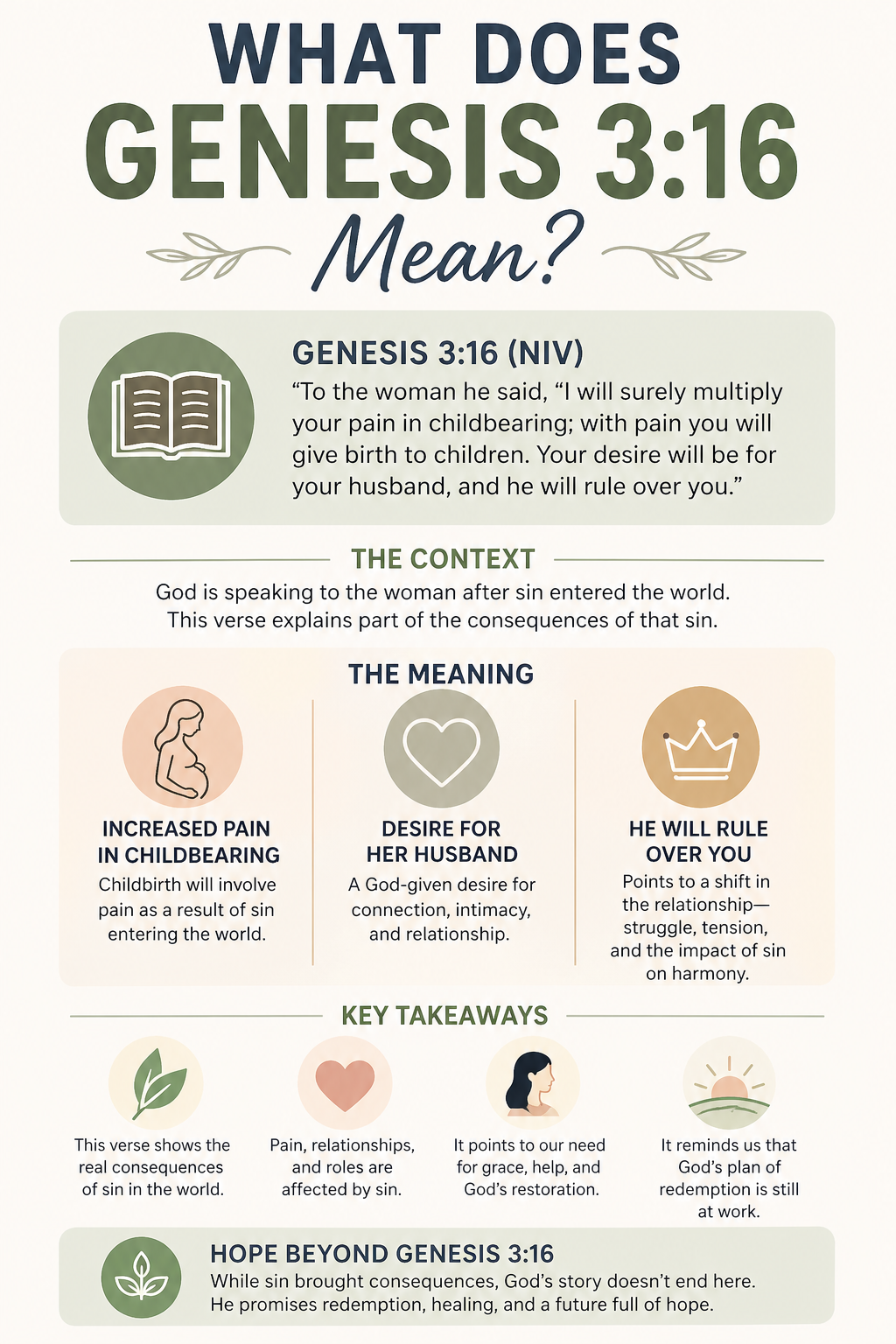
Quick Summary Answer: Genesis 3:16 records God’s words to Eve after the Fall in the Garden of Eden: “I will greatly multiply your pain in childbearing; in pain you shall bring forth children. Your desire shall be for your husband, and he shall rule over you” (ESV). This verse describes two key consequences of sin for the woman: (1) intensified pain and sorrow in childbirth, and (2) a broken relational dynamic between husband and wife, marked by a struggle for control and authority. It is not a command from God on how marriage should be, but a description of how marriage will be when sin is in charge. The good news? Through Jesus Christ, this curse can be overcome and God’s original design for marriage can be restored.
The Full Text of Genesis 3:16 in Multiple Translations
Understanding Genesis 3:16 requires looking at several translations, because the nuances of the original Hebrew are difficult to render in a single English version.
| Translation | Genesis 3:16 |
|---|---|
| ESV (2016) | “I will surely multiply your pain in childbearing; in pain you shall bring forth children. Your desire shall be contrary to your husband, but he shall rule over you.” |
| NIV | “I will make your pains in childbearing very severe; with painful labor you will give birth to children. Your desire will be for your husband, and he will rule over you.” |
| NKJV | “I will greatly multiply your sorrow and your conception; in pain you shall bring forth children; your desire shall be for your husband, and he shall rule over you.” |
| NLT | “I will sharpen the pain of your pregnancy, and in pain you will give birth. And you will desire to control your husband, but he will rule over you.” |
| NASB 1995 | “I will greatly multiply your pain in childbirth, in pain you will bring forth children; yet your desire will be for your husband, and he will rule over you.” |
| NET Bible | “I will greatly increase your labor pains; with pain you will give birth to children. You will want to control your husband, but he will dominate you.” |
Notice how different translations handle the phrase “your desire.” Some say “for your husband” (NIV, NASB), while others say “contrary to your husband” (ESV) or even “to control your husband” (NLT, NET). This reflects a genuine scholarly debate rooted in the Hebrew original — and we’ll unpack it fully below.

Context: What Happened Before Genesis 3:16?
To truly understand Genesis 3:16, you need to understand what led up to it.
In the Garden of Eden, God created Adam and Eve in His own image (Genesis 1:27) and placed them in a paradise where they had perfect communion with Him and each other. God gave them one prohibition: do not eat from the Tree of the Knowledge of Good and Evil (Genesis 2:17).
In Genesis 3, the serpent tempted Eve. She ate the forbidden fruit and gave some to Adam, who also ate it (Genesis 3:6). Both were guilty. Both were responsible for their own actions — Adam could not legitimately blame Eve, and Eve could not legitimately blame the serpent.
God then called them to account. He first addressed the serpent (Genesis 3:14–15), then the woman (Genesis 3:16), and finally the man (Genesis 3:17–19). Each received consequences fitting their role in the transgression. Genesis 3:16 is specifically God’s address to Eve.
It is critical to note: the harmony, equality, and mutual love that characterized the pre-Fall marriage (Genesis 2:18–25) was about to be disrupted by the power of sin. What God describes in verse 16 is not His ideal — it’s the painful reality of a fallen world.
Breaking Down Genesis 3:16 Phrase by Phrase
Genesis 3:16 has four major parts, each requiring careful examination:
“I will greatly multiply your pain in childbearing” → God intensifies the sorrow and toil involved in bearing and raising children.
“In pain you shall bring forth children” → Physical and emotional suffering is now inextricably linked to the most creative and life-giving act unique to women.
“Your desire shall be for your husband” → This is the most contested phrase in the verse. The Hebrew word teshuqa (תְּשׁוּקָה) is at the center of centuries of debate.
“And he shall rule over you” → The husband’s response to this “desire” will be to exercise rule or dominion — a dynamic that was absent in the pre-Fall Garden.
Top 3 Christian Books on Marriage June 2026


What Does “Pain in Childbearing” Mean?
The Hebrew word translated “pain” or “sorrow” is itsabon (עִצָּבֹון). It carries a meaning that extends beyond mere physical pain — it encompasses grief, anguish, toil, and distress. Notably, the same word is used for the man’s “painful toil” with the cursed ground in Genesis 3:17, which shows that both men and women share in the post-Fall experience of sorrowful labor.
The verse also mentions herayon, which can refer to either conception or pregnancy. Scholars suggest this is a form of merism — a literary device where two endpoints describe the whole range. In other words, the entire process from conception through childbirth is now marked by difficulty and pain.
This doesn’t mean that the joy of childbirth is removed. The New Testament affirms this: “When a woman is giving birth, she has sorrow because her hour has come, but when she has delivered the baby, she no longer remembers the anguish, for joy that a human being has been born into the world” (John 16:21). The pain is real, but it does not erase the blessing.
What Does “Your Desire Shall Be for Your Husband” Mean?
This is arguably the most debated phrase in the entire passage. There are several interpretations:
Interpretation 1: Romantic/Relational Longing
Some scholars, particularly those with egalitarian leanings, argue that this phrase simply means a woman will continue to long for her husband — for love, connection, and relationship — even though childbearing will be painful. On this view, the verse is almost compassionate: despite the hardships of marriage in a fallen world, a woman will still desire her husband. The NAS 1995 and NIV lean toward this reading.
Interpretation 2: A Sinful Desire to Control
A highly influential interpretation comes from scholar Susan Foh, whose 1975 paper “What Is the Woman’s Desire?” changed the course of evangelical commentary. Foh argued that teshuqa in Genesis 3:16 parallels teshuqa in Genesis 4:7, where God warns Cain that sin desires to “master” him. On this view, the woman’s desire is a sinful craving to dominate or usurp her husband’s authority. The NLT, NET Bible, and the updated ESV (2016) reflect this interpretation.
Interpretation 3: A Positive Devotion Despite Painful Rule
Philologist Andrew Macintosh proposed that teshuqa does not mean “desire” at all but rather “concern, preoccupation, or single-minded devotion.” Under this view, the verse describes a devoted wife who finds her devotion met not with love but with harsh rule — making the curse one of unrequited self-giving.
The tension in this verse is real and has never been fully resolved among scholars. However, most evangelical commentators today favor some form of Foh’s interpretation, while acknowledging that the pre-Fall relationship (Genesis 2) was one of loving partnership, not dominance.

The Hebrew Word Teshuqa: A Deep Dive
The Hebrew noun teshuqa (תְּשׁוּקָה) is remarkably rare — it appears only three times in the entire Old Testament:
- Genesis 3:16 — “Your desire shall be for your husband”
- Genesis 4:7 — “Sin is crouching at the door. Its desire is for you, but you must rule over it.”
- Song of Solomon 7:10 — “I am my beloved’s, and his desire is for me.”
Because the word is so rare, scholars must triangulate its meaning from these three uses, and they lead to very different conclusions:
- The Genesis 4:7 parallel suggests teshuqa can describe an aggressive, domineering desire — sin wants to consume Cain. This supports Foh’s “desire to control” interpretation.
- The Song of Solomon parallel suggests teshuqa can describe romantic, loving desire — the husband’s longing for his bride. This supports a more relational, positive reading for Genesis 3:16.
The debate essentially comes down to which parallel is more linguistically relevant. The two Genesis uses are textually closer and structurally parallel, lending support to Foh’s view. But the Song of Solomon use is more syntactically similar, suggesting a positive meaning.
The Septuagint (the ancient Greek translation of the Hebrew Scriptures, made around 285–250 BC) translated teshuqa as apostrophē (ἀποστροφή), meaning “turning” — suggesting a turning of the woman’s focus toward her husband, rather than a hostile desire against him.
Bottom line: The ambiguity is real and honest scholars acknowledge it. What is clear is that, in context, this “desire” — whatever its precise nature — is part of a description of what sin does to relationships, not what God endorses.

What Does “He Shall Rule Over You” Mean?
The Hebrew verb mashal (מָשַׁל) means “to rule, to reign, to have dominion.” It appears throughout the Old Testament for governing and leadership — it is used of God’s rule, of kings’ rule, and of human authority generally.
Here’s what is crucial and often missed: Genesis 3:16 does not introduce male leadership for the first time. The pre-Fall order already showed Adam in a leadership role:
- God created Adam first (Genesis 2:7) and gave him the responsibility of naming creation (Genesis 2:19–20).
- Adam was given God’s instructions before Eve was created (Genesis 2:16–17).
- Eve was created as Adam’s “helper” (ezer, Genesis 2:18) — not a servile subordinate, but a corresponding partner in the mission.
- Adam named Eve (Genesis 3:20), just as he named the animals, which in that culture signified a form of authority.
What Genesis 3:16 introduces is not headship but fallen, corrupted headship — the kind that tends toward harsh domination rather than loving servant-leadership. The curse didn’t create hierarchy; it distorted it.
As theologian John Piper put it, the essence of corrupted maleness is the self-aggrandizing effort to subdue and control and exploit women for its own private desires — and similarly, the essence of corrupted femaleness is the self-aggrandizing effort to subdue and control and exploit men for its own private desires.
Is Genesis 3:16 a Curse or a Consequence?
Interestingly, God never directly says “I curse you” to either the woman or the man in Genesis 3. The serpent is explicitly cursed (Genesis 3:14), and the ground is cursed (Genesis 3:17), but the man and woman receive pronouncements of consequence, not formal curses.
This distinction matters. Consequences describe what will happen because of sin. A curse is a formal invocation of divine judgment. The pain of childbirth and the marital power struggle are the natural outworking of sin in a fallen world — they are God describing reality, not necessarily prescribing a permanent divine mandate.
This is why many theologians argue that the description in Genesis 3:16 is descriptive, not normative — it tells us what sin produces, not what God commands as His eternal design.
Major Interpretive Views Explained
There are four major interpretive positions held by serious biblical scholars today:
View 1 — The Complementarian View (Most Widely Held Evangelical Position) The woman’s “desire” is a sinful craving to usurp her husband’s God-given leadership, and the man’s “rule” is his (sinful) tendency toward domination. Both actions are negative descriptions of fallen marriage. However, male headship itself predates the Fall and is not the curse — only the corruption of headship is.
View 2 — The Traditional/Historical View Eve had been under “gentle subjection” before the Fall. Now her subjection becomes burdensome and her husband’s authority becomes harsher. This was the view of Calvin, who wrote that Eve had previously been subject in a “liberal and gentle” way, but now is cast into a more difficult subjection.
View 3 — The Egalitarian View Male “rule” is introduced here for the first time as a result of sin and is therefore not God’s creation ideal. On this view, the redeemed goal should be a complete removal of hierarchy in marriage. However, this view has difficulty accounting for the pre-Fall evidence of male leadership in Genesis 2.
View 4 — The Relational Longing View The woman’s desire is her persistent, even poignant, longing for her husband in love — despite knowing that marriage in a fallen world will involve pain. This view emphasizes the pathos of the human condition rather than power dynamics.
The Egalitarian vs. Complementarian Debate
Most articles on Genesis 3:16 focus narrowly on either the “pain in childbirth” aspect or the “desire” word study, without giving readers the tools to understand why this verse has been so theologically explosive for decades.
Here is what many fail to address:
The ESV controversy (2016): The English Standard Version changed its translation from “Your desire shall be for your husband” to “Your desire shall be contrary to your husband.” This was a major departure from nearly all other translations and drew significant criticism because it essentially embedded an interpretation into the translation text itself. Several evangelical scholars pushed back strongly, arguing that the ESV editors were reading Foh’s 1975 interpretation into the biblical text rather than simply translating it.
The Complementarian/Egalitarian stakes: Both camps have enormous theological investments in this verse. Complementarians argue that pre-Fall male headship is confirmed by Genesis 2 and that Genesis 3:16 shows what happens when that order is corrupted. Egalitarians argue that Genesis 3:16 is the origin of hierarchy in marriage, meaning hierarchy is a consequence of sin to be overcome, not God’s design to be maintained.
What the New Testament says: Crucially, Ephesians 5 and 1 Peter 3 uphold a form of servant headship after Christ’s redemption — which strongly supports the complementarian argument that male loving leadership is not abolished but restored by the gospel.
Genesis 3:16 and Genesis 4:7: The Crucial Parallel
One of the most important hermeneutical keys to understanding Genesis 3:16 is its parallel with Genesis 4:7. The verbal and structural similarities in the original Hebrew are striking:
- Genesis 3:16b: “Your desire (teshuqa) shall be for your husband, and he shall rule (mashal) over you.”
- Genesis 4:7b: “Sin is crouching at the door. Its desire (teshuqa) is for you, but you must rule (mashal) over it.”
In Genesis 4:7, God warns Cain that sin desires to overpower him — it crouches like a lion, waiting to consume him. The same vocabulary is used in Genesis 3:16. This parallel suggests that the “desire” in Genesis 3:16 is similarly aggressive — a desire to overpower, to usurp, to dominate.
This parallel was the cornerstone of Susan Foh’s influential 1975 argument and remains the strongest exegetical support for the “desire to control” interpretation.
However, context matters: in Genesis 4:7, Cain is being warned so that he can resist sin. In Genesis 3:16, no such resistance is called for. God is simply pronouncing a consequence. This suggests the dynamic is more complex than a simple one-to-one parallel.
What Genesis 3:16 Means for Marriage Today
Genesis 3:16 is not ancient history — it describes something every married couple experiences. The power struggles, the resentments, the silent scorekeeping, the manipulation, the harsh words and harsh control — all of this traces back to the broken dynamic described in this verse.
Here’s what that means practically:
For wives: The tendency to want to control, manipulate, or undermine a husband’s leadership is not just a personality flaw — it is the very thing Genesis 3:16 warns about. Recognizing this is the first step to resisting it by grace.
For husbands: The tendency to rule harshly, dismiss, dominate, or neglect a wife is equally a reflection of the curse. The command in Genesis 3:16 is not a license for domination — it is a description of what sin does to men. Redeemed men are called to something radically different.
For both: Every conflict in marriage that feels like a power struggle is, at some level, a reenactment of Genesis 3. Recognizing its origin is disarming — and opens the door to grace.
The Redemptive Hope: How Christ Reverses the Curse
This is where Genesis 3:16 becomes genuinely good news.
Genesis 3:15 — the verse just before — contains the first gospel promise in Scripture, sometimes called the Protoevangelium: “I will put enmity between you and the woman, and between your offspring and her offspring; he shall bruise your head, and you shall bruise his heel.” This is a prophecy of Christ defeating the serpent.
That redemptive trajectory continues into Genesis 3:16. The curse described in verse 16 is not permanent and irreversible — Christ came to reverse the effects of the Fall.
In Galatians 3:28, Paul declares: “There is neither Jew nor Greek, there is neither slave nor free, there is no male and female, for you are all one in Christ Jesus.” This does not erase all distinctions, but it does announce that the hostility and hierarchy of the curse is overcome in Christ.
Ephesians 5:22–33 paints the picture of what redeemed marriage looks like:
- Husbands are called to love their wives sacrificially, as Christ loved the church and gave Himself up for her. This is not dominance — it is the most radical form of servant leadership imaginable.
- Wives are invited to a willing submission — not a submission born of fear or oppression, but one modeled after the church’s joyful trust in Christ.
As one theologian put it: “A wife’s proper ‘desire’ and a husband’s faithful ‘rule’ are possible only where the Spirit of Christ reigns.” What the curse corrupted, grace can restore.
Practical Applications for Christians
1. Name the curse for what it is. When you feel the pull to manipulate, control, or dominate in your marriage, recognize it as the curse operating — not as something to indulge but something to resist in Christ’s power.
2. Men: Lead like Christ, not like a ruler. The corrective to “he shall rule over you” is not the erasure of leadership but its transformation. Christ’s leadership looked like washing feet and going to a cross. That is the model for husbands.
3. Women: Resist the pull toward control. The corrective to ungodly “desire” is not passivity but godly devotion. A wife who trusts Christ can choose to support her husband’s leadership not out of cultural pressure, but out of gospel-shaped grace.
4. Both: Pursue gospel-shaped unity. Every Christian marriage is a witness to the world about what the relationship between Christ and His church looks like (Ephesians 5:31–32). When you fight the curse and love each other sacrificially, you preach the gospel without words.
5. Don’t read Genesis 3:16 in isolation. Always read it in the light of Genesis 2 (the creation design), Genesis 3:15 (the promise of redemption), and Ephesians 5 (the New Testament fulfillment). Without these, you’ll either excuse sinful domination or dismiss God’s design altogether.
Frequently Asked Questions (FAQs)
Is Genesis 3:16 a curse on all women?
Genesis 3:16 describes consequences specifically related to Eve’s role in the Fall, but its effects extend to all women throughout history. However, it is important to note that God does not use the word “curse” for the woman. The serpent is cursed (3:14), the ground is cursed (3:17), but the woman and man receive pronouncements of consequence. More importantly, in Christ, the sting of this consequence is ultimately overcome (Galatians 3:13; Romans 8:18–25).
Does Genesis 3:16 justify a husband dominating his wife?
No. Genesis 3:16 describes what sin does to men — it tends to make them domineering and harsh. It does not prescribe this behavior as God’s will. The New Testament is clear that husbands are to love their wives as Christ loved the church — sacrificially, gently, and with deep honor (Ephesians 5:25–29; 1 Peter 3:7).
What does “desire” mean in Genesis 3:16 — is it romantic or controlling?
This is one of the most debated questions in Old Testament scholarship. The Hebrew word teshuqa is used only three times in the Bible. Based on its parallel use in Genesis 4:7 (where sin “desires” to master Cain), many scholars interpret it as a desire to control or dominate. Others, pointing to its use in Song of Solomon 7:10, argue it describes loving longing. The honest answer is that the word is ambiguous, which is why translations differ significantly.
Was male headship created by the Fall (Genesis 3:16) or before it?
It was before the Fall. Genesis 2 indicates that Adam was created first, given God’s instructions first, given responsibility over creation, and designated as the one for whom Eve was made as a “helper.” Paul in 1 Timothy 2:13 explicitly grounds male leadership in creation order, not the Fall. The Fall distorted male leadership into domination, but did not create it.
How does Genesis 3:16 relate to Genesis 4:7?
They share an almost identical grammatical structure in Hebrew, using the same words teshuqa (“desire”) and mashal (“rule”). In Genesis 4:7, sin “desires” to master Cain. Many scholars use this parallel to argue that the “desire” in Genesis 3:16 is also a desire to master or control. This is the foundation of Susan Foh’s influential 1975 interpretation, which has shaped much of modern evangelical commentary on this verse.
Does the New Testament change or abolish what Genesis 3:16 describes?
Christ does not abolish the structure of marriage but redeems it. The New Testament upholds a form of servant male leadership (Ephesians 5:22–33; Colossians 3:18–19; 1 Peter 3:1–7) while simultaneously transforming its character entirely. A husband’s “rule” becomes loving sacrifice; a wife’s “desire” is redirected into joyful partnership. The curse’s consequences are not gone in this age, but the power of Christ enables believers to live counter to the curse within their marriages.
Why did the ESV change “for your husband” to “contrary to your husband” in 2016?
The 2016 ESV revision adopted Susan Foh’s interpretation more explicitly by translating the Hebrew preposition el as “contrary to” rather than the more neutral “for/toward.” This was controversial because it embedded an interpretive decision into the translation itself. Most other major translations (NIV, NASB, NKJV, CSB) retain the more traditional “for” or “toward,” allowing readers to draw their own conclusions from context.
What does Genesis 3:16 mean for Christian women today?
For Christian women, Genesis 3:16 is both a diagnosis and a call to grace. It diagnoses a real tendency — the pull toward controlling behavior in relationships — rooted in the Fall. But it also opens the door to a redemptive response: through Christ, women are freed from the compulsion of the curse and invited into the beauty of gospel-shaped relationship, characterized by love, trust, and mutual honor (1 Peter 3:1–6; Titus 2:4–5).
Is there any good news in Genesis 3:16?
Absolutely. Genesis 3:16 must be read alongside Genesis 3:15 — the Protoevangelium, the first promise of Christ’s victory over the serpent. The consequences of verse 16 are not the final word. Christ’s redemption begins to reverse the curse, and one day it will be completely undone (Romans 8:20–23; Revelation 21:4–5). Even now, Spirit-filled marriages can be a living testimony that the power of the Fall is no match for the power of the gospel.
Conclusion
Genesis 3:16 is one of the most profound and debated verses in the entire Bible. It stands at the intersection of theology, gender, marriage, and redemption. At its core, it describes the tragic reality of what sin does to two of the most beautiful gifts God ever gave humanity: the joy of bringing new life into the world and the covenant love between a husband and a wife.
The pain of childbirth, the power struggles of marriage, the cycles of manipulation and domination that mark so much of human history — Genesis 3:16 names all of it honestly. But it does not have the final word.
The same God who pronounced these consequences also promised a Savior (Genesis 3:15). That Savior, Jesus Christ, entered a fallen world, bore its curse on the cross (Galatians 3:13), and rose to inaugurate a new creation where sin’s power is broken. In Christ, marriages can be transformed. Pain can be redeemed. Husbands can learn to lead like Jesus. Wives can trust and flourish in genuine love.
Genesis 3:16 is the wound. The gospel is the cure.

About the Author
Joshua Infantado is a Christian blogger and Bible teacher who has been writing faith-based content since 2013. He is the founder of Becoming Christians, where he shares blogs, books, videos, and online courses to help believers grow in truth and grace. Joshua lives in Davao City, Philippines, with his wife, Victoria, and their son, Caleb. Contact him at joshuainfantado@gmail.com.
Discover more from Becoming Christians
Subscribe to get the latest posts sent to your email.