Summary: Genesis 2:18 teaches that God intentionally designed human beings for meaningful companionship, declaring that it is “not good” for man to be alone. This verse reveals that relationships are not an afterthought but part of God’s original plan, leading Him to create a “helper comparable” to man, a suitable and equal partner who complements him. The term “helper” does not imply inferiority but strength and support, showing that both man and woman were created to work together in unity. Ultimately, Genesis 2:18 highlights God’s concern for human well-being and establishes the foundation for relationships, especially marriage, as a purposeful and divinely designed partnership.
What does it mean when a perfect, all-knowing God looks at His own creation and says something is not good? That tension — beauty interrupted by incompleteness — sits at the heart of Genesis 2:18. This single verse unlocks one of the most profound truths in all of Scripture: that human beings are made for relationship, and that God Himself designed it that way.
In this article, we’ll explore the full meaning of Genesis 2:18, unpack its key Hebrew concepts, address common misinterpretations, and draw out spiritual and practical lessons that still speak clearly today.

Genesis 2:18 (Full Verse)
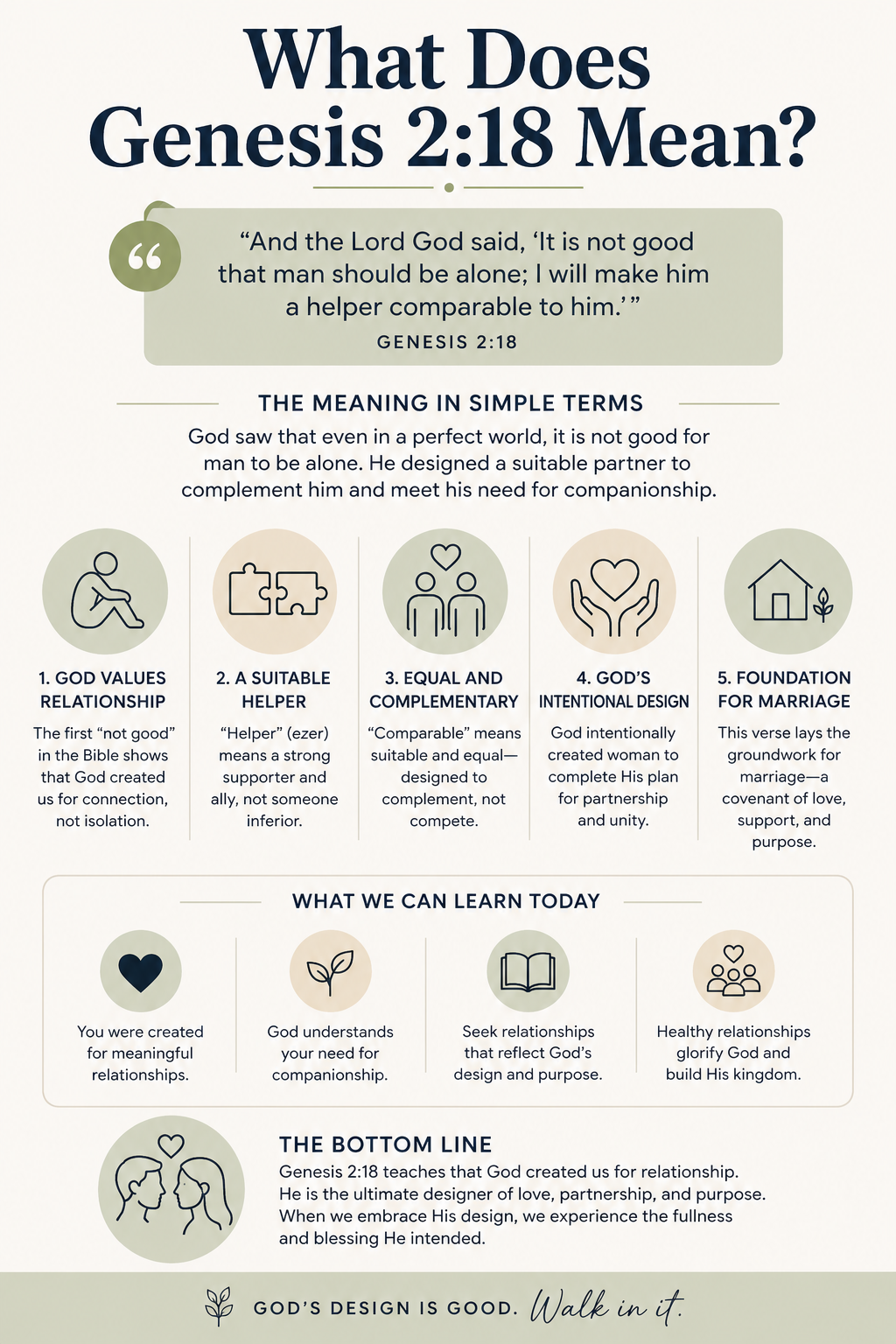
“And the Lord God said, ‘It is not good that man should be alone; I will make him a helper comparable to him.'” — Genesis 2:18 (NKJV)
Three phrases anchor the entire theological weight of this verse:
- “Not good” — a striking departure from the repeated declaration of “good” in Genesis 1
- “Alone” — a state of relational incompleteness, not moral failure
- “Helper comparable to him” — a partner who is both supportive and equal in dignity
Each of these deserves careful attention.
What Does Genesis 2:18 Mean?
At its most direct level, Genesis 2:18 is God’s recognition that the man He created — though placed in a perfect garden, given meaningful work, and walking in fellowship with God Himself — was still incomplete in a particular way. Something essential was missing: a human counterpart.
This verse falls within the second creation account (Genesis 2:4–25), which zooms in on the creation of humanity with rich, intimate detail. While Genesis 1 presents creation in sweeping, cosmic scope, Genesis 2 narrows to the relational and personal. It is here that God forms Adam from the dust, breathes life into him, gives him a garden to tend, and then — crucially — identifies a relational gap.
The meaning is clear: God intentionally designed human beings to need one another. This is not a flaw in the design. It is the design. Humanity was made for connection, and that truth begins here.
The First “Not Good” in the Bible
Throughout Genesis 1, a phrase echoes like a refrain: “And God saw that it was good.” Light — good. Dry land — good. Vegetation — good. The sun and moon — good. Living creatures — good. Humanity — very good (Genesis 1:31).
Then Genesis 2:18 arrives with a jarring shift: “It is not good.”
This is the first time in all of Scripture that God declares something about His creation to be not good. That carries enormous theological weight. It tells us:
- Aloneness is not a neutral state. It is a condition that falls short of God’s full design.
- Completeness requires relationship. Even in an unfallen world, with no sin, no pain, no broken systems — human beings still needed one another.
- Perfection included relational need. The “not good” is not about moral imperfection but about an incompleteness that God intended to fill.
This reframes how we understand human loneliness. It is not weakness. It is a God-given signal pointing toward His design for community and covenant.
Top 3 Christian Books on Marriage June 2026


What Does “Helper Comparable to Him” Mean?
Meaning of “Helper” (Ezer)
The Hebrew word translated “helper” is ezer (עֵזֶר). In modern usage, “helper” can sound subordinate — an assistant, a secondary player. But in biblical Hebrew, ezer carries a very different weight.
Strikingly, ezer is used 21 times in the Old Testament. In the majority of cases, it refers to God Himself as the helper of Israel (see Psalm 121:2, Psalm 115:9–11, Deuteronomy 33:29). This is not the language of inferiority. This is the language of strength coming to the aid of another.
To call woman the ezer of man is to say she brings powerful, essential support — not because she is lesser, but because she carries something he does not have and cannot be without.
Meaning of “Comparable”
The phrase “comparable to him” comes from the Hebrew kenegdo (כְּנֶגְדּוֹ), which carries the idea of corresponding to, suitable for, or facing him as a counterpart. It describes someone who stands opposite — not in opposition, but as a mirror image. Equal in worth. Complementary in design.
Together, “helper comparable to him” describes a partner who is:
- Strong, not subservient
- Distinct, not identical
- Equal in dignity, not ranked below
- Complementary by design, filling what the other lacks
This is not a picture of hierarchy but of harmonious partnership.
Why God Created Woman
Genesis 2:18 sets the stage for one of the most theologically rich events in Scripture: the creation of Eve. God’s stated purpose is direct —
- To complete the human design. Adam alone was not the full picture of what God intended humanity to be. Together, man and woman reflect something more complete about the image of God (see Genesis 1:27).
- To establish partnership. The creation of Eve is not an afterthought. It is a deliberate act of divine wisdom, establishing a pattern of mutual support and shared life.
- To found the institution of marriage. Genesis 2:18 is the theological root of marriage. The companionship described here becomes the basis for the covenant of marriage described in Genesis 2:24 — “Therefore a man shall leave his father and mother and be joined to his wife, and they shall become one flesh.”
- To reflect divine wisdom. God did not make a second man, an animal companion, or a heavenly being. He made a woman — someone who shared Adam’s nature, yet differed in a way that made genuine partnership possible.
God’s Design for Relationships
Genesis 2:18 is not only about marriage. It is a foundational statement about human nature itself. Embedded in our creation is a relational design — a need for connection that no amount of productivity, achievement, or solitary spirituality can fully satisfy.
Several truths follow from this:
Relationship is part of spiritual formation. God did not say Adam needed more work, more knowledge, or more religious experience. He said Adam needed a companion. Healthy relationships are not a distraction from spiritual growth — they are part of it.
Dependence and independence must be balanced. Genesis 2:18 calls us toward interdependence — neither the isolation of radical self-sufficiency nor the unhealthy fusion of codependence. We are made to need others and to bring something of our own to that relationship.
Community reflects the nature of God. The triune God — Father, Son, and Holy Spirit — exists in eternal relationship. When God said humanity needed relationship, He was, in a sense, designing us to reflect something of His own nature.

Spiritual Lessons from Genesis 2:18
1. Isolation Is Not God’s Design
The very first “not good” in the Bible is aloneness. That is not a coincidence. God designed human beings for community, and chronic, chosen isolation works against our spiritual and emotional health. This doesn’t mean solitude is bad — Jesus Himself withdrew to pray — but a life structured around isolation is a life structured against God’s design.
2. God Understands Human Needs
Before Adam could even articulate his loneliness, God identified it. This reveals the compassionate attentiveness of God — He sees our needs, He names them, and He acts to meet them. Genesis 2:18 is as much a statement about God’s character as it is about human nature.
3. Relationships Have Purpose
God didn’t create companionship merely to make life pleasant. Relationships — marriage, friendship, community — are purposeful structures designed for human flourishing, mutual growth, and the display of God’s glory. When we enter relationships with this understanding, everything changes.
4. Marriage Reflects Divine Order
The institution of marriage, rooted in Genesis 2:18, is not a cultural invention but a divine design. It was given before sin entered the world, which means it belongs to the original, unfallen blueprint for human life. Marriage is not a response to the fall — it is a feature of creation.
5. God Provides What We Lack
The pattern of Genesis 2:18 is instructive: God identified the need, God provided the answer. This is the consistent character of God throughout Scripture. Where there is genuine lack, God is not passive. He sees, He cares, and He provides — often through other people.

Practical Application for Today
Build God-Centered Relationships
Genesis 2:18 reminds us that the deepest relational needs in our lives are ultimately met through what God provides. This means that the healthiest relationships — marriages, friendships, communities — are those that are oriented around God rather than placed in God’s place. Build relationships that point both people toward God, not relationships where one person becomes the other’s entire world.
Prepare Yourself Before Seeking a Partner
Adam was working and fulfilling his God-given purpose before Eve arrived. He was not wandering in unfulfilled desperation — he was living faithfully in the life God had given him. This is a powerful model. The best preparation for a healthy relationship is becoming a whole, purposeful person in your own right.
Avoid Unhealthy Isolation
If Genesis 2:18 establishes anything, it is that withdrawal from relationship is not a virtue. Whether through social anxiety, past wounds, or self-protection, many people structure their lives around distance from others. This verse gently but firmly calls that tendency into question. Reach toward community — imperfect, messy, real community — because that is where God’s design is worked out.
Value Biblical Roles Correctly
“Helper” does not mean lesser. “Comparable” does not mean identical. Genesis 2:18 calls us to understand and value the distinct, complementary contributions that men and women bring to relationship — without flattening those differences into sameness or distorting them into hierarchy that diminishes one party.
Common Misinterpretations of Genesis 2:18
“Helper Means Inferior” (Correction)
Perhaps the most common misreading of this verse is the assumption that the woman’s role as “helper” places her in a subordinate position. As we’ve seen, the Hebrew ezer — repeatedly used of God Himself — carries no such implication. Strength, not weakness, defines the helper. The woman is not created to serve man in the sense of being beneath him; she is created to strengthen him in the sense of providing what he cannot provide for himself.
Overdependence vs. Healthy Partnership
Some read Genesis 2:18 as an endorsement of emotional or relational codependence — the idea that a person is simply incomplete and broken without a romantic partner. This misses the point. The verse describes a design feature of humanity, not a deficiency that makes singles lesser people. A single person is not “not good” — a person choosing total isolation from all meaningful human relationship is moving against the grain of their God-given design.
Misusing the Verse to Justify Control
In some contexts, Genesis 2:18 has been used to argue that women exist to serve men’s needs — that the primary purpose of woman is to fill a gap in man’s life. This is a serious distortion. The verse describes complementary partnership, not a hierarchy of service. Both the man and the woman are image-bearers of God (Genesis 1:27), both are given dominion together, and both are equal recipients of God’s design and blessing.
Genesis 2:18 and Marriage Today
Genesis 2:18 remains startlingly relevant to marriage in the modern world. Several truths from this verse directly shape a biblical understanding of marriage:
Unity is central. The creation of Eve as a “helper comparable” to Adam points toward the deep unity that marriage is meant to embody — two distinct people becoming one (Genesis 2:24). Biblical marriage is not about dominance or performance; it is about covenant union.
Purpose drives partnership. Because the original partnership was formed in the context of meaningful work (Genesis 2:15), biblical marriage is not merely about personal happiness. It is about two people joining their lives in a shared, purposeful mission.
Mutual support is the pattern. The ezer relationship is mutual in spirit — each partner brings strength, each partner serves the other. This ancient pattern speaks directly against both passive disengagement and controlling authority in marriage.
Ancient truth, modern application. The relational design of Genesis 2:18 was established before culture, before law, before civilization as we know it. It is not bound by historical context. It speaks into every era — including ours — with full force.
Final Reflection
God looked at a world He had called “good” in every sense, and He looked at a man made in His own image, tending a garden of beauty and abundance — and He said: It is not good for him to be alone.
This is not a statement of failure. It is a statement of design. Human beings are made for relationship. Companionship, partnership, and community are not optional accessories to the Christian life — they are woven into the very fabric of what it means to be human.
So here is the question worth sitting with: Are your relationships aligned with God’s design?
Are the connections in your life built on mutual strength and support? Are they oriented toward God, or placed in His place? Are they characterized by the kind of purposeful, covenant-like commitment that Genesis 2:18 points toward?
God’s design for relationship is not a burden. It is a gift. And it begins right here, on the second page of Scripture, with a God who saw what His beloved creation lacked — and moved to provide it.
🙏 A Short Prayer
Lord, thank You for designing me for relationship. Where I have settled for isolation, help me to reach toward community. Where I have misunderstood the relationships You’ve placed in my life, give me wisdom and grace. Shape my connections — marriage, friendship, and family — to reflect Your design. Amen.
💬 Reflection Prompt
Take a few minutes to consider: Is there an area of your relational life where you are resisting God’s design — either by withdrawing into isolation or by placing too much weight on another person to meet needs only God can truly fill?
Frequently Asked Questions About Genesis 2:18
What does Genesis 2:18 mean in simple terms?
Genesis 2:18 means that God, after creating the man, recognized that human beings are designed for companionship and partnership. It is not enough for a person to exist alone — even in a perfect environment. God’s solution was to create a “helper comparable to him,” establishing the foundation for human relationship and marriage.
What is a “helper” in Genesis 2:18?
The word “helper” comes from the Hebrew ezer, which describes a strong, supportive presence. It is the same word used in the Old Testament to describe God as the helper of Israel. Being called a helper does not imply inferiority — it describes someone who provides essential strength and support that the other person lacks.
Does Genesis 2:18 mean humans cannot be single?
No. The verse addresses the broad human need for relational connection, not a prescription that every individual must marry. Singleness can be a deeply meaningful and purposeful calling (see 1 Corinthians 7). What Genesis 2:18 cautions against is chosen isolation — the deliberate withdrawal from all meaningful human relationship.
What does “comparable to him” mean?
The Hebrew kenegdo means someone who corresponds to, is suitable for, and stands as an equal counterpart. It describes a partner who is different enough to be complementary and similar enough to be a genuine peer. The word points toward equality in dignity and complementarity in design.
Why did God say it is “not good” for man to be alone?
Because human beings are inherently relational — made in the image of a God who exists in eternal relationship (Father, Son, and Holy Spirit). Aloneness, in the sense of total relational isolation, contradicts the design built into human nature. It leaves something essential unfulfilled that God intended relationship to provide.
How does Genesis 2:18 apply today?
It applies in at least three key ways: (1) It calls us to invest in genuine community and meaningful relationships rather than chronic isolation. (2) It shapes a biblical understanding of marriage as partnership between equals who bring complementary strengths. (3) It reminds us that God is attentive to our relational needs and faithful to provide what we truly lack.
Discover more from Becoming Christians
Subscribe to get the latest posts sent to your email.