TL;DR — Quick Summary: What Does Submission Mean in the Bible: In the Bible, submission means voluntarily placing yourself under God-ordained authority out of love and reverence — not force or fear.
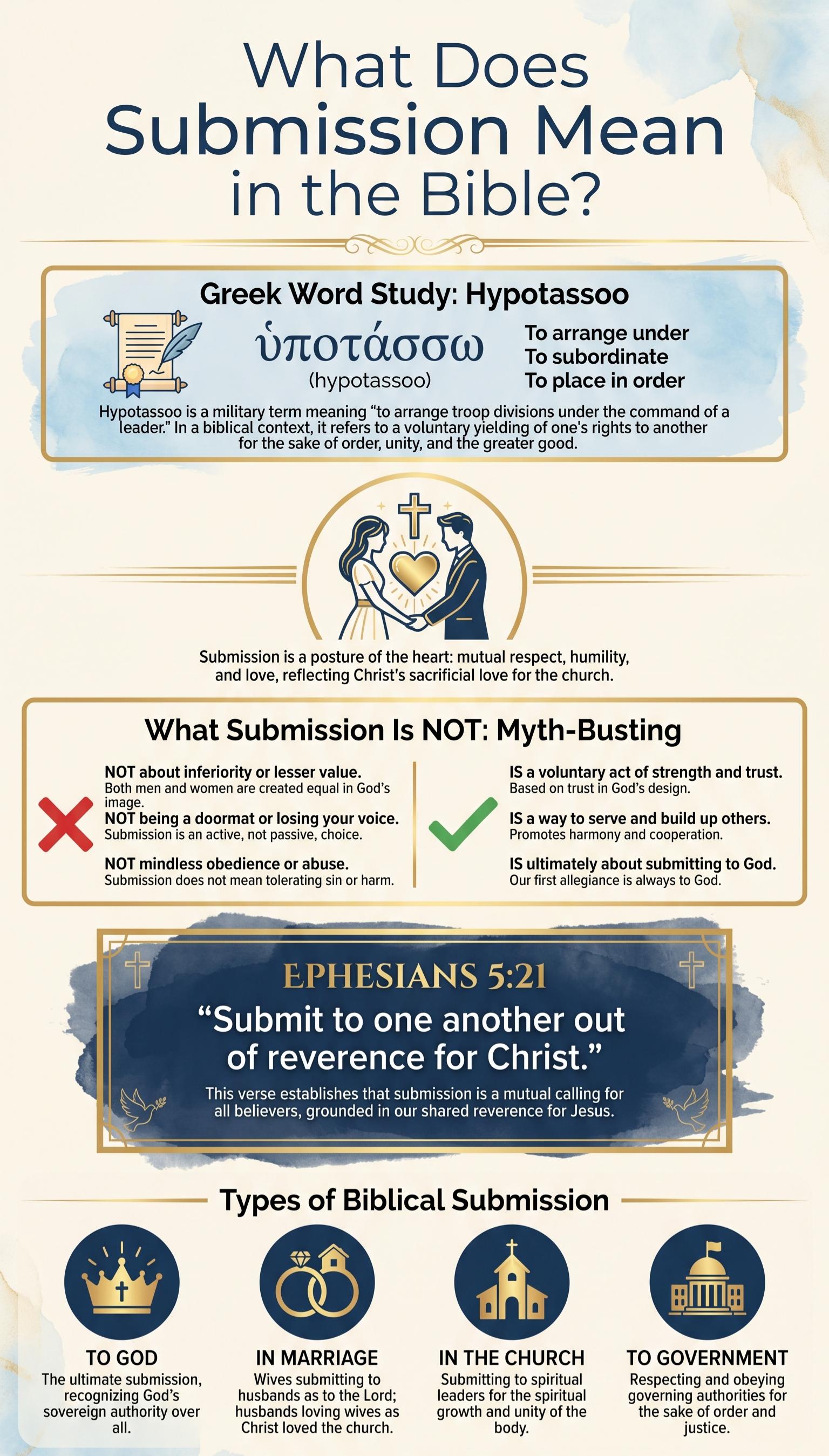
The Greek word is hypotassoo, meaning ‘to arrange under’ — a willing, ordered posture, not a sign of lesser worth.
God calls wives to submit to their husbands’ loving leadership. He calls husbands to lead sacrificially, as Christ led the church.
Men and women are absolutely equal in dignity, value, and standing before God (Galatians 3:28). Different roles do not mean different worth.
Biblical submission is first and foremost a spiritual posture toward God — and it flows into every relationship from there.
What Does Submission Mean in the Bible? (The Direct Answer)
Many people hear the word submission and immediately feel a sense of unease. Cultural voices have told us that submission is demeaning, outdated, or even dangerous. But if you come to the Bible with an open heart, you will find something strikingly different from what the world has portrayed — you will find a concept rooted not in force or inferiority, but in love, order, and trust in a God who designed all things well.
So what does submission mean in the Bible? Here is the direct, Scripture-grounded answer:
“Submit yourselves therefore to God. Resist the devil, and he will flee from you.” — James 4:7, ESV
The Core Biblical Answer
Biblical submission means voluntarily placing yourself under God-ordained authority out of reverence, love, and faith — not compulsion or fear. The Greek word hypotassoo, used throughout the New Testament, literally means ‘to arrange under’ or ‘to place in rank beneath.’ It was originally a military term describing a soldier willingly taking his place within a formation — not because he was less of a person than his commanding officer, but because order, purpose, and mission required it.
Biblical submission is first and foremost a posture toward God. From that vertical submission flows every horizontal application: in marriage, in the church, in civic life, and in our relationships with one another. It is always voluntary, always dignified, and always framed within the larger context of sacrificial love.
In the following sections, we will unpack the full beauty and depth of what God means when He calls His people to submission — beginning with the original Greek, moving through Scripture, and landing in practical, daily application.

The Greek Word Behind Submission: Hypotassoo Explained
To truly understand what the Bible means by submission, we have to go back to the original language. The primary Greek word translated as ‘submit’ or ‘submission’ in the New Testament is hypotassoo (Greek: hypotasso). Understanding this single word will transform how you read every passage on this topic.
The Meaning of Hypotassoo
Hypotassoo is a compound word formed from two parts: hypo, meaning ‘under,’ and tasso, meaning ‘to arrange, to order, or to place in rank.’ Together, the word means to arrange oneself under — a voluntary ordering, not a forced submission.
The word originates in Greek military literature, where soldiers would tasso — arrange themselves — into formation under their commanding officer. Crucially, every soldier in that formation was equally human, equally valued, equally important to the mission. The arrangement was not about one soldier being less of a person than another. It was about order, function, and the success of a shared purpose.
This is precisely the picture God paints when He calls His people to submission. The one who submits is not lesser in value. They are simply filling a different and equally essential role within God’s magnificent design.
Key New Testament Verses Using Hypotassoo
| Scripture | Translation | Context |
| Ephesians 5:22 | ESV | Wives to husbands, in the context of mutual reverence (v.21) |
| Romans 13:1 | NIV | All believers to governing authorities |
| James 4:7 | ESV | All believers to God |
| 1 Peter 2:13 | NIV | Submission to human institutions |
| Hebrews 13:17 | ESV | Submission to church leaders |
| 1 Peter 3:1 | NASB | Wives, in the context of winning unbelieving husbands |
| Ephesians 5:21 | NIV | Mutual submission among all believers |
Notice that hypotassoo applies to many different people in many different contexts — not just wives. Every Christian is called to submit in some capacity: to God, to civic leaders, to church elders, and to one another. Submission is a broadly Christian virtue before it is a specifically feminine one.
Submission to God — The Foundation of Everything
“Submit yourselves therefore to God. Resist the devil, and he will flee from you.” — James 4:7, ESV
Every discussion of biblical submission must begin here. Before we talk about submission in marriage or in the church, we must establish that the most fundamental form of submission in Scripture is the submission of every human soul to God Himself.
Submitting to God means surrendering your own will, agenda, and understanding to His. It means trusting that His ways are higher than your ways (Isaiah 55:9), that His plans for you are good (Jeremiah 29:11), and that His Word is the final authority over every area of your life. It is the act of saying, with Jesus in the Garden of Gethsemane, ‘Not my will, but yours be done’ (Luke 22:42, ESV).
This vertical submission — the soul bowing before God — is not weakness. Jesus Himself, the eternal Son of God, submitted to the Father. He is co-equal with the Father in divine nature and worth (John 10:30; Philippians 2:6), and yet He willingly placed Himself under the Father’s authority for the sake of our redemption (Philippians 2:7-8). If submission were inherently demeaning, the Son of God would never have embraced it. He did embrace it — and in doing so, He showed us that submission is not about inferiority. It is about love, mission, and trust.
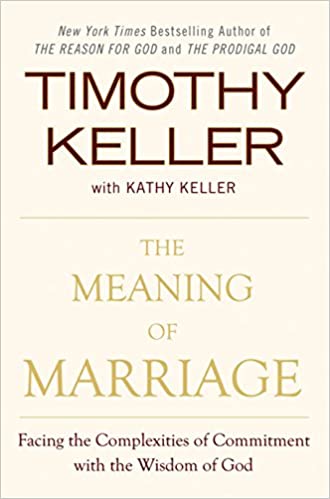
Top 3 Christian Books on Marriage June 2026


Practical Submission to God Looks Like:
- Surrendering your plans to God in prayer, asking for His guidance (Proverbs 3:5-6).
- Aligning your decisions with the Word of God, even when it is difficult.
- Trusting God’s timing and sovereignty, especially in seasons of waiting or suffering.
- Obeying the promptings of the Holy Spirit, even when they challenge your comfort.
- Receiving biblical correction with humility, not defensiveness.
Equal in Worth, Different in Role — A Key Distinction
“There is neither Jew nor Greek, there is neither slave nor free, there is no male and female, for you are all one in Christ Jesus.” — Galatians 3:28, ESV
Before we go one step further into the topic of submission in marriage, we must establish a truth that is absolutely central to everything: men and women are fully, completely, and equally valuable before God. This is not a concession or a qualification. It is a foundational biblical truth, and it must be held firmly in one hand while we hold the truth of different roles in the other.
Genesis 1:27 tells us that both male and female were created in the image of God — the imago Dei. This alone establishes that woman is not a lesser creation, a second draft, or a support role in the story of humanity. She bears the very image of God, as man does. She is co-heir of the grace of life (1 Peter 3:7). She is equally loved, equally redeemed, equally indwelt by the Holy Spirit, and equally destined for glory.
A Critical Theological Distinction
Different roles never mean different worth. This is the principle that unlocks the entire biblical theology of submission.
God the Father and God the Son are co-equal in their divine nature (John 10:30; Philippians 2:6). Yet the Son submitted to the Father’s authority in the work of redemption. Their equality of essence was never compromised by their difference in function. In the same way, a wife’s submission to her husband’s loving leadership never diminishes her equal dignity, worth, and standing before God. It reflects a beautiful, purposeful order — not a hierarchy of value.
God has designed the family — and the broader created order — with a beautiful structure of loving authority and willing submission. This structure is not the result of the Fall. Even before sin entered the world, Adam was given leadership responsibility in the garden (Genesis 2:15-17). Leadership was not introduced as a punishment. It was part of God’s original, pre-Fall design.
What the Fall corrupted was not the structure of loving authority, but the manner in which authority and submission are expressed. Sin introduced domination, resentment, and selfishness where God intended protection, love, and trust (Genesis 3:16). The gospel calls us back to God’s original design — a husband who leads with the self-giving love of Christ, and a wife who submits with the dignified trust of the church.
What the Bible Says About Submission in Marriage
“Wives, submit to your own husbands, as to the Lord. For the husband is the head of the wife even as Christ is the head of the church, his body, and is himself its Savior. Now as the church submits to Christ, so also wives should submit in everything to their husbands.” — Ephesians 5:22-24, ESV
This is perhaps the most discussed — and most misunderstood — passage on submission in all of Scripture. To understand it correctly, we must read it in its full context, beginning one verse earlier.
Ephesians 5:21 — The Context That Changes Everything
Ephesians 5:22 is never meant to be read alone. The very sentence before it sets the stage for the entire passage: ‘Submit to one another out of reverence for Christ’ (Ephesians 5:21, NIV). Paul establishes a culture of mutual humility and servant-heartedness among all believers before he addresses the specific roles of husbands and wives. The marriage relationship flows out of this broader Christian posture of mutual deference and love.
With that foundation in place, Paul then addresses three sets of relationships in what scholars call the ‘household code’ — wives and husbands, children and fathers, and servants and masters. To each group, he gives corresponding responsibilities rooted in the character of Christ.
What ‘Head’ Means in Ephesians 5
Paul writes that ‘the husband is the head of the wife even as Christ is the head of the church’ (Ephesians 5:23, ESV). The word ‘head’ (Greek: kephale) here refers to a position of loving authority and responsible leadership — not dominance or superiority. Christ’s headship over the church is defined entirely by His willingness to give Himself up for her (v.25). The model of headship God gives husbands is the cross.
This means that when a wife submits to her husband’s leadership, she is not submitting to someone who lords power over her. She is placing her trust in someone who has been called by God to lead her with cruciform, self-sacrificial love. It is a relationship of mutual trust, honor, and servant-heartedness — with clearly designated roles.
What Submission in Marriage Looks Like Practically
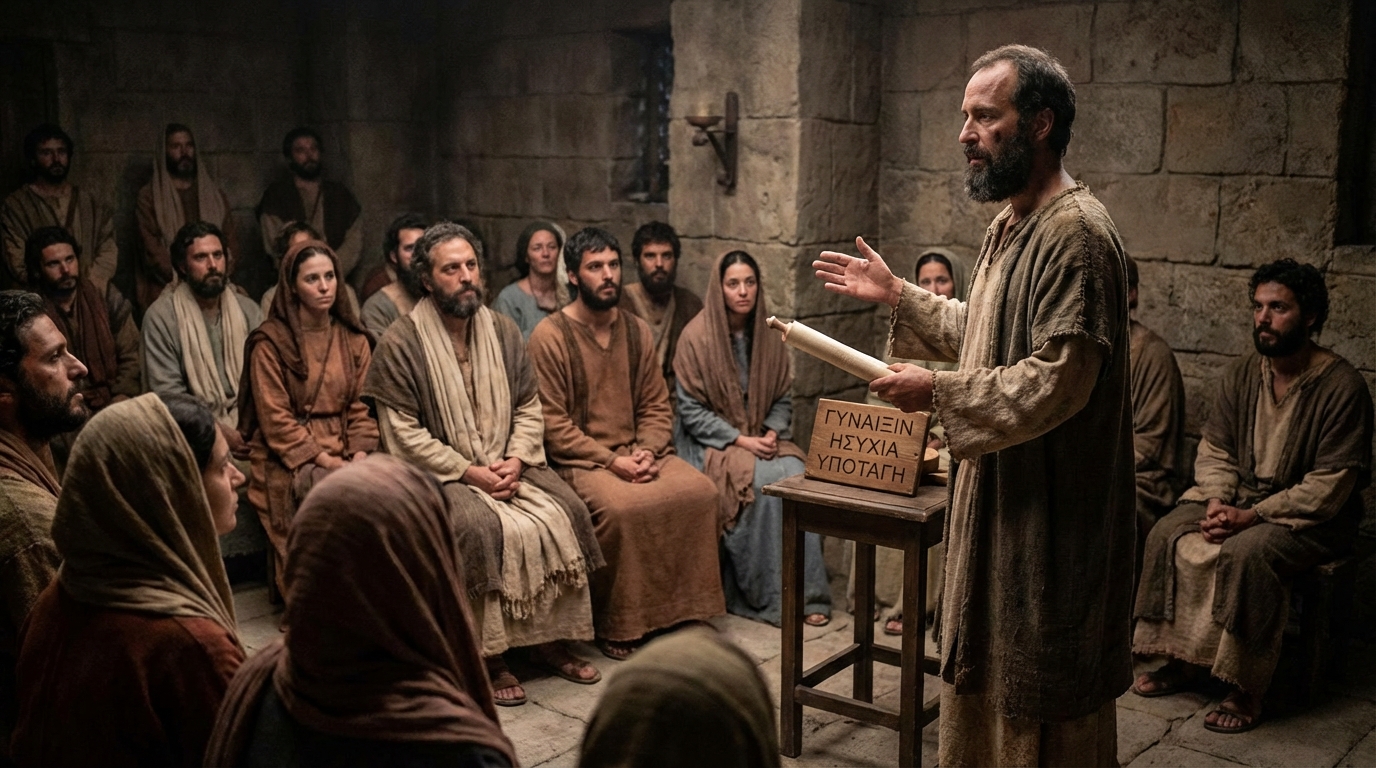
Biblical submission in marriage is not silence, passivity, or the erasure of a wife’s gifts, intellect, or voice. A godly wife is a full partner in the home — a co-laborer in raising children, managing the household, making decisions, and building the family’s life together. Her submission is expressed in this context:
- Respecting and honoring her husband’s God-given role as the head of the home.
- Supporting his leadership with her wisdom, input, and partnership — not passive compliance.
- Trusting his final decision-making authority in areas of genuine disagreement, after both have shared their perspectives.
- Encouraging and lifting him in his role rather than undermining it.
- Praying for him and with him as the spiritual partnership of the home.
A wife’s submission does not mean she never expresses disagreement, never voices her needs, or never influences decisions. A wise husband actively seeks his wife’s counsel. A truly submitted wife offers that counsel generously, honestly, and freely — and then trusts the Lord to work through her husband’s leadership.
The Husband’s Charge: Lead Like Christ
“Husbands, love your wives, as Christ loved the church and gave himself up for her… In the same way husbands should love their wives as their own bodies.” — Ephesians 5:25, 28, ESV
It is impossible to discuss a wife’s submission without giving equal — or greater — attention to what God requires of husbands. The calling placed on a husband in Ephesians 5 is breathtaking in its weight and beauty.
Paul devotes three times as much text to the husband’s responsibility as to the wife’s. And what he asks of husbands is not the easy road of passive authority. He asks for the hardest thing in the world: love that looks like the cross. Christ’s love for the church was not commanding from a distance. It was costly, sacrificial, and completely others-centered. He ‘gave himself up for her’ — He laid down His life. That is the standard God sets for husbands.
What Christlike Leadership Looks Like in a Marriage
A husband who leads like Christ does not demand submission — he earns trust through love.
He listens carefully to his wife’s wisdom before making decisions.
He protects her — emotionally, spiritually, and physically.
He serves her, not the other way around (Mark 10:45).
He takes responsibility for the spiritual atmosphere of the home.
He lays down his preferences, comfort, and agenda for her flourishing.
He treats her, in Peter’s words, ‘with understanding, showing her honor as the weaker vessel, since they are heirs with you of the grace of life’ (1 Peter 3:7, ESV).
A husband who uses Ephesians 5:22 to demand submission from his wife while ignoring Ephesians 5:25-28 has fundamentally misread the passage. God’s design is not a one-sided burden placed on wives. It is a beautiful, interlocking design in which a husband’s selfless love makes a wife’s willing submission natural and safe, and a wife’s willing submission affirms and strengthens a husband’s servant-leadership.
Other Forms of Biblical Submission
As we noted earlier, submission in the Bible is not limited to marriage. The principle of willing, ordered deference to God-ordained authority runs throughout all of Scripture and applies to every Christian.
Submission to Governing Authorities
Romans 13:1 states plainly: ‘Let every person be subject to the governing authorities. For there is no authority except from God, and those that exist have been instituted by God’ (ESV). Christians are called to be model citizens — paying taxes, respecting laws, and honoring those in leadership. This submission has one important limit: when a government commands what God forbids, or forbids what God commands, we are to obey God rather than men (Acts 5:29).
Submission to Church Elders and Leaders
Hebrews 13:17 calls believers to ‘obey your leaders and submit to them, for they are keeping watch over your souls, as those who will have to give an account’ (ESV). Church submission means placing yourself under the spiritual care and accountability of your local church leadership, receiving their teaching and correction, and participating in the community of the body of Christ.
Mutual Submission Among Believers
Ephesians 5:21 calls all believers — men and women alike — to ‘submit to one another out of reverence for Christ.’ This mutual submission is expressed in humility, in preferring others above ourselves (Romans 12:10), in serving rather than being served, and in the kind of genuine, other-centered love that Paul describes in 1 Corinthians 13.
What Biblical Submission Is NOT
Because this topic is so prone to misuse and misunderstanding, it is vital to draw clear lines around what biblical submission does not mean. The following are non-negotiable clarifications:
| Biblical Submission IS NOT… | Because… |
| An excuse for abuse | Ephesians 5:25 calls a husband to love and protect his wife — abuse is a direct violation of his calling, not a product of it. Abuse is sin. |
| Silence or voicelessness | Proverbs 31 describes a wife who speaks with wisdom and kindness. Her voice is valued and active in the home. |
| Blind, unconditional obedience | When a husband asks his wife to sin, she must obey God rather than man (Acts 5:29). No human authority supersedes God’s. |
| A sign of lesser intelligence or worth | 1 Peter 3:7 calls a wife a ‘fellow heir of the grace of life.’ She is equal in spiritual standing before God in every way. |
| Only for women | Ephesians 5:21 calls all believers to submit to one another. Submission is a broadly Christian virtue. |
| A result of the Fall | God gave Adam responsible leadership before sin entered (Genesis 2:15-17). Ordered structure is pre-Fall design, not punishment. |
| Passive compliance | A submitted wife is an active partner — praying, working, contributing her gifts, and participating fully in the family mission. |

Common Misconceptions About Submission — Debunked
Misconception 1: ‘Submission Makes Women Second-Class Citizens’
This objection confuses function with value. Within the Trinity, the Son submits to the Father’s authority — yet theologians universally affirm that the Son is fully and equally God. Submission in function has never implied inferiority in essence. The same logic applies to men and women: different roles do not produce different worth. A woman who submits to her husband’s leadership is not diminished — she is living out a God-given role with dignity and purpose.
Misconception 2: ‘Submission Is a Product of Patriarchal Culture’
The argument that Paul was simply reflecting his cultural context misses several important facts. First, Paul’s instructions in Ephesians 5 ground the husband’s headship not in first-century Roman culture, but in the relationship between Christ and the church — a theological reality that transcends all cultures and time periods. Second, Paul’s household codes were already more dignifying to women than the surrounding Greco-Roman norm, which gave husbands absolute legal control over their wives. Paul elevates the wife’s dignity, not diminishes it.
Misconception 3: ‘Real Equality Means Identical Roles’
Our culture often conflates equality with sameness. But equality of worth and identity of function are two different things. A surgeon and an anesthesiologist in an operating room have equal professional dignity, equal importance, and very different roles. No one argues that the anesthesiologist is less valuable because she serves a different function. God’s design for men and women operates on the same principle: equal in dignity, distinct in design, complementary in function.
Practical Ways to Live Out Biblical Submission Today
For Wives
- Pray regularly for your husband’s leadership — ask God to give him wisdom, courage, and Christlike love.
- Verbally affirm your husband in his role as leader of your home, especially in front of your children.
- Offer your wisdom and perspective freely in discussions, and then trust God to work through your husband’s decisions.
- Study what biblical submission looks like through resources such as solid Bible commentaries, books by respected complementarian authors, and the counsel of a trusted pastor.
- Guard against the temptation to control through indirect means — manipulation, guilt, or emotional pressure — and choose instead the beauty of trust.
For Husbands
- Lead from the posture of a servant, not a sovereign. Ask yourself daily: how can I lay down my preferences for my wife’s flourishing?
- Listen to your wife. Seek her input actively. Her wisdom is one of God’s greatest gifts to your leadership.
- Take responsibility for the spiritual temperature of your home — lead in prayer, in Scripture reading, and in worship.
- Never use Ephesians 5:22 as a weapon to demand compliance. Use Ephesians 5:25 as your daily standard.
- If you have failed in your leadership — through passivity, harshness, or neglect — go to God first, then to your wife. Humble repentance is one of the most powerful acts of leadership a husband can offer.
For All Believers
- Begin every day with a posture of submission to God — surrender your will in prayer before you engage the world.
- Practice mutual submission in your church and friendships by preferring others, serving generously, and receiving correction graciously.
- Study the full counsel of Scripture on authority, leadership, and submission — not just individual verses in isolation.

Frequently Asked Questions (FAQ)
What does submission mean in the Bible?
In the Bible, submission (from the Greek hypotassoo) means voluntarily placing yourself under God-ordained authority out of love and reverence for God. It is first and foremost a posture of the heart toward God that flows outward into relationships — in marriage, in the church, and in civic life. Biblical submission is always voluntary, always dignified, and always framed within the larger context of Christlike love.
Does the Bible teach that women are less valuable than men?
Absolutely not. Galatians 3:28 declares that in Christ ‘there is no male and female’ — all are equally one in Him. Genesis 1:27 establishes that both male and female bear the image of God (imago Dei). 1 Peter 3:7 calls a wife a ‘fellow heir of the grace of life.’ Men and women are completely equal in dignity, worth, and standing before God. Different God-given roles do not create different levels of value.
Is God’s design that men lead in the home? Does the Bible support this?
Yes. Scripture teaches that God has given the husband the role of loving, servant-hearted head of the home (Ephesians 5:23). This role was established before the Fall (Genesis 2:15-17), rooted in God’s creative design, and modeled on Christ’s headship over the church. Importantly, this leadership is defined by sacrificial love (Ephesians 5:25), not domination. It is a responsibility and a calling, not a privilege for selfish use.
What is the Greek word for submission in the Bible?
The primary Greek word is hypotassoo (hypotasso), meaning ‘to arrange under’ or ‘to place in rank beneath.’ It is a compound of hypo (‘under’) and tasso (‘to arrange or order’). The word carries a military background of soldiers voluntarily arranging themselves under a commanding officer — always with the implication of a willing, ordered posture, not forced compliance.
Does a wife have to submit even if her husband is wrong?
A wife’s submission is real, trusting, and costly — but it is not unconditional in all circumstances. She is never required to submit to a command that directly violates God’s Word (Acts 5:29). When a husband asks his wife to sin, she is to obey God rather than man. In cases of abuse, she should seek protection and pastoral counsel immediately. Outside of these boundaries, a wife who trusts God can practice submission even through imperfect leadership, trusting that God honors her faithfulness and works through the situation.
Does ‘submit to one another’ in Ephesians 5:21 cancel out the wife’s specific submission in verse 22?
No. Ephesians 5:21 establishes the broad Christian culture of mutual humility and deference that all believers practice toward one another. Verses 22-33 then address the specific and distinct expressions of that principle within the marriage relationship — where the wife submits to her husband’s loving leadership and the husband expresses his submission to Christ through cruciform love for his wife. The mutual submission of verse 21 is the foundation; verses 22-33 build the specific structure on top of it.
What does it mean to submit to God?
Submitting to God means surrendering your will, preferences, and agenda to His sovereign authority and perfect wisdom. It means trusting His Word above your own understanding (Proverbs 3:5-6), obeying His commands even when they are difficult, and receiving His discipline with faith that it is working for your good (Hebrews 12:5-11). Jesus modeled this perfectly in Gethsemane — ‘Not my will, but yours be done’ (Luke 22:42) — and He invites every believer to walk in the same posture of loving trust.
Conclusion: Submission as God’s Gift, Not a Burden
We began by asking what submission means in the Bible. We end with this: biblical submission is not a punishment, a diminishment, or a cultural relic. It is a gift — a God-designed framework for human relationships that, when embraced in its fullness and practiced in love, produces the kind of marriages, families, and communities that reflect the very nature of God Himself.
Submission is rooted in the eternal love of the Trinity, modeled by the Son who willingly placed Himself under the Father’s authority without losing one atom of His divine worth. It is practiced by every Christian who surrenders their will to God each morning in prayer. And in marriage, it is expressed in the beautiful interplay of a husband who loves like Christ gave — lavishly, sacrificially, protectively — and a wife who trusts like the church trusts — willingly, faithfully, and with full dignity.
“Therefore a man shall leave his father and mother and hold fast to his wife, and the two shall become one flesh. This mystery is profound, and I am saying that it refers to Christ and the church.” — Ephesians 5:31-32, ESV
The mystery of marriage — of headship and submission, of authority and trust — is ultimately a mystery about the gospel. It is a living parable of Christ and His church, painted in the daily choices of two people who have chosen to love each other the way God loves us. There is nothing small or ordinary about that. There is everything glorious.
May you walk in the beauty of biblical submission — first before God, and then in every relationship He has placed in your life.
Share This Article
Was this article helpful? Share it with someone who is wrestling with what biblical submission means. You can also pin the infographic, save it for your Bible study group, or send it to a couple preparing for marriage.
Have a question or a reflection? Drop it in the comments below.
Scripture Reference List
All Bible passages cited in this article for easy reference and further study:
| Reference | Theme | Translation Used |
| Genesis 1:27 | Both male and female bear the image of God | ESV |
| Genesis 2:15-17 | Adam given leadership responsibility pre-Fall | ESV |
| Genesis 3:16 | The Fall corrupts God’s design for authority and submission | ESV |
| Proverbs 3:5-6 | Trust God’s ways above your own understanding | NIV |
| Isaiah 55:9 | God’s ways are higher than our ways | NIV |
| Jeremiah 29:11 | God’s plans for His people are good | NIV |
| Luke 22:42 | Jesus submits His will to the Father in Gethsemane | ESV |
| John 10:30 | The Son and Father are one — equal in divine nature | ESV |
| Acts 5:29 | We must obey God rather than men — the limit of human authority | ESV |
| Romans 12:10 | Prefer others above yourselves | NIV |
| Romans 13:1 | Submit to governing authorities | ESV |
| 1 Corinthians 13 | The nature of Christlike love | ESV |
| Galatians 3:28 | All are equally one in Christ — no male or female hierarchy of worth | ESV |
| Ephesians 5:21 | Mutual submission among all believers | NIV |
| Ephesians 5:22-24 | Wives, submit to your own husbands | ESV |
| Ephesians 5:25-28 | Husbands, love your wives as Christ loved the church | ESV |
| Philippians 2:6-8 | Christ submits to the Father’s will without losing divine nature | ESV |
| Hebrews 12:5-11 | God’s discipline is for our good | ESV |
| Hebrews 13:17 | Submit to church leaders | ESV |
| James 4:7 | Submit to God; resist the devil | ESV |
| 1 Peter 2:13 | Submit to every human institution | NIV |
| 1 Peter 3:1 | Wives, be subject to your own husbands | NASB |
| 1 Peter 3:7 | Husbands, honor your wives as fellow heirs of the grace of life | ESV |
| 1 John 4:18 | Perfect love casts out fear | ESV |

About the Author
Joshua Infantado is a Christian blogger and Bible teacher who has been writing faith-based content since 2013. He is the founder of Becoming Christians, where he shares blogs, books, videos, and online courses to help believers grow in truth and grace. Joshua lives in Davao City, Philippines, with his wife, Victoria, and their son, Caleb. Contact him at joshuainfantado@gmail.com.
Discover more from Becoming Christians
Subscribe to get the latest posts sent to your email.