Few questions stir up as much debate among Christians as this one:
Is it a sin to drink alcohol?
Some believers insist that any amount of alcohol is sinful. Others see no issue with moderate drinking. Still others have been personally wounded by alcohol’s destructive effects and choose total abstinence.
So what does the Bible actually say?
In this comprehensive guide, we’ll examine Scripture carefully, address common misconceptions, explore practical wisdom, and give a balanced, truth-centered answer that respects God’s Word above cultural opinion.
What Does the Bible Mean by “Sin”?
Before answering whether drinking alcohol is a sin, we need clarity on what sin actually is.
The Bible defines sin as the transgression of God’s law (1 John 3:4). Sin is not merely something controversial, culturally frowned upon, or personally uncomfortable. It is something that violates God’s commands.
That distinction matters when answering the question, “Is It a Sin to Drink Alcohol?”.
Not everything debated among Christians is automatically sin. Some issues fall into what Scripture describes as matters of conscience (Romans 14). That framework helps us approach alcohol with wisdom instead of emotion.
What the Bible Actually Says About Alcohol
To answer the question honestly, we must examine both the positive and negative references to alcohol in Scripture.
1. The Bible Does Not Condemn Alcohol Itself
Scripture contains several references to wine in neutral or even positive contexts:
- Psalm 104:14–15 describes wine as something that “gladdens the heart of man.”
- Ecclesiastes 9:7 encourages enjoying wine as part of God’s gifts.
- At a wedding in John 2:1–11, Jesus Christ turned water into wine — His first recorded miracle.
Wine was a normal part of ancient life. It was consumed during meals, celebrations, and covenant ceremonies.
If alcohol itself were inherently sinful, it would be difficult to reconcile these passages.
2. The Bible Clearly Condemns Drunkenness
While drinking is mentioned neutrally or positively, drunkenness is consistently condemned:
- Ephesians 5:18 — “Do not get drunk with wine.”
- Galatians 5:19–21 lists drunkenness among works of the flesh.
- Proverbs 20:1 warns that wine can lead to mockery and strong drink to brawling.
The consistent biblical pattern is this:
Drinking is described.
Drunkenness is condemned.
That distinction is critical if you wish to truly know Is It a Sin to Drink Alcohol.
So, Is It a Sin to Drink Alcohol?
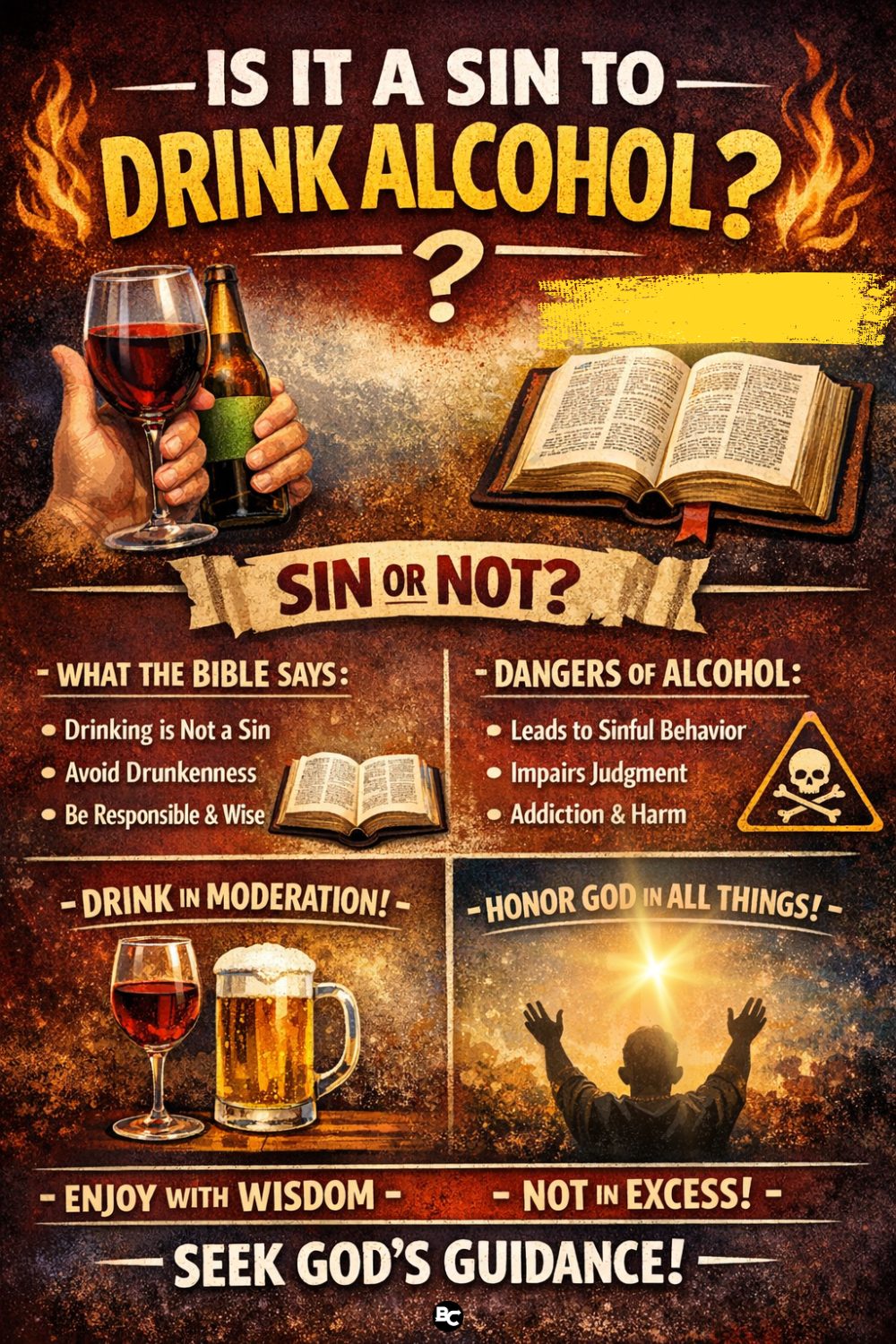
Based on Scripture alone, drinking alcohol in moderation is not automatically a sin.
However:
- Losing self-control is sin.
- Becoming enslaved to alcohol is sin.
- Harming others through your drinking is sin.
- Violating your conscience is sin (Romans 14:23).
The issue is not merely the liquid in the cup — it is the condition of the heart and the consequences of the action.
Top 3 Best Christian Books on Overcoming Addiction (March 2026)
Understanding the Difference: Drinking vs. Drunkenness
Many debates arise because these two ideas get blended together.
Drinking = consuming alcohol.
Drunkenness = impaired judgment, loss of self-control, and surrendering sobriety.
| Aspect | Drinking | Drunkenness |
|---|---|---|
| Definition | Consuming alcohol in moderation | Impaired judgment, loss of self-control, surrendering sobriety |
| Biblical View | Not inherently sinful | Condemned in Scripture (Ephesians 5:18, Galatians 5:19–21) |
| Effect on Mind & Body | Enjoyment, relaxation, social engagement | Intoxication, poor decision-making, physical and spiritual harm |
| Spiritual Consideration | Can be practiced responsibly | Contradicts command to be sober-minded (1 Peter 5:8) |
| Pastoral Insight | Often harmless when moderate | Even occasional misuse can escalate to dependency |
| Guiding Question | “Is this allowed?” | “Is this wise?” and “Does this glorify God?” |
Scripture commands believers to be sober-minded (1 Peter 5:8). Drunkenness directly contradicts that command.
From a pastoral perspective, I have seen how subtle compromise can escalate. A person who once said, “It’s just one drink,” later struggled with dependency. Not everyone goes down that road — but some do.
Wisdom asks not only, “Is this allowed?” but also, “Is this wise?”
Different Christian Views on Alcohol
Christian perspectives on alcohol vary.
1. The Moderation View
Held by many Catholic, Orthodox, and Protestant traditions:
- Alcohol is permissible.
- Drunkenness is sinful.
- Moderation and self-control are key.
2. The Abstinence View
Common among some Evangelicals and Baptists:
- Drinking is not inherently sinful.
- Voluntary abstinence protects testimony and avoids temptation.
3. The Prohibition View
Some Christian groups teach that alcohol should be avoided entirely for holiness and discipline.
These differences usually stem from prudence, pastoral concern, and cultural context — not necessarily disagreement about core biblical doctrine.
Practical Wisdom: When Drinking May Not Be Wise
Even if drinking isn’t automatically sinful, there are situations where abstinence may be the wiser choice.
1. If You Have a History of Addiction
If alcohol has controlled you before, returning to it is spiritually dangerous.
2. If It Damages Your Witness
Paul writes in Romans 14:21 that it is good not to do anything that causes a brother to stumble.
If your drinking causes confusion, temptation, or scandal in your community, love may call for restraint.
3. If It Weakens Self-Control
The fruit of the Spirit includes self-control (Galatians 5:23). If alcohol erodes that fruit in your life, that’s a red flag.
Common Misconceptions About Christians and Alcohol
“Biblical wine wasn’t alcoholic.”
Historically, fermentation was common in ancient times. The wine mentioned in Scripture contained alcohol.
“Jesus would never drink alcohol.”
The Gospels portray Him participating in meals where wine was served. In fact, critics accused Him of being a “winebibber” (Luke 7:34), though falsely and maliciously.
“Any amount of alcohol leads to sin.”
Not necessarily. Scripture condemns excess, not moderate use.

A Deeper Question: What Is Driving the Desire?
Instead of only asking, “Is it a sin to drink alcohol?” consider asking:
- Why do I want to drink?
- Is this about relaxation, social bonding, or escape?
- Would I be comfortable if Christ were physically sitting beside me?
Mature faith goes beyond rule-keeping. It examines motives.
Final Verdict: A Balanced Biblical Conclusion
So, is it a sin to drink alcohol?
No — not inherently.
But drunkenness is sin.
Addiction is sin.
Causing others to stumble can be sin.
Acting against conscience is sin.
The Bible gives freedom — but never freedom without responsibility.
Christian liberty is not license. It is guided by love, wisdom, and self-control.
A Pastoral Word
In my experience writing and counseling on difficult Christian living questions, I’ve seen two extremes:
- Legalism that condemns where God does not condemn.
- Carelessness that excuses what God clearly forbids.
The safest place is not at either extreme.
It is at the feet of Christ, asking:
“Lord, does this glorify You?”
When that question governs your decisions, you will rarely go wrong.
Frequently Asked Questions (FAQ)
Is it a sin to drink wine occasionally?
According to Scripture, drinking wine in moderation is not automatically sinful. The Bible distinguishes between drinking and drunkenness, clearly condemning intoxication but not responsible use. However, if occasional drinking leads to loss of self-control, harms others, or violates your conscience, it can become sin in that context.
Is drinking alcohol a salvation issue?
No, drinking alcohol is not a salvation issue. Salvation comes through faith in Jesus Christ and God’s grace — not through abstaining from certain foods or drinks. While drunkenness is listed among sinful behaviors, the act of drinking itself is not presented in Scripture as something that determines one’s eternal destiny.
Should Christians avoid alcohol completely?
Some Christians choose complete abstinence out of wisdom, personal conviction, or concern for their testimony. For those with a history of addiction, or in communities where alcohol causes serious harm, avoiding it altogether can be a loving and prudent decision. While the Bible does not command universal abstinence, choosing not to drink can be a powerful expression of self-control and care for others.
Is It a Sin to Drink Alcohol? Final Thought
The Christian life is not about finding the line and standing as close to it as possible.
It is about loving God with all your heart.
If drinking strengthens your gratitude and fellowship without compromising holiness, Scripture does not forbid it.
If it weakens your spiritual life, abstaining may be the wiser and holier path.
Choose what leads you closer to God — not what merely feels permissible.
Your Support Can Change Lives—Here’s How
If the articles on this website have blessed or inspired you, would you prayerfully consider supporting this ministry?
I’m not asking for much—just a simple pledge of $5 a month can make a huge difference. Right now, only 4 faithful supporters are helping carry this work forward. But there’s still so much more to be done.
With your support, we can reach more hearts, spread Yahshua’s truth further, and shine a brighter light in an increasingly dark world.
👉 Click here to become a supporter.
As a heartfelt thank-you, you’ll receive daily Bible study resources to keep you inspired, grounded, and equipped to live out your faith boldly.
Together, let’s bring the message of hope, truth, and transformation to more lives—one soul at a time.