Walk into almost any Christian bookstore and chances are you will find Jesus Calling by Sarah Young prominently displayed on the shelves. Since its release in 2004, the devotional has sold tens of millions of copies and has become one of the most popular Christian books in the world. Many believers describe it as comforting, encouraging, and deeply personal.
But popularity is not the same as biblical soundness.
As Christians, we are commanded to “test all things; hold fast what is good” (1 Thessalonians 5:21, NKJV). So, should Christians read Jesus Calling?
The answer requires careful discernment.
🧐 Do you want to know for yourself what the book is all about? Get a copy of the book, “Jesus Calling” here.

What is Jesus Calling?
Unlike traditional devotionals that explain Scripture or provide reflections on Bible passages, Jesus Calling is written in the first person as if Jesus Himself is speaking directly to the reader:
“I am with you and for you.”
“Trust Me in all your thoughts and actions.”
“Come to Me with your weaknesses and failures.”
The book presents these messages as words Sarah Young believed she received during periods of what she called “listening prayer,” where she would quietly listen and write down impressions she believed Jesus placed on her heart.
Sarah Young repeatedly stated that she did not consider her writings inspired Scripture and affirmed that the Bible alone is God’s infallible Word.
Nevertheless, this approach raises important questions.
The Pros of Jesus Calling
1. It encourages believers to spend time with God.
Many Christians who read the book report that it helped them develop a regular devotional habit and reminded them to seek God’s presence daily.
That is a positive thing.
Any book that encourages prayer, worship, trust, and dependence upon God can potentially serve a helpful purpose.
2. Many entries contain biblical truths.
A large portion of the devotional contains statements that generally align with biblical principles:
- Trust God during trials.
- Do not be anxious.
- Rest in God’s care.
- Seek God’s presence daily.
These themes are thoroughly biblical.
3. It includes Scripture references.
Most daily readings include verses for further study, which has led some readers back to the Bible itself. Sarah Young repeatedly emphasized that Scripture was the standard by which she evaluated her writings.
The Cons of Jesus Calling
This is where many Bible-believing Christians become concerned.
1. The book places words in Jesus’ mouth.
This is by far the largest issue.
The devotional is not written as:
“I believe God may be teaching us…”
Instead, it is written as:
“I am saying this to you…”
The “I” throughout the book refers to Christ Himself.
Even if Sarah Young sincerely intended to encourage believers, the practical effect is that readers are presented with statements that sound indistinguishable from divine revelation.
Scripture contains severe warnings against speaking in God’s name when God has not spoken:
“Do not add to His words, lest He rebuke you, and you be found a liar.” (Proverbs 30:6)
“You shall not add to the word which I command you, nor take from it.” (Deuteronomy 4:2)
The biblical prophets could confidently say, “Thus says Yahweh,” because they had genuinely received revelation from God.
Can modern devotional writers make the same claim?
That question alone should make believers proceed carefully.
Top 3 Best-Selling Christian Books for October 2026


2. It may encourage believers to seek extra-biblical revelation.
Sarah Young explained that she began writing after practicing “listening prayer” and recording impressions she believed came from Jesus.
The danger is subtle but significant.
Instead of asking:
“What does Scripture say?”
Some believers may begin asking:
“What is God telling me personally today?”
The Bible teaches that God’s people should be grounded in Scripture:
“All Scripture is given by inspiration of God…” (2 Timothy 3:16)
“…that the man of God may be complete, thoroughly equipped for every good work.” (2 Timothy 3:17)
If Scripture thoroughly equips us for every good work, then we do not need new messages, impressions, or dictated devotionals to complete God’s revelation.
3. Some statements go beyond what Scripture says.
Many of the entries are comforting and biblical in spirit, but some speak with an authority that Scripture itself does not provide.
For example, various entries include highly individualized statements such as:
- “I have arranged every detail of your life.”
- “I carefully orchestrate the events of your life.”
- “I designed every circumstance you encounter.”
While God’s sovereignty is biblical, Scripture does not reveal that every specific inconvenience, traffic delay, or life event was individually orchestrated in precisely the manner implied by these statements.
The problem is not whether these ideas could be true.
The problem is claiming that Jesus personally said them.
4. The book was partially inspired by another devotional that used similar methods.
Sarah Young acknowledged being influenced by the devotional God Calling, a book whose authors also claimed to receive messages directly from God through listening and writing. Critics have argued that this method resembles practices found in certain mystical and New Age traditions rather than the pattern of biblical revelation.
How Does Jesus Calling Compare With Your Biblical Convictions?
From your theological perspective, there are several areas of concern.
The sufficiency of Scripture
You place great emphasis on the Bible as God’s complete and final written revelation.
Jesus Calling does affirm biblical authority, but its format can unintentionally blur the line between Scripture and devotional reflections.
Many readers naturally treat the words as if Jesus Himself is speaking directly to them.
That can weaken confidence in the sufficiency of Scripture.
The danger of subjective impressions
Your beliefs strongly emphasize testing everything by the Bible rather than by feelings, impressions, traditions, or mystical experiences.
The method behind Jesus Calling depends heavily upon subjective impressions received during quiet meditation and then written as divine speech.
That approach would likely conflict with your conviction that doctrine and guidance must come from God’s written Word.
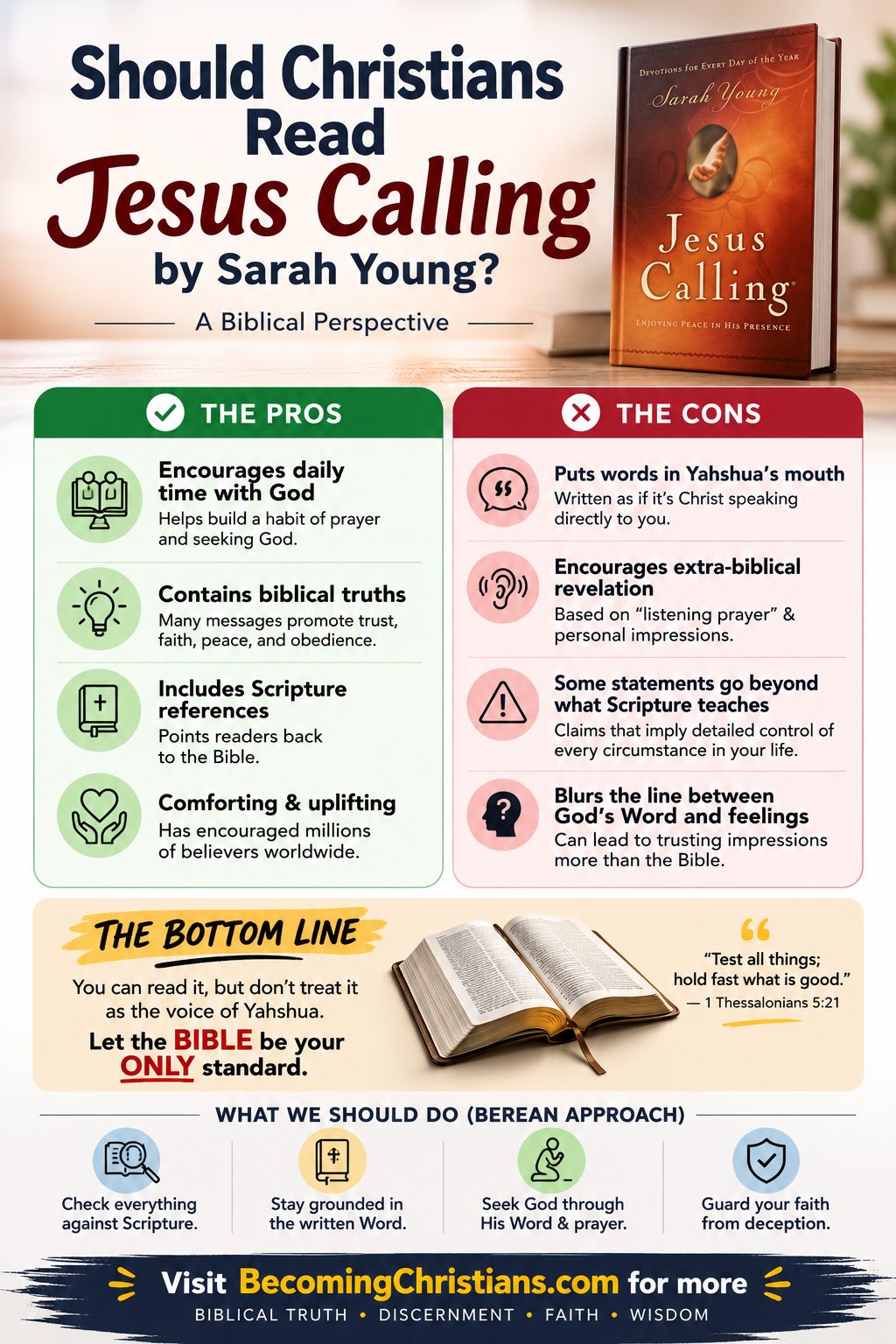
So, Should Christians Read Jesus Calling?
Can a Christian read it and benefit from it?
Yes.
Many believers have been encouraged by it.
Should Christians treat it as the voice of Jesus speaking personally to them?
Absolutely not.
A safer approach is to view the book as one Christian author’s reflections about God rather than messages from God.
Personally, if given the choice between reading:
- one chapter of Jesus Calling, or
- one chapter of Psalms, Proverbs, the Gospels, or Paul’s letters,
the Bible wins every time.
The Scriptures are inspired.
The Scriptures are tested.
The Scriptures are sufficient.
The voice of God that Christians can trust without reservation is not found in modern impressions or dictated devotionals.
It is found in the pages of the Bible.
As the Bereans did, let us examine everything carefully and hold fast to what is true (Acts 17:11).

About the Author
Joshua Infantado is a Christian blogger and Bible teacher who has been writing faith-based content since 2013. He is the founder of Becoming Christians, where he shares blogs, books, videos, and online courses to help believers grow in truth and grace. Joshua lives in Davao City, Philippines, with his wife, Victoria, and their son, Caleb. Contact him at joshuainfantado@gmail.com.
Discover more from Becoming Christians
Subscribe to get the latest posts sent to your email.