Summary: “You will know them by their fruit” means that a person’s true character is revealed not by what they say, but by the consistent results of their life their actions, attitudes, and choices over time. Jesus used this phrase in Matthew 7:15-20 (NKJV) to warn against false prophets who appear godly on the outside but produce ungodly “fruit” on the inside, saying, “A good tree cannot bear bad fruit, nor can a bad tree bear good fruit… Therefore by their fruits you will know them.” In practical terms, it means genuine faith always produces visible evidence (love, integrity, humility, and self-control) while a life rooted in deception or selfishness will eventually show itself through pride, manipulation, or harm, no matter how convincing the words sound.
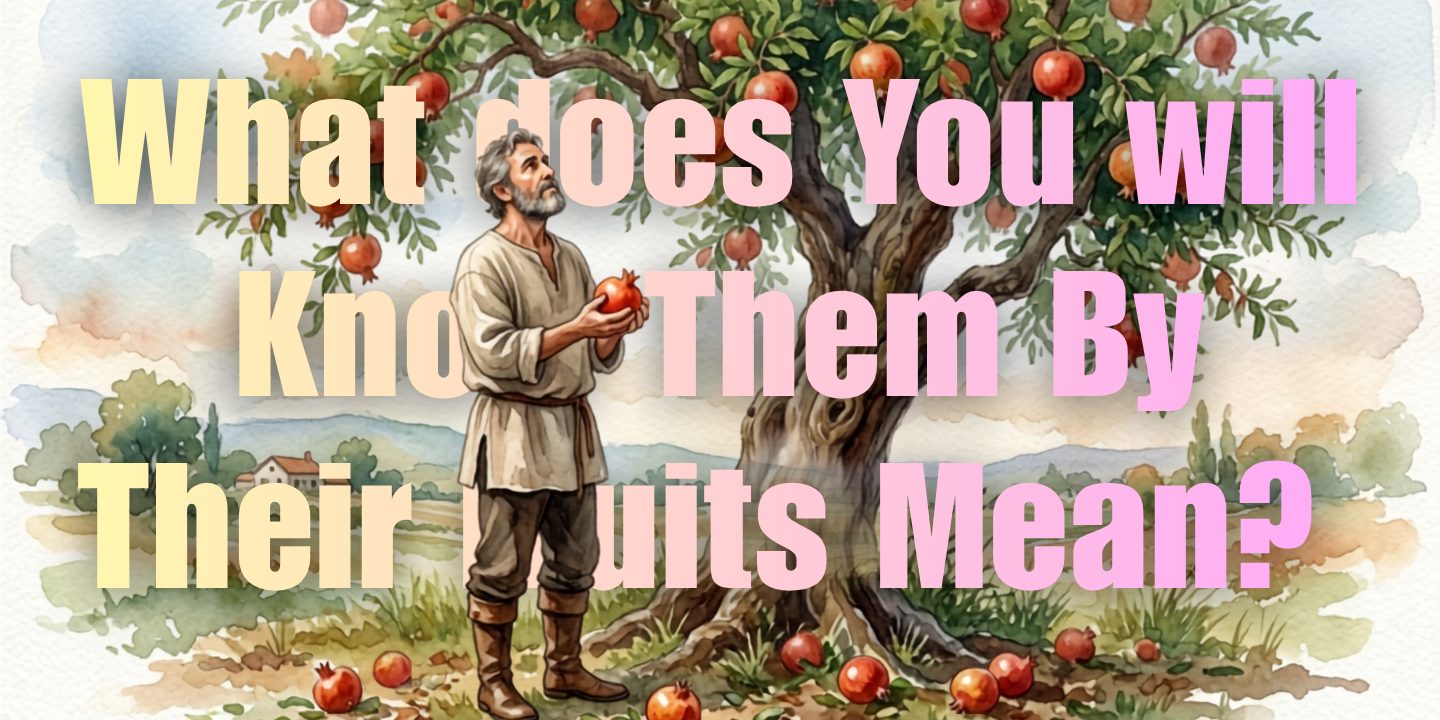
Introduction: You Will Know Them By Their Fruit
You’ve probably heard someone say it at least once.
Maybe it was after a scandal broke around a well-known pastor. Maybe it was a friend warning you about a “prophet” who felt off. Or maybe you whispered it yourself, quietly, after watching someone’s actions completely contradict everything they claimed to believe.
“Well… you’ll know them by their fruit.”
It’s one of the most quoted lines Jesus ever spoke. It shows up in sermons, Instagram captions, and heated family arguments about who’s “really” a Christian. But here’s the uncomfortable question most of us skip right past:
Do we actually know what Jesus meant when He said it — or have we just been using it as a spiritual mic-drop?
Because Matthew 7:16 isn’t a throwaway line. It’s not a clever insult for calling out people we don’t like. It’s a piercing, personal, deeply searching statement from the Son of God — and it was never meant to let you off the hook. It was meant to put you under the microscope first.
Let’s slow down and actually look at what Jesus said, why He said it, and what it means for the way you’re living today.
The Verse Nobody Reads in Context
Here’s the full passage, straight from Matthew 7:15-20 (NKJV):
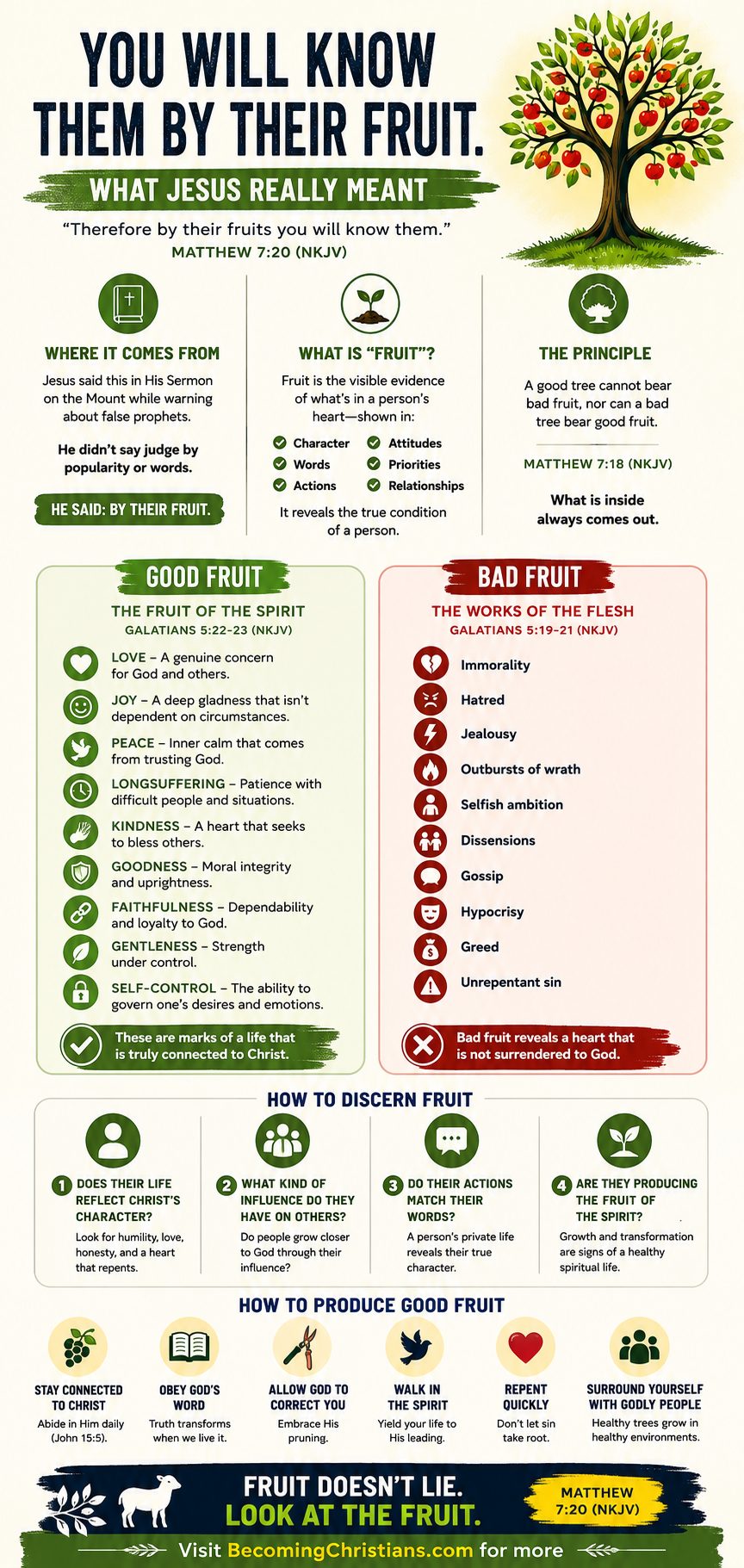
“Beware of false prophets, who come to you in sheep’s clothing, but inwardly they are ravenous wolves. You will know them by their fruits. Do men gather grapes from thornbushes or figs from thistles? Even so, every good tree bears good fruit, but a bad tree bears bad fruit. A good tree cannot bear bad fruit, nor can a bad tree bear good fruit. Every tree that does not bear good fruit is cut down and thrown into the fire. Therefore by their fruits you will know them.”
Notice something important: Jesus isn’t handing out a generic life motto here. He’s issuing a warning — a serious one — about false prophets. People who look holy. People who sound spiritual. People who know exactly which words to say and which Bible verses to quote, but whose hearts are somewhere else entirely.
He calls them wolves in sheep’s clothing. Read that again. Not obvious wolves. Not wolves wearing wolf costumes. Wolves dressed convincingly as sheep — blending in, gaining trust, standing at the pulpit, leading the Bible study, discipling your teenager.
That should stop you in your tracks. Because it means deception in the church was never going to look obvious. It was going to look good.
Fruit Isn’t What They Say. It’s What Grows.
Here’s where a lot of us get it wrong. We think “fruit” means eloquence. Charisma. Bible knowledge. A big platform. Impressive spiritual gifts.
Jesus says none of that is fruit.
Fruit is what naturally grows out of a person’s life over time — the real, unforced, unscripted evidence of what’s actually rooted inside them. You can fake a sermon. You can fake a worship set. You can fake a testimony if you practice it enough.
You cannot fake fruit indefinitely.
Paul makes this beautifully clear in Galatians 5:22-23 (NKJV):
“But the fruit of the Spirit is love, joy, peace, longsuffering, kindness, goodness, faithfulness, gentleness, self-control. Against such there is no law.”
Look at that list again. Notice what’s missing? Talent isn’t on it. Charisma isn’t on it. Correct doctrine, impressive titles, a large following — none of it made the list.
The fruit of a Spirit-filled life is character. It’s how someone treats their spouse behind closed doors. It’s how they respond when they’re wrongly criticized. It’s whether they’re patient with the barista who got their order wrong and patient with the church member who hurt them deeply. It’s whether love, not performance, is the thing that keeps showing up.
Trees don’t produce fruit by trying really hard one day. A fig tree doesn’t grind out a fig through willpower. Fruit is the overflow of what the tree already is, planted deep in its roots. Which means if you want to know what’s really inside someone — including yourself — stop looking at their highlight reel. Look at what keeps growing when nobody’s watching.
Grow Closer to God…

Why This Verse Should Make You Uncomfortable — In the Right Way
It’s tempting to read Matthew 7 and immediately start making a mental list of people you’d like to apply it to. Your critical coworker. That relative who claims to love Jesus but treats everyone around them terribly. The influencer preacher you’ve had a bad feeling about for years.
And listen — discernment matters. Jesus commanded it. We’ll get there.
But before you point this verse outward, Jesus wants you to point it inward first. Just a few verses earlier, in the same chapter, He said this in Matthew 7:1-3 (NKJV):
“Judge not, that you be not judged. For with what judgment you judge, you will be judged; and with the measure you use, it will be measured back to you. And why do you look at the speck in your brother’s eye, but do not consider the plank in your own eye?”
That’s not a coincidence. That’s the setup. Jesus is building toward “you will know them by their fruit” through a warning about hypocrisy and self-examination. He’s not saying discernment is wrong. He’s saying it has to start with an honest look in the mirror.
So here’s the question that actually matters, the one that stings a little:
If someone examined the fruit of your life this year — not your church attendance, not your Bible knowledge, not your worship playlist, but the actual fruit — what would they find?
Would they find patience where there used to be a short fuse? Would they find forgiveness where there used to be bitterness? Or would they find someone who talks about grace on Sunday and withholds it from their spouse on Tuesday?
This isn’t meant to shame you. It’s meant to wake you up. Because the beautiful truth buried inside this hard verse is this: fruit can grow. It can change. It’s not fixed. A life doesn’t have to stay thorny.
Top 3 Best-Selling Christian Books for September 2026



How to Actually Discern Fruit (Without Becoming the Fruit Police)
So how do we obey this command — to know people by their fruit — without turning into cynical, judgmental critics who tear people apart over every flaw? Because that’s not discernment either. That’s just gossip with a Bible verse attached to it.
Here’s a healthier framework:
1. Look at the pattern, not the moment. Everyone has bad days. A godly person can snap in traffic or say something they regret. That’s not the fruit — that’s a slip. Fruit is what a person’s life consistently produces over months and years, not what happens in one exhausted, stressed-out moment. Give grace for moments. Watch patterns.
2. Look at the fruit closest to home. It’s easy to be kind to strangers and cruel to the people who see you every day. The realest fruit shows up at home — with a spouse, with children, with the people who have no reason to be impressed by you. That’s where performance ends and character begins.
3. Look at how they handle power, money, and correction. Jesus said false prophets often “come to you” for something — followers, influence, money, control. Watch how someone responds when they’re told they’re wrong. Watch what they do with authority when no one can hold them accountable. That reveals roots.
4. Test doctrine against Scripture, not charisma. The Bereans in Acts 17:11 were praised because they “searched the Scriptures daily to find out whether these things were so.” A compelling speaker isn’t the same as a trustworthy one. If a teaching doesn’t line up with the whole counsel of God’s Word, it doesn’t matter how good it sounds. Bad theology is bad fruit.
5. Watch for love — real love, not performance. Jesus told His disciples in John 13:35 (NKJV), “By this all will know that you are My disciples, if you have love for one another.” Love that costs something. Love that shows up in the hospital room, not just the comment section. That’s the tell.
The Fruit-Bearing Secret Most People Miss
Here’s what a lot of well-meaning Christians get wrong. They read Matthew 7 and walk away thinking their job is to produce better fruit — to try harder, discipline themselves more, force themselves into holier behavior through sheer effort.
But Jesus already told us how fruit actually grows, and it’s not through willpower. In John 15:4-5 (NKJV), He said:
“Abide in Me, and I in you. As the branch cannot bear fruit of itself, unless it abides in the vine, neither can you, unless you abide in Me. I am the vine, you are the branches. He who abides in Me, and I in him, bears much fruit; for without Me you can do nothing.”
Read that last line slowly. Without Me you can do nothing.
You cannot grit your teeth and produce love. You cannot manufacture peace through discipline alone. You cannot fake joy long-term. These things grow — they grow out of closeness with Jesus, out of time spent abiding in Him the way a branch stays connected to a vine. Cut off the connection, and the branch withers no matter how hard it “tries.” Stay connected, and fruit becomes almost inevitable — not because you forced it, but because you’re rooted in the right source.
This is the good news hiding inside a warning passage. You’re not meant to white-knuckle your way into good fruit. You’re meant to draw near to Jesus — through prayer, through His Word, through obedience, through worship, through community — and let the fruit come as the natural result of that nearness.
Bad fruit isn’t just a discipline problem. It’s a disconnection problem.
What This Means for You Today
So where does this leave you?
Maybe you’ve been burned by someone who looked spiritual but wasn’t. Maybe this verse has been sitting in the back of your mind while you process wounds from a leader or a church that let you down. If that’s you — your instinct to examine fruit wasn’t wrong. Jesus told you to.
But maybe, if you’re honest, this is also a moment to examine your own tree. Not to spiral into guilt, but to ask God gently and honestly: What’s actually growing in me? And where do I need to reconnect with You?
Because here’s the promise tucked inside this warning: it’s not too late to bear good fruit. A tree that’s been thorny for years can still be transformed at the root. That’s literally what it means to be born again — a new root system, planted by grace, growing toward something beautiful.
Jesus isn’t asking you to perform. He’s inviting you to abide. And when you do, the fruit — real, unforced, undeniable fruit — will grow all on its own.
So take a moment today. Sit with Him. Ask Him to search your roots. And trust that the same God who planted you is faithful to grow something good.
If this spoke to you, take a few minutes today to sit with John 15 and ask God to show you where He wants to grow deeper roots in your life. And if you know someone who needs this same encouragement, pass it along — sometimes the most loving fruit we can bear is a shared word at just the right time.

About the Author
Joshua Infantado is a Christian blogger and Bible teacher who has been writing faith-based content since 2013. He is the founder of Becoming Christians, where he shares blogs, books, videos, and online courses to help believers grow in truth and grace. Joshua lives in Davao City, Philippines, with his wife, Victoria, and their son, Caleb. Contact him at joshuainfantado@gmail.com.
Discover more from Becoming Christians
Subscribe to get the latest posts sent to your email.