The first shall be last summary: Jesus is saying that your rank, wealth, or religious status in this life means nothing when it comes to standing before God. Those who are “first” in worldly terms — the powerful, the privileged, the self-righteous — hold no automatic advantage in the Kingdom of God. And those who are “last” — the humble, the overlooked, the latecomers — are the very ones God welcomes with open arms.
Introduction
Few phrases from the Gospels have lodged themselves so deeply into both religious teaching and everyday speech as this one: “the first shall be last, and the last shall be first.” You’ve likely heard it quoted in sermons, referenced in political speeches, woven into novels, and invoked whenever someone wants to speak about justice, humility, or the overturning of earthly hierarchies.
But what did Jesus actually mean when He said it? Was He making a sweeping promise about social reversal? Was He describing how salvation works? And why does He repeat it — four times across three Gospels — in very different contexts?
This article walks through every instance of the phrase, examines the parable Jesus told to explain it, unpacks its theological significance, and explores why it remains one of the most powerful and counter-cultural teachings in all of Scripture.
Where Does “The First Shall Be Last” Come From?
The phrase appears four times in the New Testament, always on the lips of Jesus, and always in connection with the Kingdom of God. Understanding each occurrence is essential to grasping the full meaning.
Matthew 19:30 — After the Rich Young Ruler
But many who are first will be last, and the last first. (Matthew 19:30)
The first recorded use of the phrase comes immediately after one of the most poignant scenes in the Gospels. A wealthy young man approaches Jesus and asks what good thing he must do to obtain eternal life. Jesus lists several commandments; the young man claims to have kept them all. Then Jesus tells him the one thing he lacks: sell his possessions, give to the poor, and come follow.
The man turns and walks away, grieved, because he had great wealth.
The disciples are stunned. If wealth was widely seen as a sign of God’s blessing in that culture, and even this exemplary young man couldn’t enter the Kingdom, then who could? Jesus replies that while it is humanly impossible for the rich to enter the Kingdom, with God all things are possible. He then reassures Peter that those who have left everything to follow Him will receive a great reward. And He closes with the line: “But many who are first will be last, and the last will be first.”
The implication is direct: the young ruler’s first-place position in this world — his wealth, his religious observance, his social standing — counts for nothing if he refuses to surrender it to Christ.
Matthew 20:16 — The Parable of the Workers in the Vineyard
So the last will be first, and the first last. For many are called, but few chosen.” Matthew 20:16
This is perhaps the most famous use of the phrase, because Jesus places it as the explicit moral of a parable He tells immediately after the Matthew 19:30 passage. The two verses are a literary bracket around the entire parable — making the story Jesus’ own explanation of what He meant.
We’ll examine that parable in full detail below.
Mark 10:31 — A Parallel Teaching
But many who are first will be last, and the last first.” Mark 10:31
Mark’s Gospel records an almost identical scene to Matthew 19 — the rich young man, the disciples’ astonishment, Peter’s question, and Jesus’ reassurance. The phrase closes this passage in the same way.
Mark’s version is particularly notable because it comes in the context of Jesus describing those who have “left house or brothers or sisters or mother or father or children or fields” for His sake (Mark 10:29) — emphasizing that the “last” are those who have made costly sacrifices that the world doesn’t honor.
Luke 13:30 — The Narrow Door
And indeed there are last who will be first, and there are first who will be last.” Luke 13:30
Luke’s use of the phrase carries the starkest warning. Jesus is responding to the question: “Lord, are only a few people going to be saved?” (Luke 13:23).
He speaks of a narrow door, and describes people who assumed their familiarity with Him — eating in His presence, hearing Him teach in their streets — would guarantee them entry. He turns them away, saying “I don’t know where you come from.”
Then He describes people coming from east and west, north and south, to take their places at the feast in the Kingdom of God. The first — those who assumed their place was guaranteed — will be last. The last — those who seemed unlikely candidates from the outside — will be first.
Top 3 Best-Selling Christian Books for August 2026



What Did Jesus Mean? A Theological Explanation
Across all four passages, a consistent theological message emerges. “The first” and “the last” are not primarily statements about social class or birth order. They are statements about one’s standing before God in relation to one’s standing in the world.
Earthly Rank Does Not Determine Heavenly Standing
In the ancient world — as in ours — people naturally assumed that advantage in this life translated to advantage before God. Wealth was blessing. Status was favor. Religious performance was currency. Jesus systematically dismantles each of these assumptions.
The rich young ruler had every earthly marker of spiritual health. Yet he was, in Kingdom terms, last — because when faced with the choice between his possessions and Christ, he chose his possessions. Meanwhile, the disciples — uneducated fishermen, tax collectors, social nobodies — had left everything. They were last in the world’s eyes, and first in the Kingdom.
Salvation Is Not Earned by Works or Status
A critical point that runs through every use of the phrase: Jesus is not describing a simple reversal where the poor automatically inherit heaven and the rich are automatically excluded. He is describing the economy of grace, in which eternal life cannot be earned, purchased, or inherited through social position.
As NeverThirsty.org explains the passage, the phrase addresses “the fact that one’s position in this life does not give a person an advantage in gaining eternal life or salvation.” Heaven is given, not achieved. What matters is not how far ahead you started, but whether you’ve trusted Christ entirely.
The Danger of Self-Righteousness
Perhaps the sharpest edge of the teaching is its warning to the religious. In Luke 13, the people being turned away are not pagans or criminals — they are people who ate with Jesus and heard Him teach. They had religious familiarity without genuine surrender. They were first in religious culture, and last in Kingdom reality.
This is the consistent pattern: those who self-righteously assert their spiritual superiority, yet resist the actual demands of the Gospel, will find their first-place position has purchased them nothing.
Humility and Servanthood as the Path to Greatness
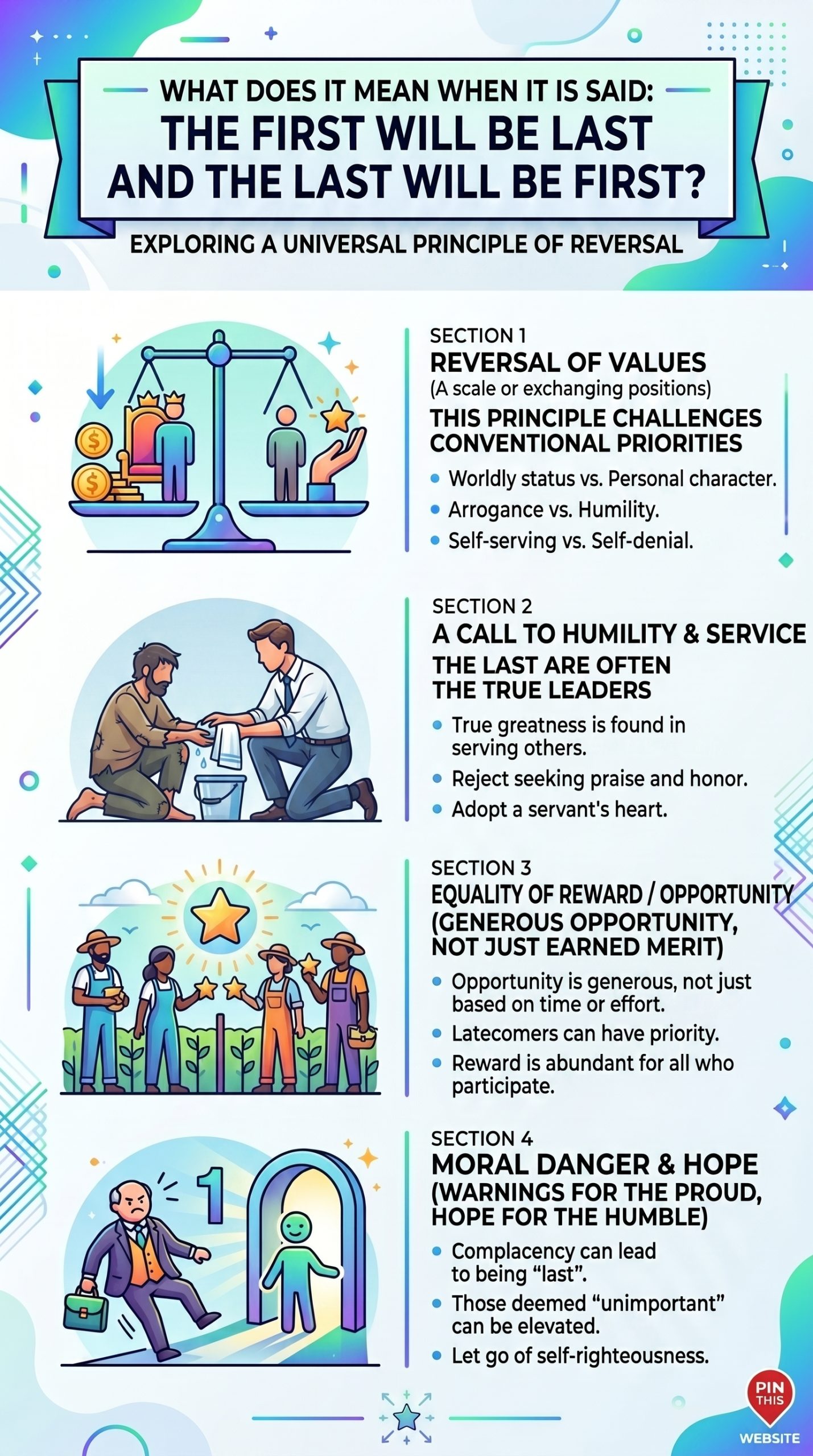
The positive flip side of the teaching appears throughout the Gospels. Jesus is not merely warning the “first” — He is defining what Kingdom greatness actually looks like. In Matthew 20:26–28, just after the parable, He tells His disciples: “Whoever wants to become great among you must be your servant, and whoever wants to be first must be your slave — just as the Son of Man did not come to be served, but to serve.”
The path to being first in the Kingdom runs directly through being last in the world. Servanthood, sacrifice, and surrender are not merely noble virtues — they are the very shape of eternal greatness.
The Parable of the Workers in the Vineyard: A Deep Dive
Jesus doesn’t leave His listeners to work out the meaning of “the first shall be last” on their own. He tells a story. It is one of the most theologically rich — and initially puzzling — parables in the entire New Testament.
The Story
A landowner goes out early in the morning and hires workers for his vineyard, agreeing to pay each of them a denarius — the standard daily wage — for a day’s work. At nine in the morning, he goes out again and finds others standing idle in the marketplace. He sends them to his vineyard too, promising to pay them “whatever is right.” He goes out again at noon, at three in the afternoon, and even at five o’clock in the evening — just one hour before the workday ends — and hires the remaining idle workers.
When evening comes, the landowner instructs his foreman to pay the workers, beginning with the last ones hired. The workers hired at five o’clock each receive a denarius — a full day’s wage for one hour of work. When those who were hired first see this, they expect more. They, after all, bore “the burden of the work and the heat of the day.” But they, too, receive exactly one denarius.
They grumble. The landowner replies: “I am not being unfair to you, friend. Didn’t you agree to work for a denarius? Take your pay and go. I want to give the one who was hired last the same as I gave you. Don’t I have the right to do what I want with my own money? Or are you envious because I am generous?”
What the Landowner Represents
The landowner is God. His vineyard is the work of the Kingdom. The denarius is not merely a wage — it represents the gift of eternal life itself, given equally to all who answer the call, regardless of when they come.
This reframes everything. The early workers didn’t receive less than they were promised — they received exactly what was agreed. Their complaint was not about injustice; it was about envy. They had calculated that their longer labor should earn them a greater reward, and they were offended that God’s generosity extended to latecomers with the same fullness it extended to them.
Grow Closer to God…

The Theological Point About Grace
The parable makes a striking claim: grace is not proportional. God does not give eternal life on a sliding scale based on years of service, depth of sacrifice, or years of faithful church attendance. The thief on the cross — hired, so to speak, at the eleventh hour — received the same promise of Paradise as the apostles who had given up everything years earlier (Luke 23:43).
This is simultaneously the most comforting and most disorienting aspect of the Gospel. Comforting, because it means no one is too late. Disorienting, because it means no one can claim a greater share on the basis of their own effort.
The Warning Against Entitlement
The early workers in the parable stand as a warning to anyone who has served God faithfully and begins to feel entitled on that basis. Religious seniority, doctrinal correctness, or years of sacrifice can subtly become a source of pride rather than gratitude. When they do, the “first” have already begun their journey toward last.
Summary: “The First” and “The Last” Compared
| Category | “The First” in Context | “The Last” in Context |
| “The First” | The privileged and powerful in earthly life | Those who pursue status while rejecting God’s call |
| “The Last” | The humble, overlooked, or late-coming | Those who follow Christ through sacrifice and surrender |
| Earthly reward | Wealth, prestige, early advantage | Often poverty, rejection, or obscurity |
| Kingdom reward | Not guaranteed — may forfeit salvation | Eternal life; honored before God |
| Key example | Rich Young Ruler (Matthew 19:16–22) | Workers hired at the eleventh hour (Matthew 20:9) |
The First Shall Be Last in Modern Life
The phrase “the first shall be last” has long since escaped the pages of Scripture and entered the broader culture. Understanding how it’s used — and where its use diverges from Jesus’ original meaning — matters for anyone seeking to apply it faithfully.
Cultural and Political Usage
Politicians across the spectrum invoke the phrase to argue for the elevation of the marginalized over the powerful. In Katharine Boo’s Pulitzer-winning journalism, in the political sermons of liberation theology, in the activism of civil rights movements, “the first shall be last” is used as a rallying cry for social justice and redistribution of power.
These applications are not entirely wrong — Jesus did clearly teach that worldly privilege carries no guarantee of divine favor, and that the humble are exalted. But the phrase is often stripped of its core theological content: the specific context of salvation, grace, and the Kingdom of God. When it becomes merely a slogan for earthly reversal, something essential is lost.
Improve your prayer life with this FREE Downloadable GUIDE!

Literature and Everyday Speech
The phrase appears in countless novels, films, and everyday expressions. In Barbara Kingsolver’s The Poisonwood Bible, the youngest daughter Ruth May clings to it as a child’s hopeful promise. It surfaces in sports commentary, motivational speeches, and competitive narratives — wherever underdogs defy expectations.
Again, these uses capture a real echo of the truth: the world’s hierarchies are not permanent, and the humble often outlast the proud. But the deepest meaning of the phrase is not about winning in the end — it’s about surrendering the need to win at all.
Practical Application for Believers
What does this teaching look like in daily life? Jesus’ words press believers toward several specific postures:
- Pursuing greatness through service rather than through rank, title, or recognition.Releasing status-seeking.
- Celebrating rather than resenting those who find faith late, receive grace abundantly, or seem undeserving of God’s goodness.Welcoming latecomers.
- Recognizing that professional achievement, financial security, and social influence are not spiritual currencies.Holding success loosely.
- The landowner’s defining trait is not fairness — it is extravagant generosity. Imitating God means being generous beyond what seems proportional.Practicing radical generosity.
- The knowledge that eternal life is a gift frees believers from both spiritual pride and spiritual despair.Trusting in grace, not performance.
Frequently Asked Questions
What does “the first shall be last” mean in the Bible?
In the Bible, “the first shall be last” means that earthly rank, wealth, or religious status does not determine one’s standing before God. Those who are privileged and powerful in this life hold no advantage in gaining salvation. Eternal life is given by grace to all who genuinely trust Christ, regardless of when they come or how much they have accomplished.
Where in the Bible does it say “the first shall be last”?
The phrase appears four times across three Gospels: Matthew 19:30 (after the rich young ruler), Matthew 20:16 (as the conclusion of the Parable of the Workers in the Vineyard), Mark 10:31 (in a parallel account of the rich young ruler), and Luke 13:30 (in the context of the narrow door and the coming Kingdom feast).
What is the meaning of the Parable of the Workers in the Vineyard?
The parable teaches that God’s grace is not proportional to human effort or religious seniority. All who answer God’s call — whether early in life or at the last moment — receive the same gift of eternal life. The workers who grumble represent those who treat their service as a basis for greater entitlement before God, which misunderstands the nature of grace entirely.
Is “the first shall be last” about salvation?
Yes, in its primary biblical context it is directly about salvation. Every time Jesus uses the phrase in the Gospels, He is addressing who will and will not enter the Kingdom of God. The consistent message is that salvation cannot be earned by status, effort, or religious achievement — it is received by faith and surrender to Christ.
How many times does Jesus say “the first shall be last”?
Jesus uses the phrase (or its equivalent, “the last shall be first, and the first last”) four times in the Gospels: twice in Matthew (19:30 and 20:16), once in Mark (10:31), and once in Luke (13:30). The repetition across multiple contexts underscores that this was a central and deliberate teaching.
What is “the first” and “the last” referring to in Matthew 20:16?
In Matthew 20:16, “the first” refers to those who came early — both literally (the workers hired at dawn) and figuratively (the religiously privileged who assume their long-standing faithfulness earns them greater divine favor). “The last” refers to those hired at the eleventh hour — latecomers, outsiders, or the seemingly least deserving who nonetheless receive the same gift of grace.
What did Jesus mean by the first will be last and the last will be first?
Jesus meant that the Kingdom of God operates by an entirely different economy than the world. Earthly advantage — wealth, status, religious performance, or an early start — confers no automatic spiritual privilege. Conversely, those the world overlooks, marginalizes, or considers spiritually unlikely are often the very ones who receive the Kingdom with open hands. The reversal is not about punishment; it is about the nature of grace.
Conclusion
The phrase “the first shall be last” is not a slogan about underdogs winning or the powerful being punished. It is one of Jesus’ most carefully repeated teachings — a deliberate, four-fold declaration that the economy of God’s Kingdom operates by entirely different rules than the economy of human status.
Earthly wealth does not purchase eternal life. Religious seniority does not earn a larger share of grace. Social power carries no currency before the throne. What does matter — what has always mattered — is surrender: the willingness to come as a person who has nothing to offer but their need, to trust not in what they have done or what they deserve, but in the extravagant generosity of a landowner who gives a full wage to the worker who arrived at five o’clock.
That is the good news embedded in this challenging teaching. The last are not doomed to stay last. Grace has no queue. The Kingdom feast has seats reserved for those who come from east and west, from the first hour and the final one, from lives of long faithfulness and lives of last-minute turning.
If you are first in the world’s eyes, Jesus’ words are a warning: hold it all loosely. If you feel like last — if you are late, overlooked, unimpressive by any earthly measure — His words are an invitation: the door is open, the wage is full, and the feast has a place with your name on it.
“So the last will be first, and the first will be last.” — Matthew 20:16
Scripture references: Matthew 19:30; 20:16 · Mark 10:31 · Luke 13:30; 23:43 · Matthew 20:26–28

About the Author
Joshua Infantado is a Christian blogger and Bible teacher who has been writing faith-based content since 2013. He is the founder of Becoming Christians, where he shares blogs, books, videos, and online courses to help believers grow in truth and grace. Joshua lives in Davao City, Philippines, with his wife, Victoria, and their son, Caleb. Contact him at joshuainfantado@gmail.com.
Discover more from Becoming Christians
Subscribe to get the latest posts sent to your email.