Have you ever stopped in the middle of an Easter morning… surrounded by pastel-colored baskets, chocolate bunnies, and painted eggs… and asked yourself: What does any of this have to do with the resurrection of Jesus Christ?
The question seems almost too obvious to ask. And yet, most of us never do. We inherit these traditions, wrap them in the language of faith, and move on.
But the truth is, this question deserves a serious, honest, and biblical answer. Because what you discover when you look closely may disturb you… and ultimately, set you free.
Bunnies and eggs don’t match
Let’s start with the obvious. Bunnies do not lay eggs.
Not in nature.
Not in Scripture.
Not anywhere.
There is no moment in the Gospel of Matthew, Mark, Luke, or John where a rabbit hops past the empty tomb. There is no Easter egg in the Garden of Gethsemane. There is no chocolate in the Upper Room.
These symbols have absolutely zero connection to the death, burial, and resurrection of Jesus Christ… the most pivotal event in all of human history.
So where did they come from? Why are they so deeply woven into what billions of people call a “Christian” celebration? The answer, as we shall see, is not found in the Bible. It is found in history and it points to something God calls an abomination.

The Pagan Origins of Easter
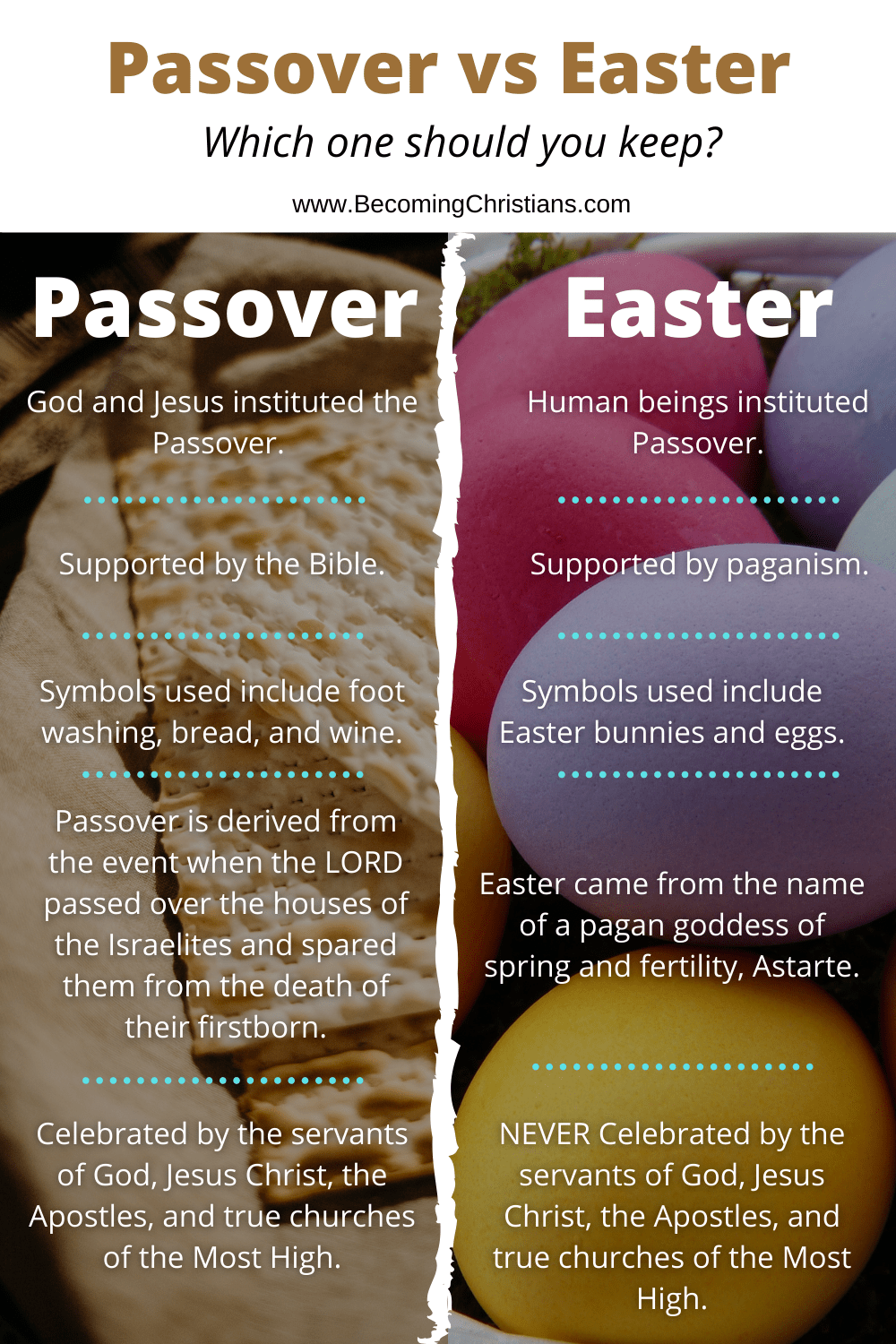
The word “Easter” itself is revealing. Many historians and scholars trace it to Eostre (also spelled Ostara), a Germanic goddess of spring, fertility, and dawn, documented by the Venerable Bede, an eighth-century monk, in his work De Temporum Ratione. Eostre was worshipped in the spring month that bore her name, with festivals celebrating new life, fertility, and the renewal of the earth.
And what were the symbols of this fertility goddess? The hare, an animal long associated with rapid reproduction and lunar cycles. And the egg, a universal symbol of new life, birth, and fertility across dozens of ancient pagan religions including those of Babylon, Egypt, and Persia.
The ancient Babylonian religious system, rooted in the worship of Nimrod, Semiramis, and Tammuz, celebrated a spring festival honoring the resurrection of Tammuz, a counterfeit resurrection story that predates Christianity and was emphatically condemned by God Himself.
In the book of Ezekiel, God showed the prophet a vision of the women of Israel weeping for Tammuz right at the doorstep of His temple:
Then he brought me to the door of the gate of the Lord’s house which was toward the north; and, behold, there sat women weeping for Tammuz. Then said he unto me, Hast thou seen this, O son of man? turn thee yet again, and thou shalt see greater abominations than these.— Ezekiel 8:14–15 (KJV)
God did not call this harmless tradition. He did not call it a cultural expression. He called it an abomination — and He said it was happening right at the doorstep of His house of worship. Does that sound familiar?
How Paganism Crept Into the Church
As Christianity spread through the Roman Empire in the early centuries, a dangerous pattern began to emerge. Rather than calling pagan converts to completely abandon their old festivals and rituals, some church leaders chose to baptize pagan holidays — essentially keeping the timing, symbols, and festivities of ancient pagan celebrations while relabeling them as Christian.
This process, known as syncretism, seemed practical and even compassionate at the time. But it was a direct violation of God’s explicit command.
The spring fertility festival (with its eggs, its hares, its celebration of rebirth) was gradually merged with the remembrance of Christ’s resurrection. The dates, symbols, and customs of Eostre worship were simply reframed in Christian language.
Over centuries, this blended tradition became so normalized that almost no one questioned it anymore. The rabbit and the egg outlasted their pagan origin story. Most people today have no idea where these symbols came from. But God does.
Learn not the way of the heathen… For the customs of the people are vain.— Jeremiah 10:2–3 (KJV)
Take heed to thyself that thou be not snared by following them… and that thou inquire not after their gods, saying, How did these nations serve their gods? even so will I do likewise. Thou shalt not do so unto the Lord thy God: for every abomination to the Lord, which he hateth, have they done unto their gods.— Deuteronomy 12:30–31 (KJV)
This is not a minor preference God is expressing. This is a command. He is explicitly saying: Do not worship Me the way the pagans worship their gods. He does not want their rituals re-dressed in His name. He does not want their symbols placed at His altar. He does not want Easter eggs at the foot of the cross.
Top 3 Best-Selling Christian Books for March 2026


God Will Not Share His Glory with Idols
Some may say, “But we mean well. We’re celebrating Jesus.” And perhaps the heart is sincere. But sincerity has never been God’s only standard.
Consider the story of Nadab and Abihu in Leviticus 10 — two sons of Aaron who offered “strange fire” before the Lord, fire He had not commanded. They were sincere. They were priests. They knew God. And yet God struck them dead, saying to Aaron:
I will be sanctified in them that come nigh me, and before all the people I will be glorified.— Leviticus 10:3 (KJV)
God does not accept worship on our terms. He accepts worship on His terms. And His terms are clearly laid out in Scripture, not in ancient Babylonian fertility rites repackaged with Christian greeting cards.
Consider also what He said through the prophet Isaiah:
I am the Lord: that is my name: and my glory will I not give to another, neither my praise to graven images.— Isaiah 42:8 (KJV)
When we bring the symbols of Eostre, the bunny of fertility, the egg of rebirth, into the celebration of Jesus’ resurrection, we are, whether we intend to or not, mixing His glory with the imagery of another.
And God says He will not share His glory. Not with a bunny. Not with an egg. Not with anyone or anything.

What the Resurrection of Jesus Actually Deserves
Here is what we must not lose in this discussion: the resurrection of Jesus Christ is the most glorious, world-altering, death-defeating event in the history of creation. It is the cornerstone of the Christian faith. The Apostle Paul made this staggeringly clear:
And if Christ be not risen, then is our preaching vain, and your faith is also vain… But now is Christ risen from the dead, and become the firstfruits of them that slept.— 1 Corinthians 15:14, 20 (KJV)
The resurrection is not a springtime theme. It is not a seasonal feeling.
It is the bedrock of our eternal hope. It deserves reverence, not rabbits. It deserves the Word of God, not painted eggs. It deserves the solemn, joyful, scripture-saturated worship of a redeemed people not a holiday borrowed from the fertility cults of ancient Babylon.
The early church did not celebrate Easter with eggs and bunnies. They kept what Jesus commanded and that is to keep the Passover as a remembrance of Him. It’s not Easter. You will never see Easter being celebrated by Christ, His disciples, or even the early church!
What Should a Believer Do?
This is the question that truly matters. And the answer begins with truth. Knowing the truth does not make you a fanatic. It makes you free. Jesus said, “And ye shall know the truth, and the truth shall make you free” (John 8:32). The freedom He speaks of is not the freedom to continue in ignorance — it is the freedom to worship God in spirit and in truth, uncontaminated by the ways of the world.
The Apostle Paul pleaded with the church at Corinth:
Wherefore come out from among them, and be ye separate, saith the Lord, and touch not the unclean thing; and I will receive you.— 2 Corinthians 6:17 (KJV)
And the Apostle John, in the book of Revelation, echoes the same call:
Come out of her, my people, that ye be not partakers of her sins, and that ye receive not of her plagues.— Revelation 18:4 (KJV)
The call is not to anger, not to judgment of others, and not to self-righteous withdrawal from the world. The call is to personal holiness… to love God enough to worship Him on His terms, not the world’s. It is a call to examine what we celebrate and why. To ask whether our traditions glorify God or merely comfort us. To be willing to let go of what is familiar if it leads us away from what is true.
This is not about condemning anyone. God sees the heart, and He is merciful. But He also calls His people to grow in knowledge and obedience. To know better and do nothing is its own kind of disobedience. “Therefore to him that knoweth to do good, and doeth it not, to him it is sin.” — James 4:17 (KJV)
FREE BOOK

Click here to get the free PDF book copy of “11 Irrefutable Proofs Jesus Wasn’t Resurrected on Sunday.“
The Empty Tomb Needs No Decoration
Here is the breathtaking truth: the resurrection of Jesus Christ stands entirely on its own. It does not need a bunny. It does not need an egg. It does not need a pagan goddess’ name. It does not need anything that human tradition or ancient idolatry can offer it.
The tomb was empty. The grave clothes were folded. Death was conquered. And Jesus Christ rose bodily, gloriously, and victoriously. So that you and I might have life.
That story — that story — is enough. It is more than enough. It is the greatest story ever told, and it requires nothing borrowed from Babylon to make it beautiful.
So the next time spring rolls around, instead of asking, “Where did we hide the eggs?” let us ask the question that matters most — the same question the angels asked on that first resurrection morning:
The Only Question Worth Asking
“Why seek ye the living among the dead? He is not here, but is risen.”
— Luke 24:5–6 (KJV)
He is risen. That is the celebration. That is enough.